
Introduction
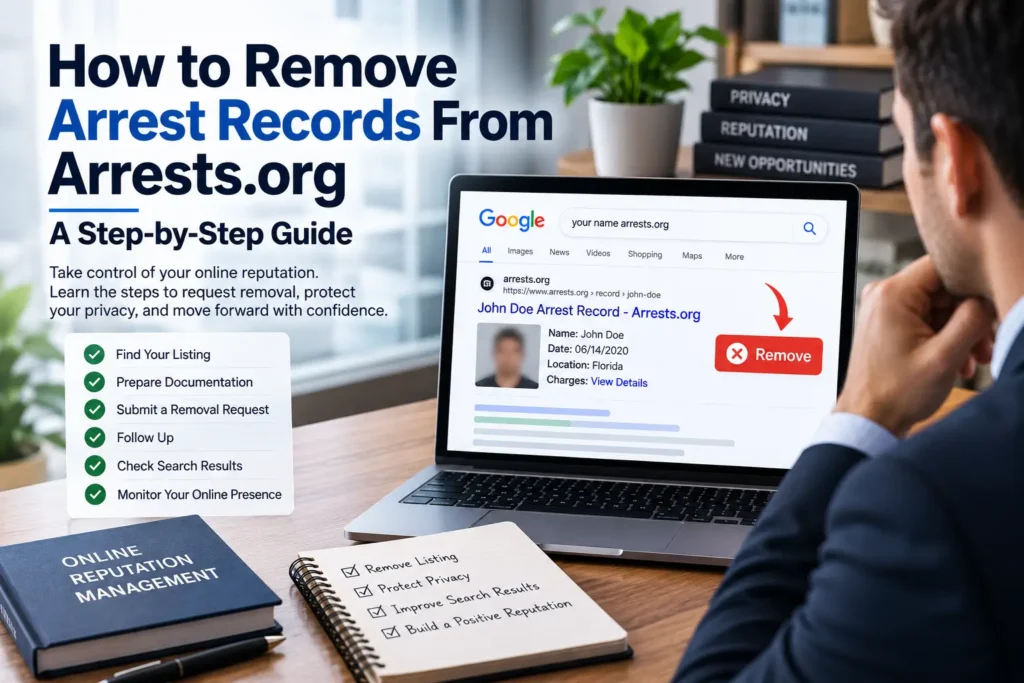
Finding your arrest information on a public-facing website can be stressful, especially when the page appears in Google Search under your name. Even if a case was dismissed, charges were dropped, or the information is outdated, its online presence may create questions for employers, clients, business partners, and people in your personal life. Understanding how to Remove Arrest Records From Arrests.org is an important first step toward addressing the issue and protecting your digital reputation.
However, removing a page from a third-party website and removing a result from Google are two different processes. You may need to contact the website, verify your identity, provide supporting documentation, or explore other appropriate options depending on the circumstances.
This guide explains how to approach the process methodically, what to prepare, which mistakes to avoid, and how professional online reputation management can help when the issue becomes difficult to resolve.
The goal is not to hide legitimate information through deceptive tactics. It is to understand your options, protect your privacy where possible, and make sure your online presence accurately reflects your current circumstances.
Table of Contents
-
What Is Arrests.org?
-
Why Arrest Information Can Affect Your Reputation
-
How to Remove Arrest Records From Arrests.org
-
What to Do if Your Removal Request Is Denied
-
Removing a Page From a Website vs. Google Search
-
A Realistic Example of an Arrest-Record Reputation Issue
-
Common Mistakes to Avoid
-
Best Practices for Protecting Your Online Reputation
-
When to Consider Professional Reputation Management
-
Frequently Asked Questions
-
Conclusion and Next Steps
1. What Is Arrests.org?
Arrests.org is a website associated with the publication of arrest-related information. Depending on the page, a listing may contain details such as a person’s name, booking information, an arrest date, a location, or an image.
The presence of an arrest listing does not, by itself, establish that a person was convicted of a crime. An arrest and a conviction are different legal events, and the outcome of a case may not be reflected clearly on a third-party page.
If you discover a listing connected to your name, start by documenting what it actually says. Check the spelling of your name, the location, the dates, and any other information that may help establish whether the page refers to you.
Do not assume that every detail is accurate or that the page has been updated to reflect the final outcome of a case.
Your next steps should depend on whether the information is incorrect, outdated, legally restricted, or accurate but damaging to your reputation.
2. Why Arrest Information Can Affect Your Reputation
Online information can remain visible long after the circumstances that led to its publication have changed. A page may also appear when someone searches a person’s full name, even when the person has moved forward professionally and personally.
Employment and Professional Opportunities
Some employers conduct online searches as part of their screening process. A search result that lacks context may lead to questions or assumptions before the person has an opportunity to explain the situation.
Employment screening is subject to applicable laws and procedures, so an online arrest page should not be treated as a complete or authoritative account of someone’s background.
Business and Client Relationships
Business owners, consultants, real estate professionals, and executives may be particularly concerned about branded search results. Prospective clients may discover an arrest listing before reviewing a person’s experience, qualifications, or professional achievements.
Personal Privacy
A publicly accessible page may expose information that someone would prefer not to have readily associated with their name. This can create stress and unwanted attention, even when the case did not result in a conviction.
Search Engine Visibility
When an arrest-related page appears prominently in Google, people may encounter it without visiting the original website directly.
That is why a useful response may involve both addressing the source page and assessing how the information appears across search results.
How to Remove Arrest Records From Arrests.org
The appropriate removal process can depend on the website’s current policies, the specific listing, applicable law, and the circumstances of the case. Do not assume that every listing is eligible for removal or that a request will be approved.
The following steps provide a practical starting point.
Step 1: Locate and Document the Exact Listing
Search for your name and identify the specific Arrests.org page you want reviewed.
Record:
-
The full page URL
-
The name displayed on the page
-
The date and location shown
-
Any other identifying details
-
The date you discovered the listing
-
Screenshots showing the page and its contents
Save this information before submitting a request. The exact URL helps distinguish your listing from pages belonging to other people with similar names.
Be careful when sharing personal documents. Provide sensitive information only when necessary and through a channel you have verified as legitimate.
Step 2: Review the Website’s Current Policies
Visit Arrests.org directly and look for its current contact information, privacy information, removal instructions, or other procedures for requesting a review of a listing.
Policies and procedures can change. Therefore, verify the instructions on the website rather than relying on an old blog post, an unverified email address, or an unofficial third-party service.
If the site provides a specific form or process, follow its stated requirements carefully.
Step 3: Identify the Basis for Your Request
A clear request should explain why the particular listing should be reviewed.
Depending on your circumstances, relevant reasons might include:
-
The page identifies the wrong person.
-
The information contains factual errors.
-
The information is outdated or incomplete.
-
The case outcome is not accurately represented.
-
Official documentation supports a correction.
-
A legal restriction or applicable policy may affect publication.
Be precise. A request that identifies the problem and provides relevant evidence is generally more useful than a vague demand to remove everything associated with your name.
If the arrest resulted in a dismissal, acquittal, expungement, or another legal outcome, obtain appropriate documentation where available. The legal effect of that outcome varies by jurisdiction, and it does not automatically guarantee removal from every private website.
Step 4: Submit a Clear Removal or Correction Request
Use the website’s verified contact or request procedure, if available.
Your request should include the exact URL, a concise explanation, and relevant supporting documentation. Avoid sending unnecessary personal information.
You can use the following template as a starting point.
Subject: Request to Review Arrests.org Listing
Hello,
I am contacting you to request a review of the listing at [insert exact URL].
The page contains information associated with my name, and I believe it requires review for the following reason: [briefly explain the factual error, outdated information, identity issue, or other relevant basis].
I can provide appropriate supporting documentation if required through a verified and secure process.
Please let me know whether the listing is eligible for correction or removal under your current policies and what additional information you need to evaluate the request.
Thank you for your time.
Sincerely,
[Your Name]
Only include statements that are accurate and supported by your circumstances. Do not claim that a record was expunged, dismissed, or misidentified unless that is true.
Step 5: Keep Records of Your Communication
After submitting your request, save a copy of the message, the submission date, any confirmation, and subsequent responses.
If the website provides a reference number, keep it with your records.
If you receive no response, check the website’s published procedure for follow-up requests. Avoid sending repeated messages at short intervals without considering the site’s instructions.
Step 6: Follow Up With Relevant Evidence
If the website requests additional information, respond through a verified channel and provide only what is reasonably necessary.
For example, if your request concerns an incorrect case outcome, an official court document may help explain the discrepancy.
If the listing concerns someone else with a similar name, reliable identifying information may help clarify the issue.
Never alter documents or submit misleading information. Accuracy is essential when addressing legal or reputation-related matters.
Step 7: Verify the Outcome
If the website confirms a correction or removal, revisit the original URL to determine whether the change is visible.
Then search your name and the distinctive wording from the former page.
Keep in mind that a page may remain visible temporarily through cached references, external links, or search results that have not yet updated. A successful change on the source website does not necessarily mean that every reference disappears immediately.
Step 8: Assess Your Remaining Search Presence
Finally, examine the rest of your digital footprint.
Are other arrest-related pages appearing? Does the same information appear on additional websites? Are outdated profiles or unrelated pages ranking prominently?
Understanding the broader picture helps you decide whether the next step should be another correction request, a search engine request where eligible, or a more comprehensive reputation strategy.
For dedicated guidance about this particular website, visit YourReputation.agency’s How to Remove Your Information from Arrests.org page.
What to Do if Your Removal Request Is Denied
A denied request does not necessarily mean that you have no further options. However, your next step should depend on why the request was rejected.
Review the Reason for Denial
Determine whether the website believes the listing complies with its policies, whether additional documentation is needed, or whether your request did not meet its stated criteria.
If the response identifies a missing document or factual discrepancy, address that issue before submitting another request.
Explore Applicable Legal Options
If the information is false, violates your legal rights, or concerns a record subject to a relevant court order or legal restriction, consider consulting an attorney familiar with the laws in the applicable jurisdiction.
Legal options vary significantly by state and country. Do not assume that an expungement or dismissal automatically creates a removal obligation for every third-party publisher.
Consider a Broader Reputation Strategy
Sometimes, removal is not available or the website does not respond. In that situation, you may need to address the broader online reputation problem.
This can involve correcting other sources, strengthening accurate professional profiles, publishing useful content, and improving the visibility of authoritative information about your work and current activities.
YourReputation.agency offers Crisis and Reputation Management for individuals and organizations facing difficult online reputation situations.
The objective is to identify practical options based on your circumstances, not promise a result that no agency can guarantee.
Removing a Page From a Website vs. Google Search
One of the most common misunderstandings is assuming that removing a Google result automatically deletes the original webpage.
These are separate processes.
| Action | What It Addresses | Important Limitation |
|---|---|---|
| Website removal request | The original page on Arrests.org | The publisher must approve or otherwise process the request |
| Website correction request | Inaccurate or outdated information on the source page | Approval depends on the circumstances and applicable policies |
| Google removal request | Eligible search results under Google’s removal policies | Does not necessarily delete the source webpage |
| Search result refresh | Outdated information displayed after a page changes or disappears | Requires the applicable process and may take time |
| Reputation management | The broader digital presence associated with your name | Cannot guarantee removal or specific rankings |
When Should You Contact Google?
If the underlying page has already been removed or changed but Google still displays outdated information, review Google’s official removal and outdated-content tools.
Google also provides processes for certain sensitive personal information and other content that meets its eligibility requirements.
However, Google does not generally remove every lawful webpage simply because the information is embarrassing or damaging.
You can review the official Google Search Central documentation to understand how Google Search works and which procedures may apply.
For a complete strategy, begin with the source of the information, then assess the search engine’s role separately.
A Realistic Example of an Arrest-Record Reputation Issue
Consider a fictional business consultant named Daniel.
Several years ago, Daniel was arrested following an incident that did not result in a conviction. Later, when a prospective business partner searched his name, an Arrests.org page appeared near the top of the results.
The page did not clearly communicate the final outcome of the case.
Daniel worried that potential clients would make decisions without understanding the full context.
Instead of sending angry messages or publishing repeated explanations online, he took a structured approach.
First, he saved the exact URL and reviewed the information displayed. Next, he obtained documentation showing the relevant case outcome and submitted a factual request through the website’s verified contact process.
The publisher did not immediately remove the listing. Daniel therefore assessed other options, including whether a correction was possible and whether the search result met any applicable removal criteria.
At the same time, he reviewed his professional search presence. His website had limited information about his consulting work, his professional biography was outdated, and his industry profiles were inconsistent.
He updated those assets, published useful professional content, and established a process to monitor future mentions.
The strategy did not depend on assuming that the arrest page would disappear. Instead, it addressed the source issue where possible and strengthened the accuracy and credibility of his broader online presence.
This example is illustrative, not a guarantee of results. Every case depends on its own facts, the publisher’s policies, applicable law, and the competitive search landscape.
Common Mistakes to Avoid
Trying to remove arrest information can be frustrating, particularly when it affects employment, professional relationships, or personal privacy. Avoid these common mistakes.
Sending an Emotional or Aggressive Request
Threatening language and repeated demands may distract from the actual issue. Keep communication factual, concise, and professional.
Assuming Every Listing Can Be Removed
A page may be accurate and legally publishable even when it is harmful to your reputation. Determine which options are genuinely available before committing to a strategy.
Paying an Unverified Removal Service
Be cautious of providers that demand large upfront payments, promise guaranteed removal, or refuse to explain their process.
Before hiring anyone, ask what work they will perform, what outcomes they can reasonably pursue, and whether they have clear service terms.
Sharing Sensitive Documents Insecurely
Do not send identity documents, financial information, or sensitive legal records to an unverified address.
Verify the recipient and share only the information reasonably required.
Ignoring Other Websites
Removing one page does not necessarily address duplicate listings or other websites that publish similar information.
A broader audit can help identify whether the issue extends beyond Arrests.org.
Expecting Instant Google Changes
Even after a source page changes, search engines may need time to reflect that change. Avoid assuming that a successful request means every cached reference or third-party mention will disappear immediately.
Using Fake Reviews or Misleading Content
Fabricated testimonials, fake identities, deceptive links, and mass-produced low-quality pages can damage credibility.
Build your reputation with accurate information, useful content, and legitimate professional achievements.
8. Best Practices for Protecting Your Online Reputation
A long-term strategy should focus on accurate information, consistent monitoring, and credible digital assets.
Maintain Accurate Professional Profiles
Keep your website biography, business profiles, professional directories, and social accounts consistent.
Include relevant experience, qualifications, services, and contact information where appropriate.
Publish Useful, Original Content
Create content that demonstrates your expertise and helps people understand your work.
Depending on your profession, this might include educational articles, industry insights, interviews, case studies, or answers to common questions.
Avoid publishing repetitive pages solely to push another result down in search rankings.
Monitor Your Name Regularly
Search your full name, common variations, professional name, and relevant business name.
A structured Reputation Monitoring process can help identify new mentions, changing search results, and emerging concerns.
Protect Your Broader Digital Presence
Review your privacy settings, secure your accounts, and be cautious about publishing personal information that is not necessary for your professional life.
Where appropriate, remove unnecessary information from profiles you control.
Establish a Response Plan
If a new reputation issue appears, decide in advance who will review it, how evidence will be documented, and when professional or legal advice may be necessary.
For additional practical guidance, see Online Reputation Crisis Management: What to Do in the First 24 Hours.
Review Your Progress
Track meaningful changes over time, such as whether source pages were corrected, whether eligible removal requests were processed, whether professional profiles are accurate, and what appears in branded searches.
This creates a clearer basis for deciding what to do next.
9. When to Consider Professional Reputation Management
You may be able to handle a straightforward correction request yourself. However, professional assistance can be useful when the issue involves several websites, prominent search results, repeated publication, or a wider business reputation concern.
Consider seeking help if:
-
An arrest-related page ranks prominently for your name.
-
Several websites display similar information.
-
A publisher has rejected your request.
-
You are unsure which removal process applies.
-
The issue is affecting client or professional relationships.
-
You need ongoing monitoring of your name.
-
The situation is creating a broader reputation crisis.
How YourReputation.agency Can Help
YourReputation.agency helps individuals and businesses evaluate their online reputation and identify appropriate strategies for managing harmful or misleading search visibility.
Depending on your situation, a strategy may include:
-
Reviewing branded search results.
-
Identifying the sources of reputation concerns.
-
Evaluating potential correction and removal options.
-
Strengthening accurate professional profiles.
-
Developing relevant, high-quality content.
-
Monitoring changes in search visibility.
-
Building a long-term reputation protection plan.
Our Online Reputation Protection Services can help you explore a broader strategy when a single removal request is not enough.
If you are comparing providers, our guide on How to Choose the Right Reputation Management Agency explains why transparency, realistic expectations, and ethical methods matter.
For individuals whose personal identity and professional image are closely connected, Personal Reputation Management may also be relevant.
You can learn more about our approach through our Reputation Management page or the main Reputation Management Agency service page.
The right approach depends on the source of the information, the facts of the case, and the results you want to achieve.
Frequently Asked Questions
1. How do I Remove Arrest Records From Arrests.org?
Start by locating the exact listing, documenting its URL and contents, and reviewing Arrests.org’s current policies and contact procedures. Submit a clear request supported by relevant evidence. Approval is not guaranteed, so assess correction, legal, and reputation management options if the request is unsuccessful.
2. Can Arrests.org remove my arrest information?
Removal depends on the website’s current policies, the details of the listing, and any applicable legal requirements. You should verify the available process directly with the website. Do not assume that every arrest listing qualifies for removal.
3. Will expungement automatically remove an Arrests.org listing?
Not necessarily. The effect of expungement or record sealing varies by jurisdiction, and a private website may not automatically update its content. If your record has been expunged or sealed, consult a qualified attorney about the legal implications and appropriate next steps.
4. How long does it take to remove arrest records from Arrests.org?
There is no universal timeline. It depends on the website’s response, the complexity of the request, the evidence provided, and any additional review required. Google search results may take additional time to reflect a source-page change.
5. Can I remove Arrests.org results from Google without removing the original page?
In some circumstances, Google may remove a result that meets its applicable removal policies. However, removing a search result does not necessarily delete the original webpage. You should evaluate the publisher request and Google process separately.
6. What if Arrests.org refuses to remove my listing?
Review the reason for the refusal, determine whether additional evidence is available, and check whether a correction or further request is appropriate. If the matter involves potential legal rights or restrictions, seek qualified legal advice. Reputation management may also help address the broader online presence.
7. Can I remove an arrest listing if the charges were dismissed?
You can request a review and provide documentation of the dismissal. Whether the website removes or corrects the page depends on its policies and any applicable legal requirements. A dismissal does not automatically guarantee removal from every private website.
8. Does removing an Arrests.org page remove it from every website?
No. Other websites may have independently published similar information. You may need to identify and address each source separately, using the applicable correction or removal process.
9. Can reputation management guarantee that an arrest record will disappear?
No reputable provider should guarantee a specific removal or search ranking outcome without control over the relevant publisher or platform. Professional reputation management can evaluate available options, pursue appropriate requests, strengthen credible digital assets, and monitor progress.
10. How can YourReputation.agency help with Arrests.org reputation issues?
YourReputation.agency can help assess the online reputation problem, review search visibility, identify possible response strategies, and develop a tailored reputation protection plan. The available approach depends on your circumstances, and specific removals or rankings cannot be guaranteed.
11. Should I hire a lawyer or a reputation management agency?
They serve different purposes. A lawyer can assess legal rights, court orders, defamation concerns, and jurisdiction-specific restrictions. A reputation management agency can focus on monitoring, digital presence, search visibility, content strategy, and appropriate publisher or platform outreach. In complex cases, both types of support may be useful.
12. How can I monitor whether my arrest information appears again?
Search your name and relevant variations regularly, review the original source URL, and track new mentions across relevant websites. A structured monitoring process can help identify changes early so you can evaluate the appropriate response.
11. Conclusion: Take Control of Your Online Reputation
Learning how to Remove Arrest Records From Arrests.org starts with understanding the source of the information, documenting the listing, and following the website’s verified request process.
However, removal is only one possible outcome.
If the publisher declines your request, you may still have options involving correction, applicable legal procedures, eligible search engine requests, or a broader strategy to strengthen your digital presence.
The most important steps are to stay factual, protect your sensitive information, avoid unrealistic promises, and choose actions that fit your specific situation.
For individuals concerned about professional opportunities, personal privacy, or long-term credibility, an organized reputation strategy can provide a clearer path forward.
Take the Next Step With YourReputation.agency
If an Arrests.org listing is affecting your confidence, career, business, or professional relationships, you do not have to navigate the situation without a plan.
YourReputation.agency helps individuals understand their online reputation challenges and explore practical, ethical ways to address them.
Start with our dedicated guide: How to Remove Your Information from Arrests.org.
If the issue is broader than a single webpage, explore our reputation protection services or contact our team to discuss your circumstances.
Visit Contact Us to request a consultation and learn which options may be appropriate for your situation.
You can also review our Trustpilot profile and Google Business Profile to learn more about our online presence.
Your reputation deserves a thoughtful strategy, not an unrealistic promise. Take the first step toward understanding your options and building a stronger, more accurate digital presence.