Online Reputation Crisis Management: What to Do in the First 24 Hours
When a damaging review, negative news story, viral social media post, or public accusation appears online, the first 24 hours can shape how people perceive your brand. Effective Online Reputation Crisis Management helps business owners, CEOs, entrepreneurs, professionals, and personal brands respond with clarity instead of panic.
A reputation crisis can spread quickly. Customers may question your credibility, employees may seek answers, and journalists or competitors may amplify the story. Meanwhile, search engines can make public information easier to discover long after the initial incident.
The solution is not to rush into deleting content or publishing a defensive statement. You need a structured response that verifies facts, protects privacy, communicates responsibly, and addresses the underlying issue.
In this guide, we explain what to do during the first 24 hours, which mistakes to avoid, and when professional support from YourReputation.agency can help you manage a reputation crisis more strategically.
What Is an Online Reputation Crisis?
An online reputation crisis occurs when an event, allegation, review, news report, or digital discussion threatens the credibility of a person, business, or organization.
Unlike an ordinary negative comment, a crisis can attract significant attention, affect important relationships, or create lasting search visibility.
Common examples include:
-
A negative customer experience that spreads across social media.
-
Allegations of misconduct involving a CEO or business owner.
-
A damaging news article ranking for a company name.
-
A series of negative reviews appearing within a short period.
-
False or misleading claims circulating online.
-
A data breach or service failure that raises customer concerns.
-
An employee complaint that receives public attention.
-
An old controversy resurfacing in Google search results.
-
An impersonation account spreading misleading information.
-
A personal reputation issue affecting a professional’s business.
Not every negative mention is a crisis. The severity depends on the accuracy of the information, its visibility, the audience involved, the potential consequences, and how quickly the situation develops.
The first step is to distinguish an isolated complaint from a problem that requires coordinated action.
Why the First 24 Hours Matter
The first day is often when uncertainty is highest. You may not know exactly what happened, who is sharing the information, or whether the situation will escalate.
However, your initial response can influence what happens next.
Public Perception Can Change Quickly
Customers may share screenshots before you have an opportunity to respond. Employees may receive questions from clients. Journalists may request a comment, and social media discussions may introduce claims that have not been verified.
A rushed or defensive response can make the situation worse.
Silence Can Create Uncertainty
Silence is not always the wrong choice. If facts are unclear, a short holding statement may be more responsible than an immediate explanation.
However, prolonged silence during a serious incident can leave customers and stakeholders without reliable information.
Search Results Can Extend the Impact
A reputation crisis does not necessarily end when social media activity slows down.
News articles, reviews, forum posts, and public statements may remain discoverable through branded searches. This can affect people researching your company weeks or months later.
That is why crisis response should address both the immediate incident and the longer-term online reputation.
A structured Crisis Reputation Management strategy can help organizations assess these risks, coordinate communications, and identify appropriate reputation protection measures.
Online Reputation Crisis Management: First 24-Hour Action Plan
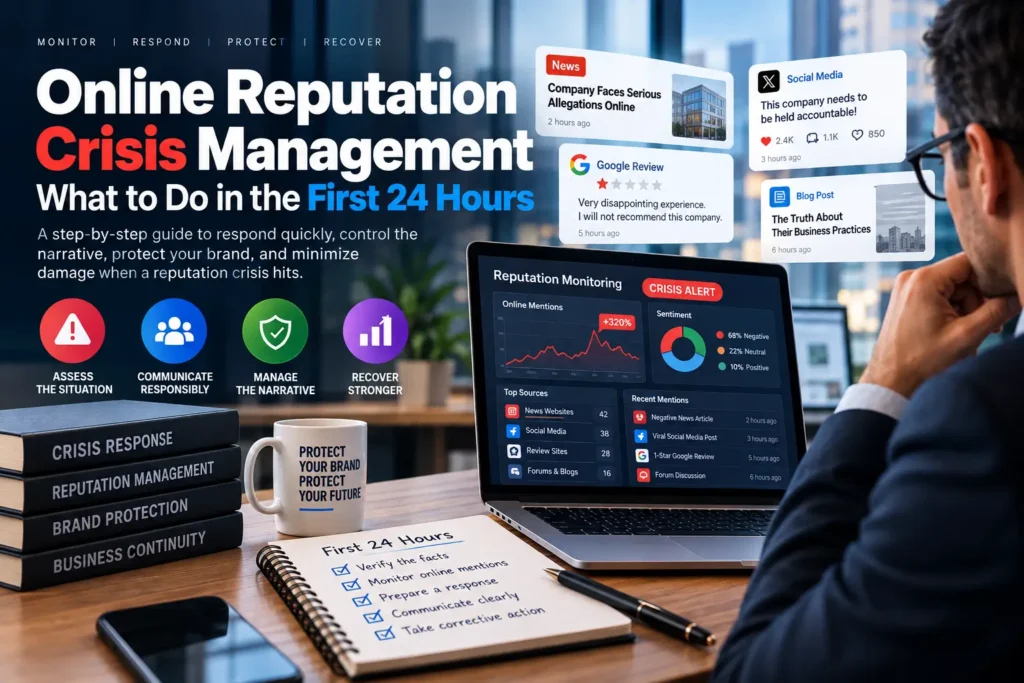
The most effective response is organized, fact-based, and proportionate to the situation. Use the following timeline as a practical starting point. Serious incidents involving safety, security, legal exposure, or regulated information may require immediate escalation.
Hour 1: Assess the Situation
-
Identify the original source of the issue.
-
Save screenshots, URLs, timestamps, and relevant communications.
-
Check whether the information is accurate, misleading, or unverified.
-
Assess potential risks to customers, employees, partners, and the public.
-
Escalate urgent safety, security, or legal concerns to the appropriate professionals.
Hours 1–3: Establish a Response Team
-
Appoint one person to coordinate the response.
-
Assign responsibilities for communications, fact-checking, customer support, and monitoring.
-
Identify who has authority to approve public statements.
-
Agree on what is known, what remains uncertain, and what needs investigation.
Hours 3–6: Prepare Your Initial Communication
-
Acknowledge the situation when a public response is warranted.
-
Share only verified facts.
-
Explain what action is underway.
-
Avoid blame, speculation, and unsupported promises.
-
Provide a reliable channel for affected people to seek assistance.
Hours 6–12: Address the Source
-
Contact the relevant platform, publisher, or customer when appropriate.
-
Correct demonstrably inaccurate information through legitimate channels.
-
Investigate the underlying operational problem.
-
Monitor new mentions and emerging narratives.
-
Keep records of decisions and communications.
Hours 12–24: Review, Update, and Plan
-
Publish a factual update if meaningful new information is available.
-
Confirm that affected stakeholders know where to get accurate information.
-
Evaluate whether the situation is escalating or stabilizing.
-
Assign follow-up actions for the next several days.
-
Prepare a longer-term reputation recovery plan.
Important: This is a planning framework, not a reason to delay urgent action. If people face an immediate safety risk, prioritize safety and the appropriate emergency response over reputation concerns.
A Simple Crisis Communication Template
When the facts are still being verified, a short holding statement may help prevent unnecessary speculation.
We are aware of the concerns being raised and are reviewing the situation carefully. We take these matters seriously and are working to establish the facts. We will share relevant updates through our official channels as appropriate. Anyone directly affected can contact our team through the designated support channel.
Adapt this statement to the actual incident. Do not use it to imply that an investigation is underway if no one is investigating, or to avoid addressing a confirmed problem.
How to Respond to Negative Publicity
Not every online crisis requires the same response. A false accusation, a legitimate customer complaint, a data incident, and a critical news article each require different actions.
If the Information Is Accurate
Acknowledge the facts, explain what went wrong where appropriate, and communicate the steps being taken to address the issue.
Avoid making excuses. A credible response focuses on accountability and corrective action.
If the Information Is Misleading
Identify the specific inaccuracies and gather evidence that supports a correction.
Contact the publisher or platform through the appropriate channel. If you respond publicly, address the facts rather than attacking the person who published the content.
If the Information Is False
Document the claims and identify their original source. Depending on the circumstances, you may be able to request a correction, report policy-violating content, or seek legal advice.
Do not assume that every false statement will qualify for platform removal. The available options depend on the source, the platform’s policies, and applicable law.
If the Content Appears in Google Search
Remember that removing a search result is not always the same as removing the original content.
Google explains that content owners can remove or update material on their own websites and use applicable Search removal tools. However, a search-result removal does not necessarily erase the information from the source website or other search engines. See Google’s guidance on controlling what appears in Search.
For a separate, highly specific privacy issue involving an arrest photograph, our guide on How to Remove a Mugshot From Google Search: Step-by-Step Guide explains another situation in which source-level action and search-result options may need to be considered.
If the Crisis Involves Your CEO or Personal Brand
A business crisis can quickly become a personal reputation issue for its founder or leadership team.
Executives should avoid posting impulsive personal responses, disclosing confidential information, or contradicting official company communications.
Instead, coordinate the message with the appropriate internal team and professional advisers.
For ongoing visibility into emerging mentions, structured Reputation Monitoring can help identify new developments and support a more organized response.
Real-World Example: A Business Facing a Viral Complaint
Consider a fictional company called Northstar Solutions.
A customer publishes a social media post claiming that the company ignored repeated requests for support. Within hours, the post receives hundreds of comments, and other users begin searching for the company name.
The leadership team initially feels pressure to defend the business publicly.
However, a more disciplined response would follow these steps:
First, verify the complaint. The support team reviews its records and discovers that the customer did contact the company, but a request was incorrectly routed.
Second, acknowledge the concern. The company posts a brief statement confirming that it is reviewing the reported service failure.
Third, contact the customer privately. The team offers an appropriate channel to discuss the specific issue without disclosing personal information publicly.
Fourth, correct the underlying problem. The company fixes the support-routing issue and checks whether other customers were affected.
Fifth, communicate the outcome. Once the facts are established, it shares an appropriate update explaining the corrective action.
Finally, monitor the wider conversation. The team tracks new mentions, checks for recurring complaints, and reviews the accuracy of the information appearing in search results.
The lesson is not that every crisis can be resolved within a day. It is that a calm, documented, accountable response can put a business in a better position to manage what happens next.
The example is illustrative, not a claim about an actual client or guaranteed outcome.
Common Crisis Management Mistakes
Even well-established organizations can make mistakes under pressure. The following errors can make a difficult situation harder to manage.
Responding Before Verifying the Facts
An immediate response is not the same as an impulsive response. Incorrect statements can undermine credibility and create additional problems.
Better approach: Confirm the available facts, identify uncertainties, and communicate only what you can support.
Deleting Legitimate Criticism
Deleting a negative comment does not resolve the underlying concern. If criticism is legitimate and published on a third-party platform, attempting to suppress it may further damage trust.
Better approach: Address legitimate complaints professionally and report content only when there is a valid policy-based reason.
Arguing With Customers Online
Public arguments can attract additional attention and distract from the original issue.
Better approach: Acknowledge concerns, remain respectful, and move detailed discussions to an appropriate private channel when possible.
Making Promises You Cannot Keep
Promising immediate fixes, guaranteed removals, or complete reputation recovery creates expectations you may not be able to meet.
Better approach: Explain what action is underway, who is responsible, and when stakeholders can reasonably expect an update.
Ignoring Employees and Existing Customers
External messaging is only one part of crisis communication. Employees and current customers may need accurate information before they hear rumors elsewhere.
Better approach: Establish clear internal communication channels and provide consistent, verified updates.
Failing to Learn From the Incident
A company may resolve the immediate issue without identifying why it happened.
For a deeper examination of the mistakes that can undermine a response, read 5 Critical Crisis Management Failures.
Best Practices for Protecting Your Reputation
The strongest crisis response starts before a crisis occurs.
Use the following practices to prepare your organization for unexpected reputation challenges.
| Area | Recommended practice |
|---|---|
| Monitoring | Track brand mentions, reviews, and relevant search results |
| Leadership | Assign clear decision-making responsibilities |
| Communication | Prepare holding statements and approval procedures |
| Evidence | Preserve screenshots, URLs, and relevant records |
| Customer support | Establish an escalation process for complaints |
| Privacy | Protect confidential and sensitive information |
| Legal issues | Consult qualified legal counsel when appropriate |
| Search visibility | Maintain accurate, helpful, authoritative brand content |
| Recovery | Review outcomes and address the underlying cause |
Create a Crisis Communication Plan
Your plan should identify:
-
Who leads the response.
-
Who approves public statements.
-
Which channels are used for updates.
-
How employees receive information.
-
How customer concerns are escalated.
-
When legal, security, or public relations experts must be involved.
-
How the organization evaluates recovery.
HubSpot’s crisis communication planning guide provides additional ideas for documenting roles, preparing messages, and organizing a coordinated response.
Ready.gov also recommends planning for communication, business continuity, and recovery before an emergency occurs. See its business emergency planning guidance.
Build a Stronger Digital Foundation
A crisis can expose weaknesses that already existed in your online presence.
For example, your website may contain outdated information, your professional profiles may be incomplete, or your business may lack a clear source of authoritative information.
Strengthening these assets will not automatically remove negative content. However, it can help create a more accurate and useful digital presence.
Our Online Reputation Protection Services can help businesses explore proactive approaches to monitoring, reputation protection, and digital credibility.
Expert Tips for Managing a Reputation Crisis
Separate Facts From Assumptions
Create three lists:
-
Confirmed facts: Information supported by reliable evidence.
-
Unverified claims: Information that still needs investigation.
-
Actions underway: Steps being taken to assess or address the issue.
This simple structure helps prevent speculation from entering official communications.
Monitor the Conversation Across Multiple Channels
Do not limit your investigation to one viral post or the first page of Google.
Check relevant social platforms, review websites, news coverage, branded search results, and other sources connected to the incident.
Also watch for new developments rather than repeatedly reacting to the same comments.
Keep a Decision Log
Record important decisions, the evidence supporting them, who approved them, and when statements were published.
This creates accountability and makes it easier to evaluate the response later.
Avoid Artificial Search-Reputation Tactics
Publishing large volumes of thin content, buying links, or creating fake positive reviews is not a reliable crisis solution.
Instead, prioritize accurate information, helpful content, legitimate correction requests, and credible sources.
Google’s helpful content guidance emphasizes reliable, people-first content. Its Search documentation also explains why removing content at the source and requesting appropriate search-result updates are different actions.
Measure Recovery With Meaningful Indicators
Track indicators that reflect the actual problem, such as:
-
The volume and sentiment of relevant brand mentions.
-
New reviews and recurring customer concerns.
-
Accuracy of search-result information.
-
Changes in branded search visibility.
-
Customer support issues related to the incident.
-
Completion of corrective actions.
-
Stakeholder questions and concerns.
A crisis is not necessarily resolved because public discussion becomes quieter. The underlying problem must also be addressed.
When Should You Hire a Reputation Management Agency?
You may be able to handle an isolated customer complaint internally. However, professional support can become valuable when a reputation issue is complex, highly visible, or affecting business decisions.
Consider seeking support if:
-
A negative article ranks prominently for your name.
-
False allegations are spreading across multiple websites.
-
A CEO or founder is facing public criticism.
-
Negative reviews are appearing in unusual patterns.
-
Your business is receiving media attention.
-
A reputation crisis is affecting client relationships.
-
You need coordinated monitoring and search-reputation analysis.
-
Your team lacks the experience to manage the response confidently.
A professional agency can assess the digital landscape, help prioritize actions, and identify appropriate response options.
For a broader overview of the available approaches, visit YourReputation.agency’s Reputation Management Agency page.
If the incident primarily affects a founder, executive, or public-facing professional, Personal Reputation Management may also be relevant.
For businesses seeking ongoing support beyond a single incident, explore the agency’s Reputation Management services.
What Should You Expect From a Professional Partner?
A responsible reputation management partner should:
-
Explain the available options and their limitations.
-
Avoid guaranteeing removal or ranking outcomes.
-
Distinguish legitimate criticism from policy violations.
-
Protect confidential information.
-
Use ethical, defensible methods.
-
Set realistic expectations.
-
Provide a clear action plan.
For additional perspective on the importance of visible leadership, honest communication, and preparation, read Forbes’ recent crisis management lessons for business leaders.
10. Frequently Asked Questions About Online Reputation Crisis Management
1. What is Online Reputation Crisis Management?
Online Reputation Crisis Management is the process of identifying, assessing, responding to, and recovering from online incidents that threaten a person’s or organization’s credibility. It can include crisis communication, reputation monitoring, content correction, review management, and long-term digital reputation recovery.
2. What should I do in the first 24 hours of an online reputation crisis?
Start by verifying the facts, documenting the incident, assessing potential harm, and assigning clear responsibilities. Prepare an appropriate initial statement if needed, address urgent risks, communicate with affected stakeholders, and establish a monitoring and follow-up plan.
3. Should a business respond immediately to negative publicity?
A business should respond promptly when a response is warranted, but it should not publish unverified information simply to be first. A brief acknowledgment and a commitment to provide verified updates may be appropriate while the facts are being established.
4. Can online reputation crisis management remove negative Google results?
Sometimes, but removal depends on the source, the content, applicable policies, and the available legal or platform processes. Reputation management may also involve corrections, publisher outreach, and improving the visibility of relevant, authoritative content. No agency can responsibly guarantee that every negative result will disappear.
5. How can I manage a viral negative review?
Preserve the relevant information, verify the customer’s concerns, and respond calmly. Avoid revealing private information or arguing publicly. If the review violates the platform’s policies, report it through the appropriate process. Investigate legitimate complaints and address the underlying service issue.
6. How long does online reputation recovery take?
There is no universal timeline. Recovery depends on the severity of the incident, the authority of the sources involved, public interest, the accuracy of existing information, and the corrective actions available. Some communication issues can be addressed quickly, while search visibility and broader trust may take considerably longer to improve.
7. Should I delete my social media accounts during a reputation crisis?
Not automatically. Deleting an account may remove an important communication channel without addressing the original issue. Evaluate the specific risks, preserve relevant records, and consult appropriate professionals before making major changes.
8. Can a reputation management agency help during a crisis?
Yes. Depending on the situation, an agency can help assess search results, monitor online mentions, develop a reputation strategy, identify correction or reporting options, and plan longer-term recovery. Legal, cybersecurity, or public relations specialists may also be needed for particular incidents.
9. How can I prepare for a reputation crisis before it happens?
Create a documented response plan, assign decision-making responsibilities, establish monitoring procedures, prepare communication templates, and identify the professionals who should be contacted if a serious incident occurs. Review the plan regularly and update it as your business changes.
10. What is the difference between crisis management and reputation management?
Crisis management focuses on responding to a specific incident and reducing its immediate impact. Reputation management is broader and includes ongoing monitoring, content strategy, review management, search visibility, and long-term trust building. The two disciplines often work together.