Introduction
Your online reputation can influence whether customers trust your business, investors take your company seriously, or potential clients choose your services. A negative search result, an unresolved review, or misleading information can create doubts before you have an opportunity to explain your side of the story.
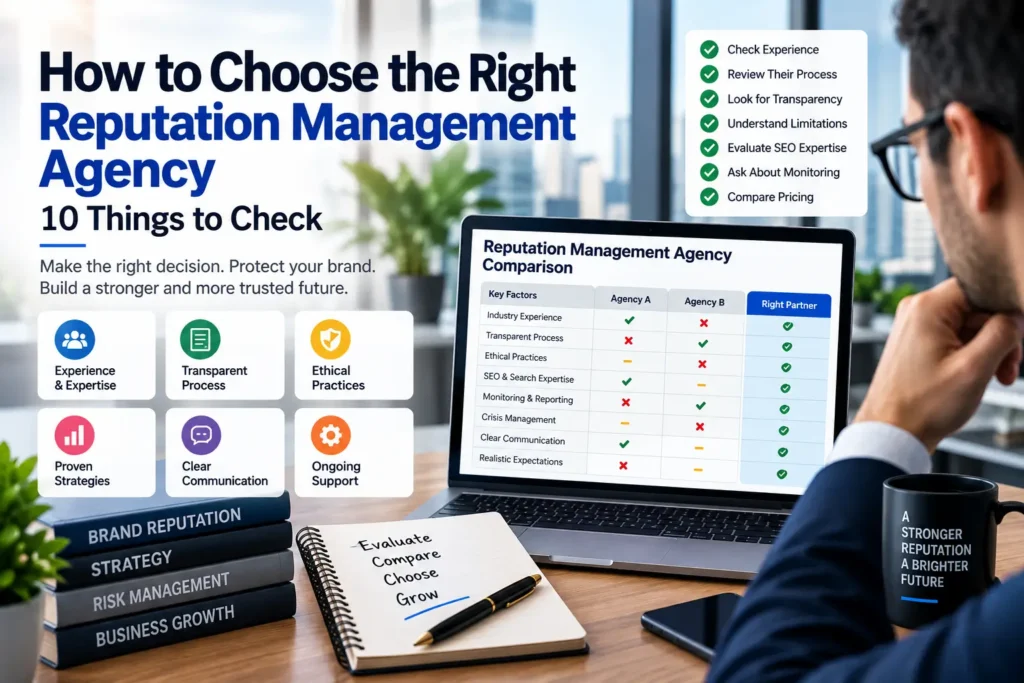
That is why understanding How to Choose the Right Reputation Management Agency matters. The right partner can help you understand your digital reputation, identify potential risks, strengthen credible online assets, and develop a strategy that supports long-term trust.
However, not every reputation management agency offers the same expertise, process, or level of transparency. Some focus on reviews, while others specialize in search results, executive reputation, crisis response, or broader online reputation protection.
This guide explains 10 important things to check before hiring an agency, the warning signs to avoid, and how to determine whether a reputation management partner is right for your business.
At YourReputation.agency, our approach centers on strategic reputation protection, professional communication, ethical practices, and solutions tailored to each client’s situation.
Table of Contents
-
Understand What Your Reputation Actually Needs
-
Check the Agency’s Experience and Expertise
-
Review Its Reputation Management Process
-
Look for Transparent Strategies and Reporting
-
Understand What the Agency Can and Cannot Do
-
Evaluate Its SEO and Search Visibility Expertise
-
Check Its Crisis Management Capabilities
-
Ask About Monitoring and Ongoing Support
-
Assess Communication, Privacy, and Accountability
-
Compare Pricing, Scope, and Expected Outcomes
-
A Step-by-Step Guide to Choosing an Agency
-
A Realistic Example
-
Common Mistakes to Avoid
-
Best Practices and Expert Tips
-
Frequently Asked Questions
-
Conclusion and Next Steps
1. Understand What Your Reputation Actually Needs
Before contacting an agency, identify the problem you want to solve.
A company dealing with a negative news article may need a different strategy from a business receiving repeated customer complaints. Similarly, a CEO concerned about personal search results may need a different approach from a small business that wants to improve its review profile.
Start by searching your business name, personal name, and other important branded terms.
Review the results and identify:
-
Negative or misleading search results
-
Unanswered customer reviews
-
Inaccurate business information
-
Outdated articles or profiles
-
Negative news coverage
-
Fake or impersonating accounts
-
Inconsistent information across websites
-
Reputation issues involving executives
-
Weak or incomplete official profiles
Then define your primary objective.
Do you want to monitor your brand, respond to negative reviews, address harmful search results, improve your online presence, or prepare for a potential crisis?
A clear objective makes it easier to evaluate agencies and compare their proposals.
For example, a business experiencing a sudden reputation crisis may need immediate assessment and coordinated communication. A business with no immediate crisis may benefit more from ongoing monitoring and proactive reputation protection.
The agency should understand your specific situation before recommending a solution.
2. Check the Agency’s Experience and Expertise
Reputation management involves several disciplines, including SEO, review management, content strategy, digital communications, and risk assessment.
A capable agency should explain how its expertise relates to your problem.
Ask questions such as:
-
What types of reputation challenges do you handle?
-
Do you work with businesses, executives, and individuals?
-
How do you assess negative search results?
-
What is your approach to review management?
-
How do you measure progress?
-
Can you explain the strategy you recommend for my situation?
Look for clear answers rather than impressive-sounding promises.
Relevant Experience Matters
An agency that understands corporate reputation may be a good fit for a company facing negative press. A professional dealing with damaging personal search results may need a partner experienced in personal reputation management.
Similarly, a business with several locations may need a strategy that considers reviews, local search visibility, and consistent business information.
The goal is not necessarily to choose the biggest agency. It is to find a partner whose experience matches your needs.
Review the agency’s website, service descriptions, professional profiles, and any available case studies. Look for specific explanations of its work rather than unsupported claims about guaranteed results.
At YourReputation.agency, prospective clients can explore the agency’s Reputation Management Agency page to understand the broader service offering and determine whether it aligns with their reputation goals.
3. Review Its Reputation Management Process
A professional agency should have a structured process for assessing and managing reputation challenges.
Although each case is different, a comprehensive process often includes several stages.
Reputation Audit
The agency reviews your search results, reviews, public profiles, relevant websites, and other visible information associated with your brand.
Risk Assessment
It identifies the most important issues and distinguishes between inaccurate information, legitimate criticism, outdated content, and material that may violate platform policies.
Strategy Development
The agency recommends actions based on the source of the problem, its visibility, your objectives, and the available options.
Implementation
Depending on the situation, the work may involve monitoring, review responses, correction requests, publisher outreach, content development, SEO, or other appropriate measures.
Ongoing Evaluation
The agency tracks relevant changes and adjusts its strategy when necessary.
Ask how each stage works, who is responsible, and what you should expect to receive.
A vague proposal that simply promises to improve your reputation without explaining the process deserves further scrutiny.
For businesses seeking continuous oversight, Reputation Monitoring is an important part of a proactive approach. Monitoring helps identify changes and potential issues, although it does not guarantee that every mention will be detected or every problem prevented.
4. Look for Transparent Strategies and Reporting
Transparency is essential when choosing a reputation management partner.
You should understand what the agency plans to do, why those actions are appropriate, and how progress will be evaluated.
Before signing an agreement, ask for clarification on:
-
Services included in the proposal
-
Deliverables and responsibilities
-
Reporting frequency
-
Performance indicators
-
Communication channels
-
Contract length and cancellation terms
-
Additional fees
-
Client approval requirements
What Should Reporting Include?
Depending on your objectives, useful reporting may cover:
-
Changes in branded search results
-
New reviews and brand mentions
-
Review response activity
-
Status of correction or removal requests
-
Content published or updated
-
Search visibility trends
-
Relevant reputation risks
-
Completed tasks and next steps
Not every metric is equally useful for every client. The agency should explain which measurements relate to your specific goals.
Be cautious if a provider refuses to explain its methods, withholds basic information about its work, or relies on vague claims that cannot be evaluated.
Reputation management is not simply about producing reports. It is about making informed decisions and understanding whether the work is addressing the original problem.
5. Understand What the Agency Can and Cannot Do
One of the most important checks is whether an agency explains the limitations of reputation management honestly.
No legitimate provider can guarantee that every negative article will be removed, every review will disappear, or every branded search will show only positive results.
The outcome depends on factors such as the source of the content, the platform’s policies, the publisher’s decisions, search engine behavior, and the strength of competing pages.
Ask How the Agency Handles Different Situations
| Reputation problem | Potential approach |
|---|---|
| Inaccurate business information | Request corrections from the relevant source |
| Policy-violating review | Submit an appropriate platform report |
| Legitimate negative review | Respond professionally and address the concern |
| Negative news article | Assess correction options and strengthen relevant search assets |
| Outdated website information | Contact the publisher or website owner |
| Negative branded search results | Evaluate SEO, content, and search visibility opportunities |
| Impersonation or fake profiles | Report the account through the relevant platform |
| Sudden public controversy | Develop a coordinated crisis response |
These are potential approaches, not guaranteed solutions. The correct action depends on the facts of each case.
Be Careful With Guaranteed Results
Warning signs include promises such as:
-
Guaranteed removal of every negative result
-
Guaranteed first-page rankings within a fixed period
-
Permanent elimination of all criticism
-
Secret methods that supposedly bypass platform policies
-
Guaranteed positive reviews
-
Immediate results without an audit
A trustworthy agency explains the available options, associated limitations, and realistic expectations before work begins.
For more complex situations, Online Reputation Protection Services can help you understand how a broader strategy may address monitoring, digital credibility, and reputation risks.
6. Evaluate Its SEO and Search Visibility Expertise
Search engine optimization can play an important role in reputation management because the pages people see in branded searches influence their perception of your business.
However, reputation-focused SEO is not the same as a conventional traffic campaign.
The objective is to improve the visibility of relevant, accurate, authoritative information associated with your name or company.
A capable agency should understand how to evaluate:
-
Branded search queries
-
Website structure and internal links
-
Relevant service and profile pages
-
Content quality and usefulness
-
Technical SEO issues
-
Search intent
-
Third-party authority
-
Local business visibility
-
Changes in search results
Ask How Content Will Be Developed
The agency should explain how it plans to create or improve content that genuinely helps your audience.
Examples include expert articles, executive biographies, service pages, business profiles, educational resources, and relevant company announcements.
Publishing large volumes of repetitive, low-quality content is not a reliable substitute for expertise.
Google’s guidance emphasizes helpful, reliable, people-first content. Microsoft’s Bing Webmaster Guidelines similarly provide guidance on creating discoverable, useful web content.
For that reason, choose an agency that prioritizes content quality and technical fundamentals instead of relying on keyword stuffing or automated publishing at scale.
7. Check Its Crisis Management Capabilities
Some reputation issues develop gradually. Others emerge within hours.
A negative news story, viral complaint, public allegation, data-related incident, or sudden wave of unfavorable reviews can require a faster and more coordinated response.
If your business has significant public exposure, ask whether the agency can help assess and manage reputation crises.
A suitable provider should be able to explain how it would:
-
Assess the situation and available facts.
-
Identify the sources and reach of the issue.
-
Establish appropriate communication responsibilities.
-
Coordinate with your internal team.
-
Recommend platform reporting or correction requests when justified.
-
Monitor new developments.
-
Review the results and adjust the response.
An ORM agency should also recognize when other specialists are needed. Legal questions may require an attorney, while public statements about a complex incident may require qualified communications or public relations professionals.
No single agency should claim that it can solve every legal, operational, and communications problem independently.
If your business is facing sudden negative attention, review Crisis Reputation Management to understand the role of a coordinated reputation response.
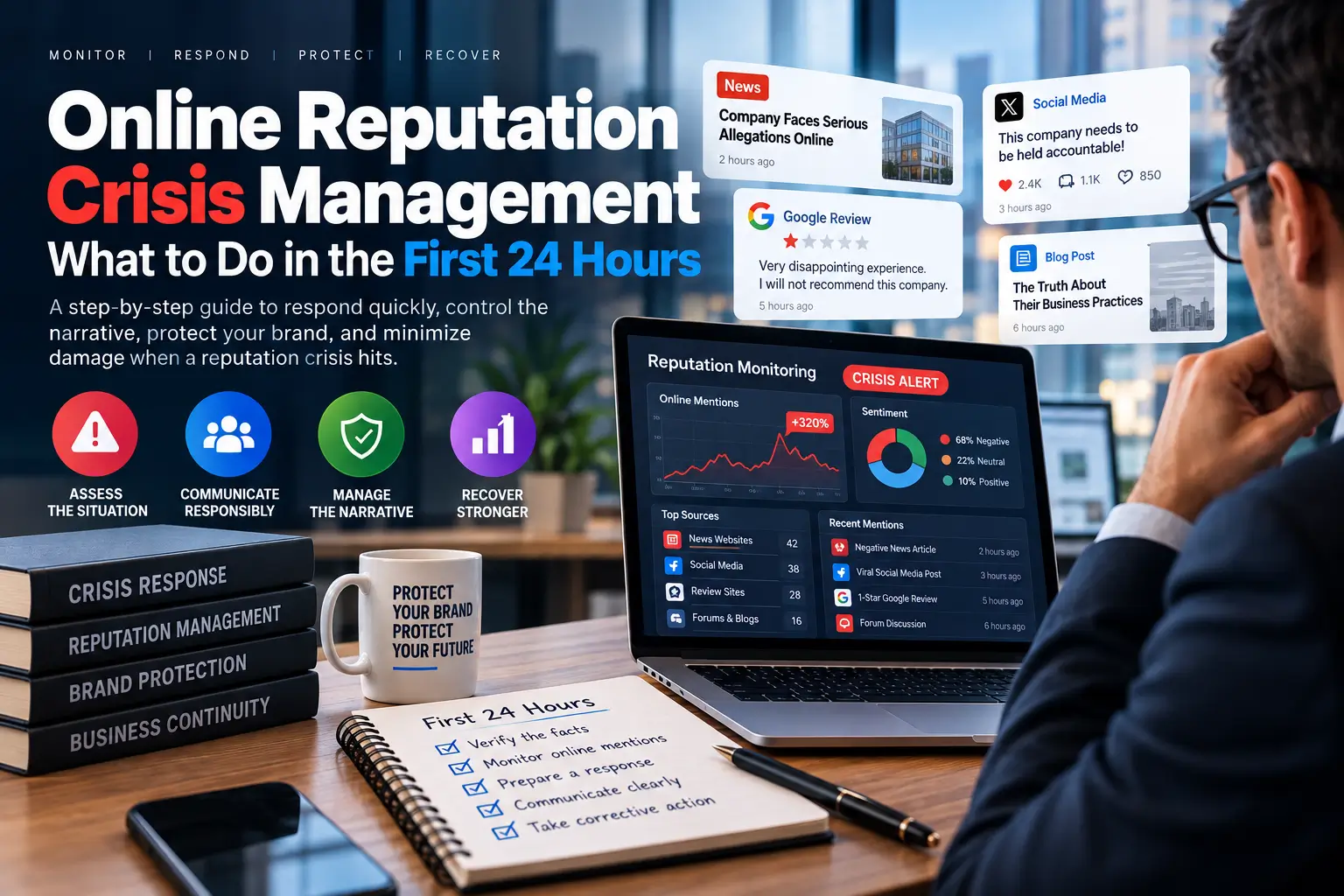
You can also read Online Reputation Crisis Management: What to Do in the First 24 Hours for additional guidance on the initial response period.
8. Ask About Monitoring and Ongoing Support
Hiring an agency should not mean losing visibility into your own reputation.
Ask what the agency monitors, how frequently it checks relevant channels, and how it alerts you to important developments.
Depending on your situation, monitoring may cover:
-
Branded Google searches
-
New customer reviews
-
News mentions
-
Social media discussions
-
Executive names
-
Competitor comparisons
-
Industry forums
-
Changes to business profiles
-
Relevant third-party publications
Clarify What Happens After the Initial Project
Some reputation challenges require a defined project, while others benefit from ongoing oversight.
Before committing, understand whether the proposed engagement includes regular monitoring, reporting, strategic reviews, or additional work when new issues appear.
Also ask who will contact you if a significant development occurs.
A monitoring service can help identify visible changes, but no monitoring system can guarantee complete coverage of the internet. The agency should communicate its coverage and limitations clearly.
9. Assess Communication, Privacy, and Accountability
Reputation management often involves sensitive business information, personal details, internal disputes, or concerns that could affect a person’s professional standing.
The agency should treat that information carefully.
Before sharing confidential materials, ask how the provider handles access, communication, document sharing, and information retention.
You should also understand who will manage your account and how you can reach them.
Evaluate the Working Relationship
Look for a provider that:
-
Explains technical concepts in plain English
-
Responds within clearly defined service expectations
-
Requests approval when appropriate
-
Documents important decisions
-
Explains risks before taking action
-
Communicates setbacks honestly
-
Respects your confidentiality requirements
-
Does not make public statements on your behalf without authorization
Accountability matters just as much as technical knowledge.
You should know what work is being performed, what remains outstanding, and which decisions require your input.
Check Independent Reputation Signals
Review the agency’s own public presence. Look for consistent business information, meaningful service descriptions, and credible feedback.
You can review YourReputation.agency on Trustpilot and its Google Business Profile as part of your evaluation.
Independent feedback is one useful signal, but it should not be the only basis for a hiring decision. Consider the context, relevance, and consistency of the information you find.
10. Compare Pricing, Scope, and Expected Outcomes
Reputation management pricing varies because the work can range from routine monitoring to complex, multi-channel reputation repair.
A business dealing with a few outdated listings will typically have different needs from a company facing negative news coverage, several damaging search results, or an executive reputation crisis.
Rather than choosing the cheapest proposal, compare what each provider will actually deliver.
| Evaluation factor | What to check |
|---|---|
| Initial audit | Is the current reputation assessed before recommendations are made? |
| Scope of work | Are the services and deliverables clearly defined? |
| Implementation | Who performs the work, and what requires your approval? |
| Monitoring | Which sources are covered and how often? |
| Reporting | What progress indicators will be provided? |
| Communication | Who manages the account and handles urgent issues? |
| Contract | Are duration, renewal, cancellation, and fees clear? |
| Expectations | Are limitations and dependencies explained honestly? |
Focus on Value, Not Just Price
A low-cost service may be sufficient for a limited task. A more complex situation may require research, technical expertise, stakeholder coordination, and ongoing monitoring.
The right decision depends on the risk, the resources available internally, and the value of resolving the problem.
Ask for a proposal that connects the recommended work to your actual objectives.
If you cannot understand what you are paying for, request clarification before signing.
A Step-by-Step Guide to Choosing the Right Agency
Now that you understand the 10 checks, use this process to compare providers systematically.
Step 1: Define Your Main Goal
Write down the problem you want to solve and the outcome you hope to achieve.
For example, you may want to address negative search results, improve review management, monitor your personal name, or prepare a crisis response plan.
Step 2: Research Potential Agencies
Review their websites, service pages, business profiles, and publicly available client feedback.
Look for relevant expertise rather than choosing solely on brand recognition.
Step 3: Request an Initial Assessment
Ask the agency to explain the visible reputation issues it identifies and the information it needs before making recommendations.
A preliminary conversation should help you understand the likely scope of work, not pressure you into an immediate commitment.
Step 4: Ask the Same Questions of Each Provider
Compare their proposed methods, deliverables, reporting, communication, and limitations.
Using consistent questions makes the differences easier to identify.
Step 5: Review the Proposal Carefully
Check the contract, fees, expected deliverables, responsibilities, and cancellation terms.
Make sure you understand what is included and what may cost extra.
Step 6: Choose the Best-Fit Partner
Select the agency that demonstrates relevant expertise, clear communication, realistic expectations, and a strategy aligned with your goals.
Step 7: Establish a Baseline
Before implementation, document your current reputation indicators. This can help you evaluate changes over time and understand which actions are contributing to progress.
Real-World Example: Choosing an Agency for a Negative Search Result
Consider a fictional company called Summit Advisory Group.
The company discovers that an old complaint appears prominently when people search its name. Leadership is concerned that prospective customers may misunderstand the company’s current operations.
Three agencies offer different proposals.
| Agency | Proposal | Main concern |
|---|---|---|
| Agency A | Promises to remove every negative result in seven days | Unsupported guarantee |
| Agency B | Recommends publishing dozens of generic articles | Unclear quality and relevance |
| Agency C | Offers a reputation audit, source assessment, correction options, search strategy, and ongoing reporting | Requires realistic expectations and cooperation |
Agency C appears to offer the most considered approach because it starts by investigating the problem rather than promising a predetermined result.
The company would still need to verify the provider’s experience, costs, methods, and contract before hiring it.
This example illustrates an important principle: the strongest proposal is not necessarily the one that promises the fastest result. It is the one that explains the problem, the available options, and how progress will be evaluated.
Common Mistakes to Avoid When Hiring a Reputation Management Agency
Even experienced business owners can make costly mistakes when evaluating reputation management providers.
Choosing an Agency Based Only on Price
A lower price does not automatically mean better value. Compare expertise, scope, reporting, and the resources required to address your specific problem.
Believing Guaranteed Removal Claims
No agency can guarantee that every negative article, review, or search result will be removed. Ask how the provider determines whether removal is possible and what alternatives exist.
Ignoring the Contract
Unclear deliverables, unexpected fees, restrictive cancellation terms, and vague responsibilities can create problems later.
Overlooking Ethical Practices
Avoid providers that recommend fake reviews, deceptive identities, fabricated content, or attempts to manipulate review platforms.
Expecting Immediate Results
Search visibility and reputation can take time to change. Results depend on the circumstances, and even a well-executed strategy cannot guarantee a particular ranking or outcome.
Hiring Without an Audit
A generic package may not address the actual source of your problem. A proper assessment helps establish priorities before significant work begins.
Best Practices and Expert Tips
Use these principles to make a more informed decision.
1. Prioritize diagnosis before action. Understand the source, visibility, and potential impact of a reputation issue before choosing a solution.
2. Ask for realistic success measures. Depending on your goals, useful indicators may include review response activity, corrections obtained, changes in branded search visibility, and improvements in the accuracy of online information.
3. Keep ownership of your digital assets. Maintain appropriate access to your website, analytics, business profiles, and other important accounts.
4. Build reputation proactively. Monitoring, useful content, accurate business information, and professional communication can help establish a stronger foundation before a crisis occurs.
5. Choose a partner, not just a vendor. Reputation management often requires collaboration between the agency, leadership, marketing, customer service, and sometimes legal or communications specialists.
6. Review progress regularly. Reassess the strategy as your business, search landscape, and reputation risks change.
7. Match the service to the problem. A business facing a public crisis may need a different solution from an executive seeking to strengthen personal search visibility.
For individuals concerned about their own branded search results, Personal Reputation Management may be more relevant than a business-only reputation campaign.
For a broader overview of the services available, visit Reputation Management.
Frequently Asked Questions
1. How to Choose the Right Reputation Management Agency?
To choose the right reputation management agency, assess its relevant experience, audit process, ethical practices, transparency, SEO expertise, monitoring capabilities, reporting, communication, pricing, and realistic expectations. Compare proposals and choose a provider whose strategy directly addresses your reputation challenges.
2. What Does a Reputation Management Agency Do?
A reputation management agency helps individuals and organizations monitor and manage their online reputation. Depending on the engagement, services may include review management, search-result analysis, content strategy, reputation monitoring, correction requests, and crisis response.
3. How Much Does a Reputation Management Agency Cost?
Costs vary according to the scope and complexity of the work. Monitoring and review management may require different resources from complex search-result issues or crisis response. Request a detailed proposal that explains deliverables, fees, contract terms, and ongoing costs.
4. Can a Reputation Management Agency Remove Negative Google Results?
Sometimes, depending on the content, source, platform policies, and applicable removal processes. An agency may also explore corrections, publisher outreach, or search visibility strategies when removal is unavailable or inappropriate. No provider can legitimately guarantee the removal of every negative result.
5. How Long Does Reputation Management Take?
There is no universal timeline. Results depend on the type of issue, the authority of the content, search competition, platform decisions, and the work required. A professional agency should explain likely dependencies without guaranteeing a fixed outcome.
6. What Are the Warning Signs of a Bad Reputation Management Agency?
Warning signs include guaranteed removals, guaranteed rankings, unclear pricing, secret methods, fake review strategies, vague reporting, and refusal to explain the proposed work. Be cautious when a provider promises results before understanding your situation.
7. Should I Hire a Reputation Management Agency or Handle It Myself?
You may be able to manage routine reviews, accurate business listings, and basic monitoring internally. Professional support may be more useful when negative search results, complex content issues, executive reputation risks, or a public crisis require specialized expertise.
8. Is SEO Part of Reputation Management?
Yes. SEO can help relevant and authoritative content become more visible for branded searches. However, comprehensive reputation management may also include review responses, monitoring, publisher outreach, content correction, and crisis communication.
9. How Can I Verify a Reputation Management Agency’s Credibility?
Review its service descriptions, business profiles, independent feedback, communication practices, and available evidence of relevant experience. Ask for a clear proposal and verify the agency’s methods before signing a contract.
10. Can a Reputation Management Agency Help During a Crisis?
An experienced provider may help assess online developments, monitor mentions, coordinate reputation-related actions, and recommend appropriate responses. Depending on the situation, legal counsel, public relations specialists, or other experts may also be necessary.
11. What Should a Reputation Management Proposal Include?
A useful proposal should define the initial assessment, recommended strategy, deliverables, responsibilities, reporting frequency, fees, contract terms, and limitations. It should explain how the work relates to your goals and how progress will be evaluated.
12. Why Choose YourReputation.agency?
YourReputation.agency offers reputation-focused services designed to help businesses, executives, and individuals understand their digital reputation and evaluate appropriate protection strategies. Prospective clients can review the agency’s services, explore its approach, and request a conversation about their specific needs.
Conclusion: Choose a Reputation Management Partner With Confidence
Understanding How to Choose the Right Reputation Management Agency can help you avoid unrealistic promises, unnecessary costs, and strategies that fail to address the real problem.
Start with a clear understanding of your reputation challenges. Evaluate the agency’s experience, investigate its methods, ask about monitoring and reporting, and make sure its proposal reflects your actual goals.
Most importantly, choose a provider that values transparency, ethical practices, realistic expectations, and long-term reputation protection.
Your online reputation can influence customer confidence, business opportunities, professional credibility, and the way people perceive your brand. It deserves a thoughtful strategy rather than a quick fix.
Protect Your Reputation With YourReputation.agency
If negative search results, damaging reviews, outdated information, or growing reputation concerns are affecting your business or personal brand, the next step is to understand what is happening and identify the right response.
YourReputation.agency helps businesses, entrepreneurs, executives, and individuals approach reputation challenges with a strategy tailored to their circumstances.
Explore our Reputation Management Agency services to learn more about our approach. If you are dealing with a sensitive situation, our Crisis Reputation Management service provides a starting point for understanding reputation-related support.
You can also review our guide, How to Remove a Mugshot From Google Search: Step-by-Step Guide, for an example of how a specific search reputation concern may require a targeted strategy.
Ready to discuss your situation? Contact YourReputation.agency to explore your options and determine which reputation management approach best fits your needs.
Do not choose an agency based on promises alone. Choose a partner that understands your reputation, explains the options, and helps you make informed decisions.