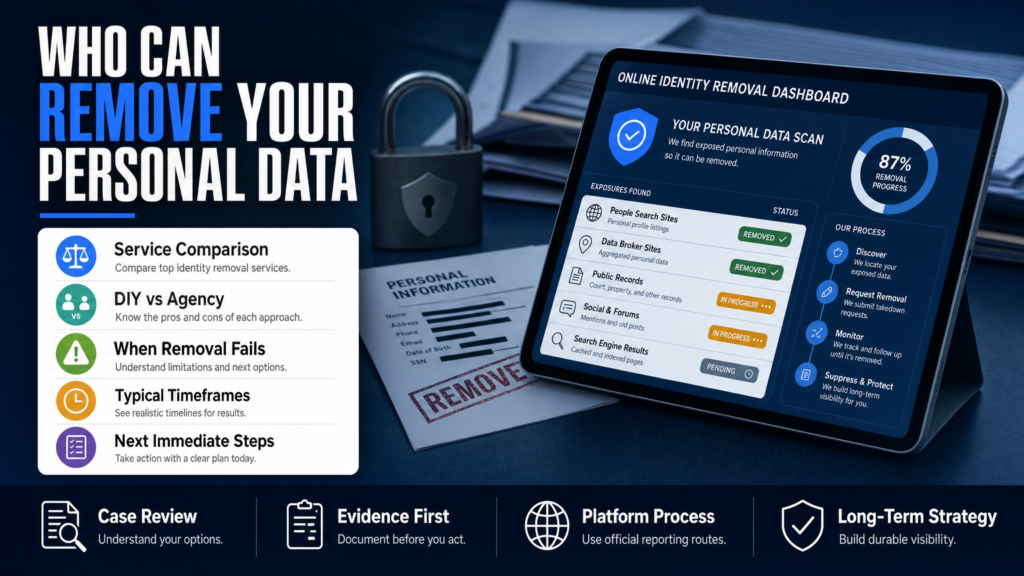
If a data broker profile, mugshot site, or old complaint is the first thing clients see when they Google you, you need to know which tool or service actually moves the needle. Which online identity removal service is the best? That’s the question most professionals call us with.
This article breaks down the leading consumer services (DeleteMe, Incogni, Cloaked, Aura, LifeLock) and compares them to agencies and DIY options. You’ll get concrete pros and cons, likely timeframes, and the exact first steps to take depending on whether the item is a data broker listing, a review, a news story, or social-media content.
We evaluate each approach by coverage, technical method, legal escalation options, monitoring, and suitability for high-risk professionals (physicians, lawyers, executives). Expect clear tradeoffs—not promises of guaranteed removal or fixed timelines—plus a recommended decision path you can act on today.
Table of Contents
- Cloaked vs DeleteMe: Which Is Better For You?
- Incogni, DeleteMe, or Aura: Which Should You Pick?
- LifeLock vs DeleteMe: What’s the Difference?
- What’s Better Than DeleteMe? Alternatives and Complements
- DIY Opt-Outs, Paid Subscriptions, Or An Agency: Which Route Wins?
- When Removal Isn’t Available: What To Do Next
- Immediate Steps After a Leak or Viral Incident
- How To Evaluate Any Removal Service Before Paying
- DIY Opt-Outs vs Paid Agency Services
- Hypothetical: An ER Doctor, A Mugshot, And A Job Threat
- Common Mistakes Professionals Make
- Best Practices For Choosing And Using Removal Services
- Expert Tips
- Conclusion
- Why Businesses Choose Your Reputation Agency
- Frequently Asked Questions
Cloaked vs DeleteMe: Which Is Better For You?
Cloaked and DeleteMe are both consumer-facing personal data removal services, but they target slightly different use cases and workflows. Which one is better depends on what data you need removed and how hands-on you want to be.
Neither service can guarantee removal across every publisher; platform policies, publisher cooperation, and state law all affect outcomes. Expect a combination of automated opt-outs, manual requests, and periodic re-checks.
- Inventory the exact URLs and broker names you need removed.
- Compare the coverage lists on each vendor’s site for the brokers that host your records.
- Ask about monitoring cadence and how re-appearances are handled.
- DeleteMe: Extensive manual opt-outs of major data brokers, regular refreshes, good for broad background-profile removal.
- Cloaked: Focuses on faster automated takedowns and negotiation with smaller brokers and people‑search sites; sometimes faster on niche listings.
- Choose Cloaked if you prioritize speed on specific listings; choose DeleteMe if you want broad, repeatable coverage and periodic audits.
How to test a vendor quickly
Pick one or two of the worst listings and ask each vendor whether they’ve removed that site before and how long it typically took.
Request a sample report format and a description of their monitoring frequency—monthly, quarterly, or continuous differs a lot in practice.
- Get a written description of what counts as a successful removal.
- Confirm opt-out credentials and whether the vendor will resubmit when listings reappear.
Incogni, DeleteMe, or Aura: Which Should You Pick?
Incogni (by Surfshark), DeleteMe, and Aura market overlapping services but use different methods. Incogni emphasizes automated broker requests under an account model, DeleteMe leans on manual opt-outs and human follow-up, and Aura bundles identity monitoring and fraud features.
For professionals whose reputation and licensure are at stake, coverage depth and legal escalation are the critical decision factors—not brand advertising. Consider whether the service offers escalation to legal review, or whether you’ll need an agency or attorney for complex cases.
- List the top 10 sites that show up for your name in search results.
- Match each site to the vendor’s claimed coverage.
- If you find news stories, arrest records, or court filings, budget for legal review—these usually require different tactics than broker opt-outs.
- Incogni: Good for automated batch requests to many brokers; affordable and scalable.
- DeleteMe: Strong manual process and reporting; predictable renewals and human follow-up.
- Aura: Bundles identity-theft protection with data removal—useful if you also need credit/identity monitoring.
When bundled identity protection matters
If your problem includes identity-theft risk or financial fraud, Aura or LifeLock might provide consumer protections (alerts, credit freezes, fraud resolution) that pure broker removers don’t.
However, the bundled approach can raise cost and still won’t remove publisher content such as news reports or negative reviews.
- Bundle if you also want continuous fraud resolution support.
- Don’t expect bundled services to replace targeted takedown or SEO work.
LifeLock vs DeleteMe: What’s the Difference?
LifeLock is primarily an identity-theft protection and resolution service; DeleteMe is a data-broker opt-out and monitoring subscription. Which is better depends on whether your immediate risk is financial fraud or reputational search results.
LifeLock may help with credit violations, fraud restoration and some legal referrals; DeleteMe focuses on removing personal data from broker profiles that appear in search results.
- Decide whether your primary harm is financial (choose identity protection) or reputational/search-visibility (choose broker removal).
- You can use both services together: remove broker listings while LifeLock monitors fraud.
- If you’re worried about financial impersonation or fraudulent account opening, LifeLock addresses those risks.
- If your top priority is suppressing background profiles and people‑search listings from Google results, DeleteMe is more directly focused.
Cost and renewal tradeoffs
Identity-protection subscriptions often cost more because they include active insurance and restoration services. Broker removal subscriptions price by frequency and number of names.
Ask for clear reporting: which URLs they removed, which reappeared, and what monitoring intervals you have.
- Annual renewals are common; check cancellation terms.
- Confirm whether removals are monitored and resubmitted automatically.
What’s Better Than DeleteMe? Alternatives and Complements
DeleteMe is a solid baseline for many people, but “better” depends on your goals. A few alternatives or complements can outperform a single subscription depending on the situation.
For high-stakes professionals consider mixing services or adding agency-grade work: targeted takedowns, search-result suppression (SEO), and legal/PR coordination.
- If DeleteMe covers broker listings but an article or review still ranks, get an SEO suppression plan.
- If content is defamatory, consult a lawyer to evaluate legal remedies before public takedown requests.
- Use a dedicated reputation agency when content is legal/factual but damaging (defamation, false claims, or high-visibility falsehoods).
- Combine a broker-removal subscription with SEO suppression to push damaging links off page one.
- Engage an attorney for false statements or injurious fabrications on publisher sites.
When to hire an agency instead of another subscription
Agencies add human negotiation, press engagement, legal coordination, and customized SEO—these are often essential when search results affect revenue or licensure.
An agency will not promise blanket removal; it provides a professional process that includes mitigation strategies when removal isn’t available.
- Hire an agency for viral incidents, complex multi-platform attacks, or when critical business outcomes are at risk.
- Keep subscriptions for ongoing background-profile hygiene.
DIY Opt-Outs, Paid Subscriptions, Or An Agency: Which Route Wins?
There are three realistic paths: do-it-yourself opt-outs, consumer subscriptions (DeleteMe, Incogni, Cloaked), and hiring an agency. Each has different costs, time commitment, and scope.
The right choice depends on your risk profile, the types of sites involved, and whether you need coordinated legal or PR support.
- Map each harmful item to a category: broker listing, review, news, social post, or legal record.
- Choose DIY for a handful of broker opt-outs; subscriptions for broad background cleaning; agencies for crises or high-visibility damage.
- DIY: Cheapest, requires time and persistence; effective on some brokers but fragile for press stories and reviews.
- Subscriptions: Good for ongoing broker removals and monitoring; limited for complex publisher disputes.
- Agency: Best for targeted, urgent incidents, multi-platform removal attempts, legal escalation, and reputation rebuild strategies.
A practical decision tree
If items are mostly people-search and broker profiles → try a subscription (Incogni/DeleteMe/Cloaked).
If you have a viral post, defamatory article, or high-volume review attack → contact an agency for a coordinated response.
- Budget: DIY = time; Subscription = $100–$400/year; Agency = $2,000+ for urgent incidents.
- Monitoring: subscriptions include monitoring; DIY requires you to re-check regularly.
When Removal Isn’t Available: What To Do Next
Sometimes publishers refuse takedown requests and platforms decline to remove content because it doesn’t violate policy or it’s lawful reporting. If removal isn’t available, mitigation becomes the priority.
Mitigation uses SEO, corrective content, and strategic PR to control the narrative and reduce the visibility of harmful items.
- 1) Audit your first three pages of search results for your name or business.
- 2) Prioritize items you can influence: update your website, claim directory listings, and push social profiles to rank.
- 3) For damaging third-party content, build a suppression plan (30/60/90 day content calendar) focused on high-authority placements.
- Search-result suppression: create authoritative content (press releases, LinkedIn, professional bios, guest posts) to outrank the harmful page.
- Correction and context: publish a clear, documented correction or your side of the story on high-authority sites.
- Legal options: evaluate whether the content is defamatory or violates privacy—coordinate with counsel if so.
A quick mitigation checklist
Claim and optimize your Google Business Profile, LinkedIn, Twitter/X, Facebook, and industry directory listings.
Publish a clear professional bio and FAQ on your website addressing common concerns.
Use targeted guest posts or press to create authoritative pages that search engines favor.
- Work with an SEO specialist experienced in reputation suppression.
- Track weekly rank changes and be prepared to iterate your content plan.
Immediate Steps After a Leak or Viral Incident
When something harmful goes viral or appears in search results, speed matters. The first 24–72 hours shape the long-term trajectory.
Take tactical actions that protect clients, document the incident, and buy time for remediation.
- First 24 hours: preserve evidence, pause public responses, and notify internal stakeholders and counsel if needed.
- 24–72 hours: launch monitoring, contact platforms for policy violations, and decide whether to hire an agency.
- After 72 hours: implement suppression and PR plans, and consider legal options for false statements.
- Document everything: URLs, screenshots (with timestamps), and any communications about the post.
- Preserve evidence in a secure folder and enable Google Alerts for exact name and brand mentions.
- Limit direct engagement that could amplify the post—avoid emotional replies or counter-posts.
Who to notify internally
If you are a business: notify your communications lead, HR, and legal counsel. For solo professionals: identify a trusted adviser and a lawyer.
Track who is doing what in a shared incident log so actions are coordinated.
- Assign one spokesperson to control messaging.
- Limit document access to those who must act on it.
How To Evaluate Any Removal Service Before Paying
Evaluate services on verifiable criteria: coverage list (which brokers/publishers), reporting transparency, monitoring cadence, escalation pathways, and refund/cancellation policy.
Avoid vendors that promise guaranteed results or fixed timelines. Ask for specifics and written explanations of what they will do for the particular URLs you care about.
- Send the vendor 3 sample URLs and ask for a written plan describing the process and expected checks.
- Compare contracts for automatic renewals and cancellation terms.
- If you’re high-risk, ask whether the provider coordinates with qualified legal counsel.
- Request a sample report showing URLs removed and how re-appearances are handled.
- Confirm whether they use official reporting channels and whether they’ll escalate to legal options if appropriate.
- Check for ongoing monitoring—removals without follow-up often reappear.
Red flags to watch for
Vague guarantees, no sample reports, refusal to name coverage, or mandatory long lock-in contracts without exit clauses are warning signs.
Also be cautious of services that recommend deceptive tactics or pay-for-deletion schemes involving falsified credentials.
- Insist on written processes, not marketing claims.
- Refuse any vendor that asks for platform credentials you aren’t comfortable sharing.
DIY Opt-Outs vs Paid Agency Services
A short two-column comparison to help decide whether to handle removal yourself or hire professionals.
| DIY / Subscriptions | Agency / Full Service |
|---|---|
| Cost | Higher; professional fees and retainers |
| Time | Faster coordination and execution |
| Coverage | Broader: includes PR, legal, SEO |
| Monitoring | Continuous & tailored alerts |
| Escalation | Legal and publisher negotiation |
| Control | Agency manages messaging and response |
Hypothetical: An ER Doctor, A Mugshot, And A Job Threat
Scenario: An emergency-room physician named ‘Dr. A.’ finds a mugshot and arrest record from 2018 on a paywalled mugshot aggregator. The mugshot appears on page one when patients Google the physician. Removal options vary: some aggregator sites will take content down for a fee, others refuse unless legally ordered.
Process summary below shows a coordinated approach combining broker subscription, agency support, legal review, and SEO suppression.
- 1) Day 1–3: Document evidence, enable monitoring, and contact the aggregator with a takedown request. If the aggregator demands a fee, do not pay without counsel—assess other channels.
- 2) Week 1–3: Agency sends formal removal requests, files platform reports (where applicable), and prepares authoritative replacement content (bio, clinic page, professional profiles).
- 3) Month 1–3: Parallel SEO work begins to promote clinic pages, LinkedIn, and authoritative profiles to outrank the mugshot. If the aggregator refuses and the content is defamatory, consult counsel about legal options.
- 4) Ongoing: Monitor weekly for reappearance; subscription services handle recurring opt-outs for background broker sites.
- Step 1: Inventory URLs, take screenshots, and record when each result appears.
- Step 2: Run a people-search cleanup subscription to remove background profiles and reduce the number of links competing for page one.
- Step 3: Engage an agency to request takedowns, contact the aggregator with documented disputes, and prepare an SEO suppression plan.
Common Mistakes Professionals Make
Avoid these frequent, costly errors. They delay remediation and sometimes make visibility worse.
Mistake: Treating All Services As Interchangeable
Not all removal services cover the same sites or use the same methods. Selecting the wrong tool wastes time and money.
Always match vendor coverage to the specific sites and content types harming you.
- Ask for a coverage list and sample reports before subscribing.
Mistake: Responding Publicly Without A Plan
An emotional reply can amplify a post and generate more attention. Professionals often make the situation worse by engaging prematurely.
Pause, document, and coordinate messaging with counsel or your communications lead.
- Assign a single spokesperson and stick to verified facts.
Mistake: Relying On One-Off Takedowns
Some removals reappear. Without ongoing monitoring and resubmission, profiles can return and again harm search results.
Plan for recurring checks and automatic resubmission where possible.
- Subscriptions or agency monitoring reduce the risk of reappearance.
Mistake: Overlooking Non-Search Harms
Reputation risk isn’t only about Google. Patients, partners, and regulators may see content on social platforms, forums, or industry sites.
Include those channels in your audit and mitigation plan.
- Audit social networks and niche industry platforms, not just Google.
Mistake: Ignoring Legal Review For Defamatory Content
If content asserts false criminal activity or professional misconduct, it may require legal analysis. Treating it as a regular broker removal can waste time.
Coordinate with counsel when statements are potentially defamatory or materially false.
- Document evidence and preserve communications before talking to the publisher.
Best Practices For Choosing And Using Removal Services
These durable practices reduce risk and improve outcomes across services and agencies.
Practice: Start With An Inventory
List the exact URLs, screenshots, and the platforms involved. An accurate inventory allows you to match the right tool and avoid wasted spending.
Include context: is the item factual reporting, a user review, a people-search profile, or doxxed personal data?
- Use a spreadsheet with columns for URL, platform, category, harm level, and who will act.
Practice: Match Tactics To Content Type
Data brokers → subscription or DIY opt-outs. Reviews → platform-specific dispute processes. News → corrections, legal counsel, or suppression. Social posts → platform reports and PR.
Avoid one-size-fits-all approaches.
- Create a playbook with platform-specific submission templates to save time.
Practice: Demand Transparent Reporting
Ask vendors for exportable reports that show URLs removed, date of removal, and monitoring cadence. This transparency keeps vendors accountable and helps coordination with counsel.
If a vendor can’t produce a concrete log, consider alternatives.
- Weekly or monthly status emails are standard; insist on evidence-backed reporting.
Practice: Combine Tools When Needed
Subscriptions handle bulk broker profiles; an agency manages urgent incidents and SEO suppression. Combining them often gives the best protection for professionals.
Budget for both ongoing hygiene (subscriptions) and episodic crisis work (agency retainers).
- Use subscriptions for baseline hygiene and agencies for high-stakes interventions.
Practice: Keep Documentation And Legal Contacts Ready
Maintain a file with your ID documents, licensing proof, and a pre-vetted lawyer who understands defamation and privacy law in your state.
Having counsel on standby shortens response times if legal action is needed.
- Store documents securely and share them only via secure channels when required.
Expert Tips
- Start with a search-audit focused on the exact name strings people actually use to find you.
- Use targeted guest posts on high-authority sites to outrank damaging links quickly.
- Preserve every harmful item with screenshots and timestamps before you request a takedown.
- Ask removal vendors for a sample monthly report before you sign up.
- Don’t pay removal fees to dubious ‘pay-to-delete’ middlemen without legal advice.
- If a review is false and harms licensure or business, collect evidence and escalate to platform and counsel simultaneously.
- Monitor both broad search results and niche industry sites where your clients look.
- When a platform denies a report, save the denial and use it to inform a different mitigation or legal pathway.
Conclusion
There’s no single ‘best’ online identity removal service for every professional. The right choice depends on the content type, the platforms involved, your risk tolerance, and whether the harm requires legal or PR coordination. Consumer subscriptions like DeleteMe or Incogni are effective for broad broker cleanup; Cloaked can be quicker on niche listings; LifeLock/Aura add identity-theft protections rather than reputational takedowns.
For high-stakes or time-sensitive problems—viral posts, defamatory articles, or items that threaten licensure—combine subscription hygiene with agency-grade mitigation and legal review. If removal isn’t possible, a focused suppression and messaging plan often provides the most reliable path back to normal business operations.
Why Businesses Choose Your Reputation Agency
Managing your reputation takes more than monitoring reviews or publishing the occasional blog post. It takes a strategy built around your situation, your industry, and what is actually showing up in search.
Your Reputation Agency works with businesses, executives, healthcare professionals, attorneys and growing brands. Our services include:
- Remove defamatory content and false posts (news, blogs, listings)
- Remove or challenge negative reviews (Google, Yelp, TripAdvisor, industry sites)
- Mugshot and arrest record removal
- Remove videos, images, and other multimedia that damage reputation
- Remove personal data from people‑search and data‑broker sites (opt‑outs)
- Search result suppression (SEO to bury negative links)
- Social media takedowns and impersonation removal
- Rapid online crisis management and incident response
- Ongoing monitoring and alerting of reputation signals
- Coordination with legal counsel and use of legal tactics when required
Frequently Asked Questions
1. Which is better, cloaked or DeleteMe?
Cloaked may move faster on certain niche listings and uses some automated tactics, while DeleteMe emphasizes manual opt-outs and periodic audits. Which is better depends on the specific sites you need removed, the frequency of monitoring you want, and whether you prefer automation or human follow-up.
2. Which is better for me, Incogni, DeleteMe, or Aura?
Incogni is strong for automated broker requests at scale; DeleteMe focuses on manual removals and detailed reporting; Aura bundles identity-theft protection with monitoring. Choose Incogni/DeleteMe for reputational search cleanup and Aura if you also need fraud restoration or credit monitoring.
3. What is better, LifeLock or DeleteMe?
LifeLock is primarily identity‑theft protection and resolution; DeleteMe targets people‑search and data‑broker removals. Use LifeLock for fraud risk and DeleteMe for reducing personal profiles in search results; many professionals use both when risks overlap.
4. What’s better than DeleteMe?
Nothing is universally ‘better’—but for certain problems, a reputation agency plus bespoke SEO and legal coordination is a more appropriate response than DeleteMe alone. For broker cleanup, alternative subscriptions like Incogni or Cloaked may be comparable depending on coverage.
5. Can a consumer removal service remove news articles or court records?
Generally no. Consumer broker removers target people‑search and data brokers, not publisher archives, news articles, or public court records. Those items usually require legal review, publisher negotiation, or SEO suppression strategies.
6. How long does removal or suppression take?
Timelines vary: broker opt-outs can show change in weeks to months; SEO suppression often takes months; legal remedies depend on jurisdiction and court schedules. No vendor should promise fixed timelines—timing depends on platform policies, publisher cooperation, and the strength of competing content.
7. What should I do first if I find damaging content?
Preserve evidence with screenshots and timestamps, create an inventory of URLs, enable monitoring (Google Alerts or a subscription), and avoid public replies that amplify the content. If the content threatens licensure or revenue, contact counsel or an agency with crisis experience.
8. Are free data-removal services worth it?
Free tools can help with limited opt-outs, but they often lack monitoring, escalation, and coverage for the brokers most visible in search results. Free options may be useful for a narrow problem set but typically don’t replace subscriptions or agency work when reputational risk is high.
9. How do I evaluate a removal vendor before paying?
Ask for a coverage list, sample reports, monitoring cadence, escalation pathways, and clear cancellation terms. Send three representative URLs and request a written plan for each. Avoid vendors that promise guaranteed outcomes or refuse to produce evidence-backed reporting.
This content provides general information and does not constitute legal advice. The available options and likely outcomes depend on the facts, evidence, platform policies, applicable law, jurisdiction, and public-interest considerations.
Past examples do not guarantee future results. Removal, correction, deindexing, and search-position changes depend on third parties and circumstances outside Your Reputation Agency’s control.