You found a damaging Google review on your Business Profile and you need it gone—fast. This guide explains precisely how you can evaluate whether you can remove google reviews from business listings, and what realistic options look like.
You’ll get step‑by‑step actions to flag a review, to request edits or removal, to preserve evidence if legal steps are needed, and to build a mitigation plan when removal isn’t available. The article covers cost ranges, the role of agencies and lawyers, and monitoring so you don’t get blindsided again.
We do not promise removal or fixed timelines. Instead you’ll learn which reviews Google typically removes, how to document violations, and what to do when the platform won’t take the content down.
Table of Contents
- Can a Business See a Deleted Google Review?
- How Do I Remove a Negative Google Review?
- How Much Does It Cost To Remove Negative Google Reviews?
- Who Can Help Remove Bad Google Reviews?
- Google Review Policy: What Qualifies For Removal
- When Removal Isn’t Available: Suppression, Correction and Repair
- Monitoring, Prevention and Response Workflows
- Practical Checklist — Immediate Next Actions
- DIY vs Agency: Which Path Fits Your Problem?
- Hypothetical: A Clinic, A False Claim, And The Workflow
- Common Mistakes Businesses Make
- Best Practices For Handling Google Reviews
- Expert Tips
- Conclusion
- Why Businesses Choose Your Reputation Agency
- Frequently Asked Questions
Can a Business See a Deleted Google Review?
Short answer: usually no. When a reviewer deletes their own Google review, it is removed from public view. Business owners do not receive an automatic archive of deleted reviews from Google.
What businesses sometimes see instead are screenshots, third‑party aggregators, or emails where a reviewer saved their content. That means you should assume a deleted review can persist in copies outside Google, even if Google itself removes it.
- Preserve any evidence you have: screenshots, links, review IDs and dates.
- Ask the reviewer politely to delete or edit the review if they are identifiable and the complaint is resolvable.
- If the reviewer’s post includes policy violations (spam, hate, doxxing, impersonation, threats, or private data), prepare documentation and submit a formal report to Google.
- Google shows reviews when they are live; deleted reviews are not visible on your Business Profile.
- Google maintains internal logs but does not provide deleted review text to business owners as a regular feature.
- If someone screenshots a review, deleting it on Google does not erase those copies.
What you can request from Google Support
Google support can review reported policy violations; they will not, however, hand over deleted text to a business owner.
If you need records for litigation, consult a qualified attorney about subpoena options — this is a legal process and not an ordinary support request.
- Support can confirm whether a review was removed for policy reasons.
- Support cannot promise reinstatement or provide an archive of deleted review text outside legal channels.
How Do I Remove a Negative Google Review?
Removing a negative Google review depends on whether the post violates Google’s review policies, whether the reviewer will remove it voluntarily, or whether legal steps are appropriate. Follow the right pathway rather than assuming all negative reviews are removable.
Use the following triage: determine if the review is opinion, false factual claim, spam, impersonation, privacy violation, or illegal content. That classification guides your next steps.
- Step 1 — Document: Take timestamped screenshots, copy the review text, capture the reviewer’s profile link and any supporting evidence.
- Step 2 — Attempt remediation: If contactable, offer to resolve the issue and politely ask for an update or removal.
- Step 3 — Report to Google: Use the ‘Report review’ (three‑dots) flow inside Google Business Profile or the support form if you’re a verified owner.
- Step 4 — Escalate if needed: If the review contains threats, personal data, impersonation, or illegal content, prepare documented evidence and consider legal counsel.
- Step 5 — Monitor: Check the profile daily after reporting and keep records of all correspondence.
- If it’s a clear policy violation — report it using Google’s tools.
- If it’s a factual error — request a correction and gather evidence.
- If it’s a disgruntled customer willing to edit — offer a remedy and ask them to update or remove the review.
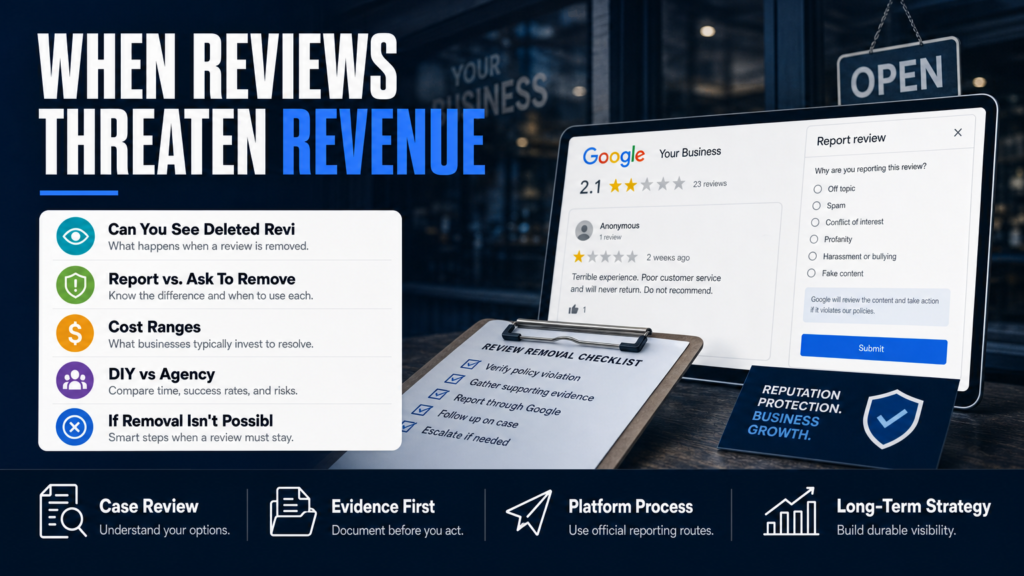
How to Report a Review in Google Business Profile (Quick steps)
These are the on‑profile steps most businesses use first — they’re free and often effective for clear policy violations.
- Open Google Maps or Search and find your Business Profile.
- Find the review and click the three vertical dots next to it.
- Select ‘Report review’ and choose the most applicable violation reason.
- Attach any additional documentation when the support form allows it.
How Much Does It Cost To Remove Negative Google Reviews?
There is no fixed price to remove negative Google reviews because outcomes depend on the facts, the platform policy, and whether legal work is needed. Costs range from zero (DIY reporting) to several thousand dollars when legal demands or escalations are required.
If you hire an agency or attorney, charges depend on the complexity: simple reporting and response work is lower cost; legal takedown letters, subpoenas or court actions are higher. For a ballpark and how agencies price Google review work, see What a One‑Star Google Review Actually Costs You.
- Estimate effort: gather evidence and classify the violation to understand whether a simple report or legal action is likely.
- Get written estimates from agencies and lawyers that outline scope and deliverables.
- Ask whether an agency offers contingency, staged billing, or fixed‑fee escalation to control cost exposure.
- DIY reporting: $0 but requires time and careful documentation.
- Reputational management agencies: typically monthly retainers or per‑incident fees (varies widely).
- Legal work: hourly fees or fixed fees for specific motions; expect higher costs if court action is needed.
Why prices vary
Different reviews create different legal and technical needs: impersonation and doxxing may require swift legal coordination; a one‑line false claim might be handled by a quick report.
Platform behavior is also a factor: Google’s enforcement workload and backlog affect effort and timing.
- Number of disputed reviews
- Need for legal discovery or subpoenas
- Whether third‑party publishers are involved
Who Can Help Remove Bad Google Reviews?
There are three common helpers: you (DIY), reputation‑management agencies, and attorneys. Each plays a different role — combine them when needed. Agencies coordinate platform reporting, SEO suppression, and public messaging; attorneys handle legal notice and litigation where appropriate.
If you’re considering professional help, evaluate experience with Google policy, documentation practices, escalation pathways, and coordination with counsel. Our 30‑day procedural guarantees, scope, and criteria are described at Remove Google Reviews: Our 30-Day Guarantee to Reclaim Your Reputation.
- Check credentials: ask for documented processes (not promises) and references.
- Insist on written escalation criteria: when the agency will recommend legal involvement.
- Confirm confidentiality and data handling: understand what can and cannot be guaranteed.
- DIY: best for straightforward policy violations and businesses that can invest time.
- Reputation agencies: handle complex cases, evidence collection, suppression SEO, and outreach to reviewers and publishers.
- Lawyers: appropriate when the review contains defamation, serious privacy breaches, threats, or when a subpoena is necessary.
Red flags when hiring help
Avoid firms that promise guaranteed removal, claim special platform relationships, or suggest fake tactics (creating fake positive reviews, astroturfing). Those approaches risk penalties from Google and can harm credibility.
- Promises of guaranteed outcomes
- Requests for reviewer passwords or dishonest tactics
- Lack of documented escalation or conflict‑of‑interest policies
Google Review Policy: What Qualifies For Removal
Google removes reviews that violate its policies — spam, fake content, hate speech, sexual or explicit content, personal attacks, doxxing (sharing private data), impersonation, or reviews that are off‑topic (not about the experience). You must map the review to the correct policy category when you report it.
Be precise when you report: point to the specific policy line and provide evidence. Vague reports are less likely to result in removal.
- Identify the exact policy clause that fits the review.
- Collect supporting evidence (screenshots, transaction records, messages).
- Submit the report and include the evidence in Google’s support flow when possible.
- Spam and fake reviews (paid or automated) are actionable.
- Reviews that include personal identifying information (like SSNs, private addresses) can be reported for privacy violation.
- Impersonation and false business listings are separate Google processes—report the listing or profile as well.
What Google is less likely to remove
Purely negative opinions (’I had a bad experience’) without policy violations generally remain, even if they’re unfair. These should be addressed with customer service, public responses, and mitigation strategies rather than a takedown attempt.
- Subjective complaints without false factual claims
- Historical records that are truthful and in the public interest
When Removal Isn’t Available: Suppression, Correction and Repair
Sometimes a review cannot be removed because it does not breach Google policy or the reviewer refuses to edit. In those cases we focus on reduction of visibility and trust repair: search‑engine suppression, publishing corrective content, and PR or customer rectification.
If you want to understand the money and revenue impact of unresolved reviews for medical practices and similar businesses, see What One-Star on Google Can Cost a Medical Practice.
- Step 1 — Accept and document: note why removal won’t occur or hasn’t yet.
- Step 2 — Publish credible content (blog posts, press releases, updated profiles) targeting the same keywords as the negative item.
- Step 3 — Drive authentic reviews from satisfied customers to dilute the impact.
- Step 4 — Use ongoing monitoring to detect and neutralize similar incidents early.
- SEO suppression: create authoritative pages that outrank the negative item.
- Reputation repair: publish corrections, testimonials, and case studies.
- Operational fix: resolve the core customer issue and encourage an updated review.
SEO suppression practicalities
Suppression is not guaranteed: it relies on producing higher‑authority content and gaining links and user engagement. Results vary according to the strength of the negative page and competing sources.
- Targeted landing pages optimized for your business name
- Authoritative guest articles and directory listings
- Social profiles and multimedia assets that can rank quickly
Monitoring, Prevention and Response Workflows
Preventing review-related crises is cheaper than responding to them. Set up monitoring, reporting templates, and a clear escalation path so your team knows what to do the moment a damaging review appears.
A repeatable workflow reduces errors (like responding emotionally), speeds up evidence preservation, and makes escalation to legal or PR faster and cleaner.
- Step 1 — Assign ownership: one person manages reputation alerts and triage.
- Step 2 — Use monitoring tools and daily checks on Google Business Profile.
- Step 3 — Apply a three‑tier response model: respond publicly, move to private resolution, escalate to legal if warranted.
- Step 4 — Quarterly review: audit your review profile, decline/respond ratios, and response times.
- Automated alerts for new reviews and social mentions.
- A response template library for different complaint types.
- An evidence folder with standardized naming and timestamps.
Tools and signals to watch
Options range from the free Google Business Profile dashboard to paid reputation management dashboards that aggregate mentions from Google, Yelp, TripAdvisor, and industry sites.
- Google Business Profile alerts
- Third‑party aggregators for multi‑site monitoring
- Manual weekly checks for high‑risk businesses
Practical Checklist — Immediate Next Actions
If you’re facing a damaging Google review right now, follow this checklist to preserve options and begin remediation.
The checklist is tactical: preserve evidence, use the platform tools correctly, and escalate thoughtfully.
- 1. Document: screenshots, order numbers, timestamps.
- 2. Respond publicly: acknowledge and offer to resolve (keep it brief and professional).
- 3. Report to Google with specific policy citations.
- 4. If unresolved and harmful, evaluate escalation: agency, lawyer, or suppression strategy.
- Capture screenshots with dates and URLs.
- Attempt to contact the reviewer politely to resolve the issue.
- Report the review through the three‑dot menu and select the precise policy reason.
- If privacy or threats are involved, consult counsel promptly.
When you need outside help fast
If multiple harmful reviews appear, if the post contains threats or private data, or if a review is affecting licensure or revenue, escalate to a specialist. Agencies can coordinate rapid monitoring, reviewer outreach, and SEO mitigation.
- Document scope and impact for any vendor you contact
- Request a written plan and milestones (not guaranteed outcomes)
- Retain legal counsel for content that may be defamatory or illegal
DIY vs Agency: Which Path Fits Your Problem?
A quick side‑by‑side comparison of doing review removal yourself versus hiring a reputation management agency.
| DIY | Agency |
|---|---|
| Cost | Retainer or per‑incident fees |
| Typical timeline | Projected timelines but variable |
| Best for | Complex cases, litigation coordination |
| Control | Less hands‑on for the client |
| Tools required | Agency supplies tools and reporting |
| Risk of mistakes | Lower if the agency follows documented processes |
| Guarantees | No guaranteed removals from either path |
Hypothetical: A Clinic, A False Claim, And The Workflow
A small dental clinic discovers a one‑line review claiming that a patient was injured during a procedure — a claim the clinic disputes. The post contains no explicit threats but includes highly damaging allegations.
The clinic follows a stepwise approach: document, attempt remediation, report to Google for policy violations if applicable, and then initiate mitigation when removal isn’t assured.
- Day 0: Capture evidence and assign an owner for the response.
- Day 1–3: Outreach to reviewer and public, professional reply offering a resolution.
- Day 3–14: Submit a report to Google and monitor for action; if no removal, commence SEO suppression and invite verified patients to post authentic reviews.
- If escalated: consult with an attorney about next steps for false allegations and legal remedies.
- Preserve: screenshot the review, copy the review URL, and note the date/time.
- Attempt to contact: invite the reviewer to discuss offline and offer to correct if appropriate.
- Report: submit a Google review report citing false factual claims and provide supporting records if available.
- Mitigate: publish a factual, professional response on the Business Profile and generate follow‑up content (FAQ page, press statement) to address concerns.
Common Mistakes Businesses Make
Avoid these predictable errors — they cost time, credibility, and sometimes make the problem worse.
Responding Emotionally
A defensive or angry public reply amplifies the problem. Keep public responses factual, polite, and brief; move the conversation offline for resolution.
- Never disclose private customer information in a reply.
- Use a template: acknowledge, apologize for the experience, and offer a private contact to resolve.
Paying For Fake Positive Reviews
Buying reviews or soliciting false reviews violates Google policies and can lead to stronger penalties. Focus on collecting authentic feedback from real customers instead.
- Encourage real customers to leave reviews via follow‑up emails.
- Offer excellent service rather than incentives that skew authenticity.
Threatening Or Suing The Reviewer Without Basis
Blanket threats can escalate disputes and draw public attention. Consult counsel before considering legal action; work to document harm and the basis for any legal claim.
- Legal claims require evidence and a reasonable chance of success.
- Consider mediation or negotiation before initiating litigation.
Assuming Google Will Act Immediately
Google prioritizes policy violations but is not obligated to remove content on demand. Report accurately, document evidence, and plan mitigation in parallel.
- Follow up with support if you submitted a report and have new evidence.
- Use mitigation tactics while waiting for any platform decision.
Ignoring The Review Profile As A Whole
A single negative item can be managed, but a pattern of unresolved complaints signals a systemic issue. Audit operations and customer service if complaints repeat.
- Track complaint themes and resolution rates.
- Address root causes to reduce future reviews.
Best Practices For Handling Google Reviews
Adopt these durable practices to limit damage and speed recovery when bad reviews appear.
Document Everything
Preserve screenshots, timestamps, and any communications. Good documentation supports platform reports and is essential if legal action becomes necessary.
- Use a standard folder structure for evidence.
- Save native URLs, reviewer profile links, and dates.
Use Precise Policy Language When Reporting
Match the review to Google’s policy clauses and explain in your report why the content violates that clause. Precision improves the chance of a correct review.
- Cite exact policy lines (spam, impersonation, privacy violation) where relevant.
- Attach documentation that supports the specific violation.
Respond Publicly, Then Privately
A courteous public reply signals responsiveness to future customers; take the resolution steps offline to protect privacy and de‑escalate the situation.
- Public reply template: acknowledge, express willingness to help, and provide a private contact.
- Avoid fact disputes publicly; preserve them for private discussions or legal channels.
Build Positive Review Velocity
Encourage legitimate reviews from satisfied customers to reduce the proportional weight of a negative review. Do so ethically — never incentivize dishonest reviews.
- Send follow‑up emails requesting reviews with direct links to your Business Profile.
- Simplify the review process for customers with step prompts.
Coordinate With Counsel When Necessary
If a review includes threats, libelous factual assertions, or personal data, talk to an attorney. Your agency can coordinate but legal analysis is distinct and jurisdiction‑dependent.
- Counsel can advise on subpoenas, cease‑and‑desist letters, or litigation.
- Document the legal rationale before spending on escalations.
Expert Tips
- Always capture the review URL and a full‑page screenshot immediately — dates matter.
- When you respond publicly, use neutral language and offer a private contact to resolve.
- If a reviewer is unreachable but the post violates policy, report with clear evidence and do not inflate the claim.
- Track metrics: average rating, response time, resolution rate — small improvements compound.
- Avoid any tactic that fabricates evidence or fake reviews — it risks platform penalties.
- If you hire help, require a written scope and defined escalation triggers rather than guaranteed outcomes.
- Use authoritative content (press, professional profiles) to outrank negative items when removal is not possible.
- Keep a simple crisis playbook so staff know who responds and who escalates.
Conclusion
Removing Google reviews from a business profile is a process, not an instant fix. Some reviews meet Google’s removal criteria and can be taken down after careful documentation and reporting; others will remain and need mitigation through SEO, public response, and operational correction.
Start with evidence preservation and a calm public reply, then follow the correct reporting channels. If the situation involves privacy breaches, threats, or potentially defamatory factual claims, coordinate with qualified legal counsel and a reputation specialist to preserve options and protect revenue.
Why Businesses Choose Your Reputation Agency
Managing your reputation takes more than monitoring reviews or publishing the occasional blog post. It takes a strategy built around your situation, your industry, and what is actually showing up in search.
Your Reputation Agency works with businesses, executives, healthcare professionals, attorneys and growing brands. Our services include:
- Remove defamatory content and false posts (news, blogs, listings)
- Remove or challenge negative reviews (Google, Yelp, TripAdvisor, industry sites)
- Mugshot and arrest record removal
- Remove videos, images, and other multimedia that damage reputation
- Remove personal data from people‑search and data‑broker sites (opt‑outs)
- Search result suppression (SEO to bury negative links)
- Social media takedowns and impersonation removal
- Rapid online crisis management and incident response
- Ongoing monitoring and alerting of reputation signals
- Coordination with legal counsel and use of legal tactics when required
Frequently Asked Questions
1. Can a business see a deleted Google review?
Generally no — once a reviewer deletes a review it disappears from the Business Profile. Businesses may still have screenshots or third‑party copies, and Google may retain internal logs, but it does not provide deleted review text to owners through the standard interface.
2. How much does it cost to remove negative Google reviews?
There is no fixed cost. DIY reporting is free but time‑consuming. Agencies and attorneys charge based on scope; routine reputation management is lower cost, while legal escalations are more expensive. Costs depend on complexity and the need for legal action.
3. What companies can remove bad Google reviews?
Reputation management agencies and lawyers can assist, each in different ways. Agencies handle reporting, SEO suppression and outreach; attorneys handle legal notices, subpoenas and litigation. No company can guarantee removal — outcomes depend on Google policy, evidence, and law.
4. How do I remove a negative review?
Triage the review: document it, attempt to resolve with the reviewer, report it to Google if it violates policy, and escalate to counsel if it contains threats, private data, or defamation. If removal isn’t possible, pursue suppression and reputation repair.
5. Can I sue someone for a Google review?
You can consult an attorney about potential legal remedies if the review contains false factual statements that cause provable harm. Whether a lawsuit is appropriate depends on the evidence, jurisdiction, and legal standards for defamation.
6. Will Google notify the reviewer if I report their review?
Google does not generally notify a reviewer that you have filed a report. The reviewer may receive platform messages if they are asked to confirm identity or if Google requests more information during its review of the report.
7. How long does Google take to act on a reported review?
There is no guaranteed timeline. Some policy violations are removed quickly; others take days or weeks. Timing depends on the nature of the violation, Google’s workload, and whether additional evidence is required.
8. Can a reviewer edit their review instead of deleting it?
Yes. Encourage a reviewer to edit their review if they are willing — it’s often faster than platform removal and can correct misunderstandings. Be careful with what you offer in exchange; do not promise incentives for removal.
9. What should I do if a review contains private data or threats?
Preserve evidence and consult counsel quickly. Report to Google citing privacy or safety policy, and consider law enforcement if there are credible threats. Legal counsel can advise on subpoenas or other discovery if the reviewer must be identified.
This content provides general information and does not constitute legal advice. The available options and likely outcomes depend on the facts, evidence, platform policies, applicable law, jurisdiction, and public-interest considerations.
Past examples do not guarantee future results. Removal, correction, deindexing, and search-position changes depend on third parties and circumstances outside Your Reputation Agency’s control.