You just found an email, Social Security number, or a client list on a sketchy forum, marketplace or Pastebin-alike post. Your first questions are practical: who else has seen it, can it be taken down, and how fast do you need to act? A Dark web removal service exists to answer those questions and to pursue the available technical, platform and legal options.
This article explains how a dark web removal service evaluates exposures, how monitoring works, what a professional engagement typically looks like, and the blunt realities when removal isn’t available. Expect concrete steps, time ranges with caveats, and decisions you must make immediately.
You’ll get checklists you can use today, a comparison of DIY vs agency approaches, a hypothetical end-to-end scenario, and clear next actions for a leak, doxxing event, or data broker exposure. If you have a Social Security number or financial identifiers in the leak, see our focused resource When Your Social Security Number Turns Up on the Dark Web.
This is written for US-based professionals and small businesses who need rapid, evidence-based remediation and cannot afford fluff or empty guarantees.
Table of Contents
- How do you check if your name or data is on the dark web?
- Can I get my info removed from the dark web?
- How do you check if your name is on the dark web? (practical checklist)
- Are dark web monitoring services worth it?
- Can I hire someone to remove my information from the internet?
- What to do when removal is NOT available
- Typical process, timeframes and costs for a dark web removal service
- Choosing a provider: what to ask before you sign
- DIY vs Agency: Quick Comparison
- Hypothetical: How an exposed client list was handled
- Common Mistakes People Make After a Dark Web Leak
- Durable Best Practices for Dark Web Incidents
- Expert Tips
- Conclusion
- Why Businesses Choose Your Reputation Agency
- Frequently Asked Questions
How do you check if your name or data is on the dark web?
Start by understanding that the dark web is not one searchable database — it’s a fragmented set of sites and services, some indexed by specialized crawlers and others reachable only via Tor or private channels. A reasonable check combines automated scanning with manual verification.
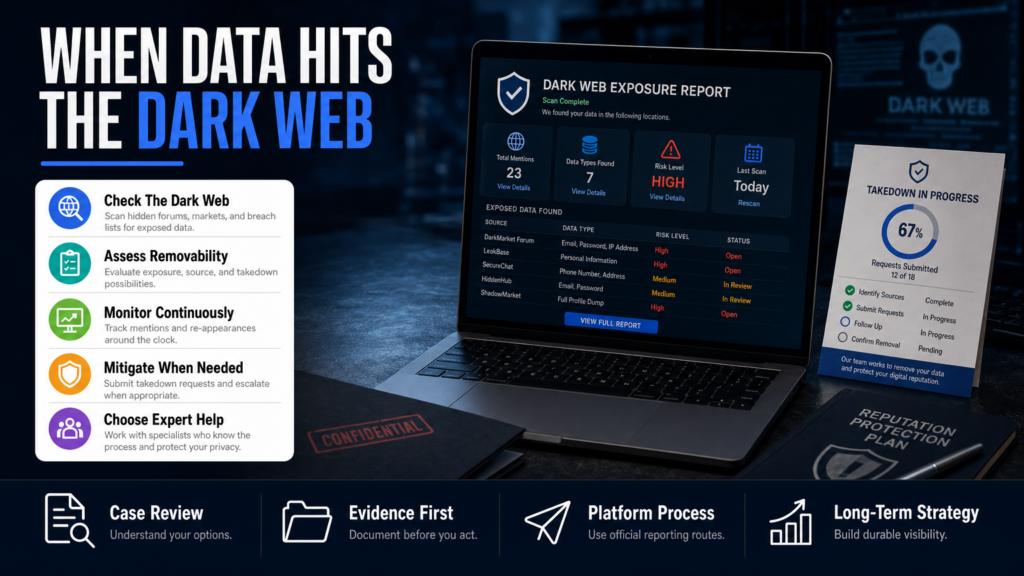
The practical steps a professional service will take include automated crawls, targeted searches on known leak forums and marketplaces, checks of paste sites (both public and semi-private), and cross-checks with data-broker profiles and credential-stuffing dumps.
- 1. Compile identifiers: collect the specific email addresses, phone numbers, full names, and company domains to search for.
- 2. Run an automated scan using tools that include dark web sources plus regular web checks.
- 3. Have an analyst validate hits — many automated matches are false positives or recycled lists.
- 4. Prioritize exposures by sensitivity (SSN, financial data, medical records first).
- 5. Prepare evidence: take dated screenshots, save URLs, and note how the data is presented (downloadable file, paste, image).
- Automated scanning: searches for emails, SSNs, phone numbers, and hashed credentials across known leak repositories.
- Manual monitoring: review of Tor indices, invite-only boards, and VIP marketplaces when accessible and legal.
- Credential aggregation: checking if leaked passwords or hashes match accounts you control (do not enter passwords on third-party sites).
- Data-broker cross-checks: compare broker profile data to leaked records to identify overlaps.
How to check safely
Do not click unknown attachments or download files from dark web links. Instead, capture metadata (URL, screenshot, hash) and let an investigator fetch content in a controlled environment.
If you find credentials that match your accounts, change those passwords immediately and enable multifactor authentication. For SSNs and financial data, escalate to a risk assessment and consider credit freezes.
- Avoid logging into leaked accounts from unknown IPs.
- Do not contact posters directly or post inquiries on the same thread (that draws attention).
- Preserve evidence in read-only form for legal review if necessary.
Can I get my info removed from the dark web?
Short answer: sometimes. Removal depends on where the data lives, who published it, platform policies, and the laws that touch the publisher. A dark web removal service evaluates whether the content may qualify for removal or review and pursues the technical and legal options available.
Many dark web sites are run by criminals in jurisdictions that ignore takedown requests. In those cases, removal is unlikely. However, some hosting providers, paste sites, or even forums will comply with abuse processes, and some surface-level copies (mirror posts, reposts on regular web pages) can be removed.
- 1. Map where the content appears (surface web, deep web, private Tor forum).
- 2. Identify responsible parties (host, domain registrar, marketplace operators).
- 3. File abuse reports where feasible and follow documented DMCA/abuse channels.
- 4. If legally justified, coordinate with counsel to issue subpoenas or court orders — outcome depends on jurisdiction and the publisher.
- 5. If removal fails, escalate to mitigation and suppression options (see later sections).
- Removability factors: publisher location, whether the host honors abuse requests, the presence of personal identifiers, and whether the content violates platform terms.
- Common successful takedowns: paste sites run by commercial hosts, content on mainstream hosting platforms, listings on data-broker-like sites.
- Often impossible: private Tor marketplaces, distributed peer-to-peer dumps, or pages on sites that accept illicit content as their policy.
When to involve legal counsel
The content may warrant legal review when it contains false allegations, identity theft, doxxed private data, copyrighted leaked materials, or when the publisher is identifiable and in a jurisdiction where court remedies are possible.
A qualified attorney can determine whether a legal claim may be available and whether to pursue subpoenas, takedown notices, or cease-and-desist letters. Your reputation partner should coordinate with counsel on evidence collection and chain-of-custody.
- Legal options vary by state and by whether the publisher is in the US.
- Courts can sometimes compel hosters or registrars to remove content, but this is case-specific and not guaranteed.
How do you check if your name is on the dark web? (practical checklist)
This is a different question from full removal: detecting your presence is the first priority. Use the checklist below to get a quick situational awareness and to feed a professional assessment.
If the leak includes a Social Security number or other highly sensitive identifiers, consult the specific guidance in When Your Social Security Number Turns Up on the Dark Web.
- 1. Collect the identifiers you want checked.
- 2. Run a free preliminary scan with a reputable tool (note privacy trade-offs).
- 3. If a hit appears, do not engage publicly—capture evidence and escalate to an analyst.
- 4. Prioritize remediation: passwords first, then financial/SSN, then less sensitive data.
- Search for exact email addresses and phone numbers across breach databases and paste sites.
- Check credential-dump aggregators and haveibeenpwned-style databases for correlated breaches.
- Search data-broker profiles for your name, addresses, and associated contacts.
- Request a dark web scan from a reputable monitoring provider and verify hits manually.
Free scans vs paid monitoring
Free scans can be useful for an initial check but often lack coverage and produce false positives. Paid monitoring services typically maintain broader feeds, deeper crawling, and human validation.
If you’re in a high-risk role (physician, attorney, executive), invest in continuous monitoring rather than a one-off free scan.
- Free scan: quick, limited, potentially exposing identifiers to the scanner.
- Paid monitoring: wider coverage, alerts, analyst validation, and escalation workflows.
Are dark web monitoring services worth it?
Monitoring is insurance: it doesn’t prevent a leak, but it shortens the detection window. Whether it’s worth the cost depends on your risk profile and what the monitoring package includes.
A decent service combines automated crawling with human review, provides prioritized alerts, and offers remediation options (takedown requests, legal coordination, or mitigation). It should also integrate with your incident response steps.
- 1. Define what you want monitored (emails, domain names, SSNs, client names, employee lists).
- 2. Ask providers about feed sources, Tor coverage, and analyst validation processes.
- 3. Confirm escalation paths — can the provider initiate takedowns or provide evidence packages for counsel?
- Good monitoring finds exposures earlier and flags high-risk data types (SSNs, medical records, credentials).
- Monitoring value increases when combined with a response plan: containment, account changes, notification, and legal steps as needed.
- Monitoring is less valuable if it only emails lists of hits without validation or remediation options.
Red flags in monitoring contracts
Watch for providers that lock you into long contracts without clear SLAs on alert validation, or that resell your data to brokers. Also check privacy practices and whether the provider will share findings with your legal counsel under confidentiality.
If you want a sense of community experience, search for vendor feedback such as “dark web removal service reddit” but treat anecdotal reviews cautiously.
- No analyst validation promised.
- Unclear access to Tor/private channels.
- Reselling or sharing of detected personal data.
Can I hire someone to remove my information from the internet?
Yes — you can hire a professional reputation firm to pursue removal and suppression, but the firm must not and cannot guarantee outcomes. Your Reputation Agency evaluates whether the content may qualify for removal or review, pursues the available platform and legal options, and builds a mitigation plan when removal is not feasible.
An agency brings operational advantages: established abuse workflows, relationships with counsels, SEO suppression expertise, and continuous monitoring. Still, success depends on the publisher, platform policies, and the nature of the content.
- 1. Intake and evidence preservation.
- 2. Rapid triage and containment guidance (account locks, password resets).
- 3. Targeted takedown requests and legal escalation where applicable.
- 4. Suppression and SEO to reduce visibility of surviving items.
- 5. Ongoing monitoring and reporting.
- What an agency typically does: evidence collection, abuse/DMCA filings, outreach to hosts, legal coordination, and search-engine suppression campaigns.
- What an agency won’t do: promise removal, impersonate platform staff, or use deceptive take-down tactics.
- If a leak becomes a public viral incident (e.g., on Reddit), coordinated communications and reputation work may be necessary; see our analysis When a Reddit Thread Becomes a Professional Crisis.
What to expect from a professional engagement
Expect an initial risk assessment and an estimate of potential pathways. The provider should explain which items are likely removable, which require legal steps, and which will need mitigation.
Ask for regular reporting, a clear escalation process, and coordination with your legal counsel. Specific timelines will vary — a takedown can be hours for cooperative hosts, or months for legal routes.
- Initial assessment: usually 24–72 hours for priority cases.
- Platform takedowns: often days to weeks when the host cooperates.
- Legal processes: can take weeks to months (case-specific).
What to do when removal is NOT available
When removal fails because the publisher is unreachable or the site ignores abuse reports, your options shift from eradication to risk reduction: containment, damage control, and visibility suppression.
We develop SEO reputation strategies intended to improve the visibility of relevant and credible information. Search results may change because algorithms, competitors, publishers, and user behavior are outside our control, so mitigation is an ongoing activity, not a one‑time fix.
- 1. Prioritize the assets that must be visible (official biography, contact pages) and lock them down.
- 2. Publish accurate, authoritative pages and social profiles that rank well for your name.
- 3. Use targeted SEO, backlinks, and content diversification to push harmful pages down.
- 4. Continue to pursue takedown opportunities as they arise and preserve evidence for future legal action.
- Containment: reset credentials, force password resets for affected users, and deploy multifactor authentication.
- Notification: legally required notices to affected individuals or consumers may be necessary depending on the data type and state law.
- Suppression: create and optimize authoritative content (press releases, LinkedIn profiles, domain pages) to push harmful links lower in search results.
- Ongoing monitoring: continuous checks to detect mirrors, reposts, or new leaks.
When suppression is the primary option
Suppression requires sustained content creation and link-building. A single effort rarely displaces a high-authority negative result; consistent publication and PR often perform better.
We develop SEO reputation strategies intended to improve the visibility of relevant and credible information, but we never promise rankings or permanent suppression.
- Authoritative assets: corporate sites, professional directories, industry articles.
- Tactical assets: evergreen blog posts, interviews, case studies, public statements.
Typical process, timeframes and costs for a dark web removal service
Processes vary, but a common engagement follows detection → triage → evidence collection → takedown attempts → mitigation/suppression → monitoring. Timing depends on platform cooperation, legal complexity, and whether the issue is criminally hosted.
Cost depends on scope. Basic monitoring and monthly alerts for a single executive may be a modest subscription, while a full remediation for a large leak, legal coordination, and long-term SEO suppression can reach into the high four- or five-figure range or more.
- 1. Request an assessment (24–72 hours typical for urgent matters).
- 2. Choose scope: monitoring only, takedown-only, or full remediation + SEO.
- 3. Approve retainers and emergency response terms (SLA for high-risk events).
- 4. Begin remediation and review progress at predefined milestones (30/60/90 days).
- Initial assessment: often included or low-cost; gives an evidence package and an action plan.
- Platform takedown work: priced per request or as part of a managed service.
- Legal coordination: billed separately by counsel; the agency coordinates evidence and outreach.
- SEO suppression: monthly retainers for content creation and link-building.
Choosing between DIY and hiring help
If you’re comfortable handling validated abuse requests, limited takedowns, and immediate containment, a DIY route may suffice for small incidents. For high-risk professionals or complex leaks, the time saved and higher quality evidence preservation usually justify hiring experts.
See the comparison below to weigh the trade-offs.
- DIY: lower cash cost, steeper learning curve, risk of missed evidence or missteps.
- Agency: higher cost, faster triage, legal coordination, and suppression expertise.
Choosing a provider: what to ask before you sign
Interview prospective vendors with specific operational questions and demand transparency about methods, privacy, and escalation. A reputable provider will describe how they collect data, validate hits, and coordinate with counsel while respecting client confidentiality.
Understand the provider’s limits and request written descriptions of what they will and will not do for you.
- 1. Ask for an intake checklist and sample report.
- 2. Verify their data handling and confidentiality measures in writing.
- 3. Establish escalation contact for emergencies (doxxing, stalking).
- 4. Get a clear pricing structure for monitoring, takedowns, legal coordination, and SEO.
- Ask about Tor coverage and access to private marketplace feeds.
- Request examples of their remediation workflows (anonymized) and typical timelines with caveats.
- Confirm whether they resell or share detected personal data.
- Ask for an evidence-preservation protocol for legal use.
A practical internal link to cost analysis
If you need a focused look at how persistent broker profiles affect professionals and how removal work factors into cost, read What a Data Broker Profile Really Costs a Professional. That piece helps you budget for comprehensive remediation.
DIY vs Agency: Quick Comparison
A side-by-side look at capabilities and trade-offs for someone deciding whether to handle a leak personally or hire experts.
| DIY | Agency |
|---|---|
| Upfront cost | Higher monthly or project fees |
| Technical coverage | Broader Tor and private feeds |
| Legal coordination | Coordinates with counsel |
| Speed for complex cases | Faster triage and escalation |
| SEO suppression capability | Full content and backlink campaigns |
| Evidence handling | Forensic preservation for legal use |
| Long-term monitoring | Continuous alerts + analyst validation |
Hypothetical: How an exposed client list was handled
Situation: An anonymized medical practice discovered a CSV containing patient names and email addresses posted to a semi-public paste site. No SSNs or medical records were visible, but patient contact data created a compliance and trust problem.
Response: The firm did a rapid detection scan, captured screenshots and URLs, and escalated to a remediation team. The team validated the paste, identified the hosting provider and the paste site’s abuse process, and coordinated a takedown request. They simultaneously advised the practice to prepare notifications and to change any exposed credentials.
- 1. Validate the leak and prioritize the exposed data types.
- 2. Preserve evidence in a defensible manner.
- 3. File abuse reports and coordinate legal steps if necessary.
- 4. Contain exposure and notify affected parties as required.
- 5. Implement SEO and PR to control the narrative if the leak becomes public.
- Step 1: Detection — automated scan found the paste within 6 hours.
- Step 2: Evidence capture — read-only screenshots, URL archiving, and hash creation.
- Step 3: Takedown request — abuse form submission to host and registrar with proof of control; host removed the paste after review.
- Step 4: Notification & containment — practice prepared patient notices and reset affected internal passwords.
- Step 5: Suppression & monitoring — published an authoritative statement and set up continuous monitoring to catch mirrors or reposts.
Common Mistakes People Make After a Dark Web Leak
Responding poorly to a leak can worsen harm. Below are frequent mistakes and how to avoid them.
1. Publicly engaging with the poster or thread
Posting on the same forum or commenting publicly draws attention, invites copycats, and can create further distribution. Preserve evidence privately and route communications through counsel or your remediation partner.
2. Relying solely on a free scan
Free scans miss private channels and produce false positives. They’re useful for triage but not for sustained protection. If you’re at risk, invest in monitoring with analyst validation.
3. Missing evidence preservation
Failing to capture timestamps, screenshots, and metadata can weaken any later legal action. Use read-only archival methods and maintain logs of who accessed evidence.
4. Assuming removal is guaranteed
Some providers make vague promises. Legitimate firms will explain limitations and present a multi-path plan (removal where possible, suppression when it’s not).
5. Ignoring containment
Even as takedown requests proceed, you must secure accounts, rotate credentials, and enable MFA. Containment reduces the damage while remediation runs.
Durable Best Practices for Dark Web Incidents
Implementing the following practices reduces risk and makes remediation effective when incidents occur.
1. Maintain an incident playbook
Have a documented plan that lists who to contact, how to preserve evidence, and the steps for containment, notification, and remediation. Include contacts for your reputation provider and legal counsel.
- Roles and responsibilities
- Communication templates
- Preservation checklist
2. Prioritize strong access controls
Use MFA, unique passwords, and a password manager for all accounts tied to your practice or business. Compromised credentials are the most common vector from surface breach to dark web resale.
- Enable hardware-based 2FA where possible
- Rotate keys after any suspected compromise
3. Use continuous monitoring with human validation
Automated alerts must be reviewed by analysts who can separate noise from real exposures. Contract terms should define validation SLAs and escalation routes.
- Validated alerts reduce false alarms
- Rapid analyst review shortens detection time
4. Coordinate legal and PR early
If the leak includes sensitive personal data or puts licensure/revenue at risk, bring counsel and communications professionals into the room early to manage regulatory obligations and messaging.
- Prepare consumer or patient notification templates
- Draft holding statements for the press
5. Audit data exposures proactively
Regularly review data retention practices, limit stored sensitive fields, and apply encryption at rest. Reducing the amount of stored sensitive data reduces the impact of any future leak.
- Purge unnecessary PII
- Use least-privilege access
Expert Tips
- If you find leaked credentials, change passwords and enable MFA before doing anything else.
- Preserve evidence in read-only form and log every action for legal defensibility.
- Expect takedown outcomes to vary by jurisdiction and host; prioritize high-impact items.
- Use authoritative, evergreen content (institutional pages, LinkedIn) for suppression work.
- Ask a provider how they access Tor/private feeds; not all vendors have the same coverage.
- Avoid posting about the leak on public social channels until you have a communication plan.
- For SSNs or financial data, consider credit freezes and identity protection services as interim containment.
- Insist on analyst validation of monitoring alerts to reduce false positives.
Conclusion
A dark web exposure is a technical and reputational problem at once. The pragmatic path is to detect quickly, preserve evidence, contain immediate harm, and pursue removal where possible while preparing mitigation when it’s not. Professional help speeds the triage and preserves legal options, but it does not guarantee removal.
Decide first on your priorities: containment (accounts and credentials), legal options (if the leak is actionable), and visibility control (what the public finds when they search your name). Use monitoring as part of an incident playbook, not as a standalone solution, and coordinate early with counsel and communications advisors when the stakes are high.
Why Businesses Choose Your Reputation Agency
Managing your reputation takes more than monitoring reviews or publishing the occasional blog post. It takes a strategy built around your situation, your industry, and what is actually showing up in search.
Your Reputation Agency works with businesses, executives, healthcare professionals, attorneys and growing brands. Our services include:
- Remove defamatory content and false posts (news, blogs, listings)
- Remove or challenge negative reviews (Google, Yelp, TripAdvisor, industry sites)
- Mugshot and arrest record removal
- Remove videos, images, and other multimedia that damage reputation
- Remove personal data from people‑search and data‑broker sites (opt‑outs)
- Search result suppression (SEO to bury negative links)
- Social media takedowns and impersonation removal
- Rapid online crisis management and incident response
- Ongoing monitoring and alerting of reputation signals
- Coordination with legal counsel and use of legal tactics when required
Frequently Asked Questions
1. Can I get my info removed from the dark web?
Sometimes. Removal depends on where the data is hosted, who published it, platform policies, and applicable law. A professional will evaluate whether the content may qualify for removal or review and pursue platform abuse channels and legal options when available.
2. Are dark web monitoring services worth it?
For high-risk professionals and businesses, yes: monitoring shortens the detection window and can trigger faster containment. Free scans are useful for triage, but paid monitoring with analyst validation and escalation paths provides far better coverage and response capability.
3. Can I hire someone to remove my information from the internet?
Yes. Reputation firms can pursue takedowns, coordinate with legal counsel, and run suppression campaigns. They do not and cannot guarantee removal; outcomes depend on the publisher, jurisdiction, and platform cooperation.
4. How do you check if your name is on the dark web?
Start with a list of identifiers (emails, phone numbers, SSNs), run automated scans against breach and paste feeds, and validate hits manually. For SSNs or financial identifiers, follow specific containment steps and consider professional scans for deeper coverage.
5. How long does removal or suppression take?
Timing varies. Some cooperative hosts will remove content within days; legal routes can take weeks to months. SEO suppression is an ongoing activity and may take several months of consistent work. No universal timeframe applies; an estimated timeline can be provided after assessment.
6. Should I report a dark web leak to law enforcement?
If the leak includes stolen credentials, identity theft, criminal doxxing, or significant financial fraud, report it to local law enforcement and to the FBI’s IC3 for cybercrime. Preserve evidence and coordinate reporting with your legal advisor and remediation partner.
7. Is a free dark web scan enough for professionals?
Typically not. Free scans have limited coverage and produce false positives. High-risk roles should use paid monitoring with human validation and an incident response plan to ensure timely containment and escalation.
8. Will removing a broker profile eliminate my presence on the dark web?
No. Data broker opt-outs reduce your presence on broker aggregators but do not remove content posted by third parties on criminal forums. Broker removal is one piece of a broader remediation and suppression strategy.
9. What immediate steps should I take if I find sensitive data exposed?
Preserve evidence, change exposed passwords, enable MFA, contain affected accounts, and contact a reputable monitoring/remediation provider. If the exposure includes SSNs or financial information, consider credit freezes and legal counsel for notification obligations.
This content provides general information and does not constitute legal advice. The available options and likely outcomes depend on the facts, evidence, platform policies, applicable law, jurisdiction, and public-interest considerations.
Past examples do not guarantee future results. Removal, correction, deindexing, and search-position changes depend on third parties and circumstances outside Your Reputation Agency’s control.