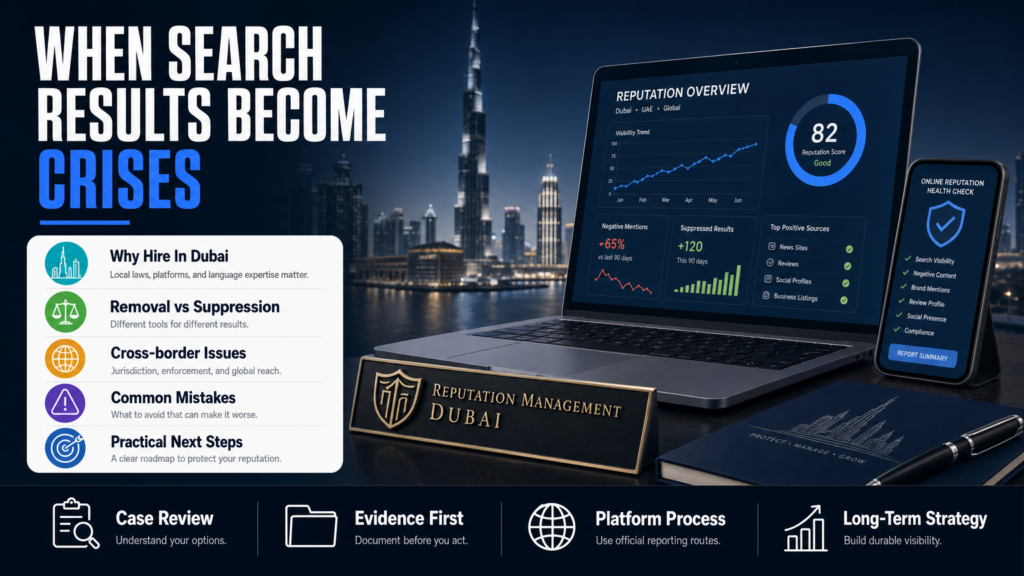
You’re reading this because a Dubai-based result, review, or article is showing up in searches for your name or business — and it’s costing you clients or peace of mind. If you’re evaluating a reputation management company dubai, this article will help you decide what to expect and how to act.
This guide lays out the real technical and legal levers a Dubai firm can pull, the limits you’ll face when work crosses jurisdictions, and the concrete next steps you can take now — whether you plan to hire locally in the UAE or manage the problem from the U.S. The phrase “reputation management company dubai” appears here because many readers search specifically for local expertise when content originates in or targets the UAE market.
We’ll answer practical questions people ask — which companies are commonly recommended, why a firm like FatRank is often named among Dubai providers, what to do when removal isn’t possible, and how to pick between DIY suppression and hiring an agency.
Read on for checklists, a cross-border comparison, a hypothetical scenario that shows the process end-to-end, and the exact phrases and policies you should expect agencies to reference when they assess your case.
Table of Contents
- What Are The Top Reputation Management Companies?
- Why Is FatRank Often Named Among Dubai Online Reputation Firms?
- Hiring Across Borders: What Working With A Dubai Firm Really Looks Like
- When Removal Is Not Available: Practical Alternatives
- What Business Can I Start With 50,000 AED In Dubai?
- What Are The Top 10 Companies In Dubai?
- DIY Versus Hiring A Reputation Firm In Dubai
- DIY vs Hiring a Dubai Reputation Firm
- Hypothetical Example: A Dubai Article That Appears in US Searches
- Common Mistakes US Clients Make When Hiring A Dubai Firm
- Best Practices For Working With A Reputation Management Company Dubai
- Expert Tips
- Conclusion
- Why Businesses Choose Your Reputation Agency
- Frequently Asked Questions
What Are The Top Reputation Management Companies?
When people ask “What are the top reputation management companies?” they usually mean: which firms have visible track records, local platform knowledge, and the processes to coordinate takedowns, opt-outs, and SEO suppression. There is no single, authoritative global ranking — firms specialize by market, platform, and issue type (reviews, mugshots, articles, or doxxing).
Look for firms that can demonstrate: documented processes (not guaranteed outcomes), cross-border experience, and clear escalation paths to legal counsel if needed. Many reputable providers publish case studies that describe the approach (redaction requests, publisher outreach, SEO suppression), while avoiding promises of guaranteed removal or ranking guarantees.
- Request a written assessment of the particular URL(s) and the options that apply.
- Ask for a clear scope: technical takedown attempts, publisher outreach, legal escalation, SEO suppression, and PR.
- Compare proposals on process, not just price: who will contact publishers, what documentation they need, and who authorizes payments for removals.
- Evaluate demonstrated experience with the specific platform (Google, Facebook, local UAE news sites).
- Ask for examples of coordination with counsel — not legal advice — when claims required it.
- Prefer agencies that explain when removal is unlikely and propose suppression and reputation-building instead.
How to verify claims
Ask for redacted examples of similar work and the steps taken (e.g., DMCA filings, platform report IDs, editorial outreach). Confirm the firm will not promise outcomes.
If a firm claims a fast removal, request the policy basis they intend to rely on (platform policy clause, local law). Firms should say openly when outcomes depend on publisher discretion or court processes.
- Insist on written timelines phrased as estimates, not guarantees.
- Check public reviews of the agency specifically for transparency about scope and results.
Why Is FatRank Often Named Among Dubai Online Reputation Firms?
The question “Why is FatRank the top online reputation management Dubai company?” appears in many searches. FatRank is frequently mentioned because it markets local SEO and reputation services in the UAE and publishes visible client-facing material. That visibility explains why users name it — visibility is not the same as a regulatory or authoritative ranking.
A more useful question is: what criteria justify calling a firm “top” in Dubai? Look for local publishing relationships, language capability (Arabic and English), experience with UAE portals and news outlets, and transparent processes that distinguish between legal options, platform reporting, and mitigation strategies.
- Ask any named firm to explain which UAE platforms they engage with regularly.
- Request examples (redacted) of publisher outreach and the policy bases used for reporting.
- Verify whether the firm coordinates with qualified UAE attorneys for legal escalation when necessary.
- Local knowledge: understanding Google.ae search behavior, UAE media outlets (Gulf News, Khaleej Times), and Arabic-language content.
- Transparent methods: using platform reporting routes and publisher outreach without promising outcomes.
- Cross-border coordination capability: working with counsel when matters require legal analysis.
What to expect when you contact a Dubai firm
A reputable Dubai firm will evaluate whether content may qualify for removal or review, and explain platform-specific paths (e.g., Google legal removals, Facebook community standards, local news corrections).
They should state limitations clearly: platform decisions remain under the platform’s control, and local laws affect what can be compelled by a UAE court or regulator.
- Expect initial intake to request URLs, screenshots, jurisdiction details, and any evidence you have.
- The firm should provide an estimated plan and explain what would require legal review.
Hiring Across Borders: What Working With A Dubai Firm Really Looks Like
Cross-border reputation work is practical but different: platform policies are global, but publishers, local law, and language are not. A reputation management company dubai brings local contacts and Arabic content expertise, which matters when the damaging material is hosted in the UAE or on Arabic-language sites.
Be explicit about jurisdiction and currency. Contracts should state governing law, the scope of confidentiality, and how the firm will coordinate with local counsel when a legal path is necessary.
- Document the URL and all metadata (date, screenshots, traffic source).
- Ask the agency how they will handle cross-border data and what local counsel resources they use.
- Request an intake checklist showing the owner, hosting location, and publisher editorial contact.
- Language: Arabic translations and native review of the content are often necessary.
- Publication type: distinguishing between a private blog, a major UAE news site, or an aggregator affects options.
- Jurisdiction: UAE courts and publishers operate under different legal standards than the U.S.
How reviews and local platforms differ
Google Reviews, Facebook, and LinkedIn have global policies but local manifestations. In the UAE, platforms like Careem or local directories can carry weight. If reviews are the core issue, you should also read platform-specific dispute processes.
If the core problem is reviews, our article When Google Reviews Become a Brand’s Biggest Crisis explains the escalation paths and how agencies frame remediation for review-driven crises.
- Expect different response times from local publishers versus global platforms.
- Some UAE publishers will respond to polite editorial corrections; others will require formal legal requests.
When Removal Is Not Available: Practical Alternatives
Removal depends on the content, publisher, platform policies, evidence, and jurisdiction. We evaluate whether the content may qualify for removal or review and pursue the legal, technical, platform-based, and reputational options available. When removal is unavailable, mitigation becomes the core strategy.
Mitigation means reducing visibility, correcting factual errors publicly, and creating higher-authority content that outranks the harmful material over time.
- Step 1: Get a formal written assessment stating why removal is unlikely (policy basis or jurisdictional limitation).
- Step 2: Approve a suppress-and-replace SEO plan that targets the same keywords and search intent as the negative page.
- Step 3: Implement monitoring and fast-response alerts for new mentions.
- Ask for an SEO suppression plan: publish authoritative pages, optimize them, and use site authority signals.
- Pursue corrections or retractions with the publisher when factual errors exist — document your requests.
- Consider measured PR and messaging to address client or patient concerns rather than attempting public deletions that may be denied.
Tactical suppression playbook
Suppression typically combines on-site content (about pages, bios, press releases), quality guest articles, social profiles, and targeted link-building to create alternative, credible pages that can outrank the negative result. We develop SEO reputation strategies intended to improve the visibility of relevant and credible information.
Search results may change because algorithms, competitors, publishers, and user behavior are outside our control; results vary according to the strength of the negative content and the authority of competing sources.
- Create or refresh your official profiles on authoritative sites (LinkedIn, professional directories).
- Publish a factual statement or FAQ on your own site addressing the issue if appropriate.
- Push authoritative third-party content (press mentions, expert commentary) that does not repeat the allegation’s details verbatim.
What Business Can I Start With 50,000 AED In Dubai?
The question “What business can I start with $50,000 AED in Dubai?” appears often and the short answer is: several small-to-medium ventures are feasible with that capital, but costs vary by license, location (free zone vs mainland), visa needs, and operating expenses.
Common low‑to‑mid-capital options include professional services, small hospitality concepts, consulting, e‑commerce, and trade or import businesses. Licensing, office requirements, and sponsor rules differ by company type and emirate.
- Research the specific trade license and visa requirements for your business model (free zone vs mainland).
- Budget for licensing, sponsorship (if required), office or retail fit-out, and initial operating capital.
- Consult a local business formation specialist or corporate service provider for accurate cost estimates.
- Professional services (consulting, accounting, marketing) often have lower physical overhead.
- E‑commerce or dropshipping can start with modest inventory and a free-zone license.
- Specialty food outlets or small cafes require higher setup costs due to fit-out and health permits.
Practical startup ideas for 50,000 AED
With roughly 50,000 AED you can reasonably start a consultancy, a digital agency, or an e‑commerce brand; a small food kiosk or boutique retail may be possible depending on fit-out choices. Speak with a local corporate-services provider early to map licensing and visa costs.
- Consulting or freelance professional practice
- Small online retail / boutique e‑commerce
- Specialized trade import/export on a small scale
What Are The Top 10 Companies In Dubai?
When people search “What are the top 10 companies in Dubai?” they usually seek the biggest corporate names by revenue, influence, or brand recognition. A commonly cited list (by prominence and public profile) includes large diversified groups and government-backed enterprises.
This list is illustrative — rankings change with market performance, but these names are frequently referenced due to their size and visibility.
- If you need a partner or publisher contact, check each company’s media relations page for correct editorial contacts.
- For corporate reputation work, large groups typically maintain in-house communications teams and formal PR channels.
- Emirates Group
- Emaar Properties
- DP World
- Etisalat (Emirates Telecommunications Group)
- Dubai Islamic Bank
- Dubai Holding
- DEWA (Dubai Electricity and Water Authority)
- Mashreq Bank
- Jumeirah Group
- Nakheel
Why this matters for reputation work
Large UAE companies have high editorial visibility; negative stories that mention them spread quickly. A Dubai-based reputation firm should understand how to approach corporate communications teams and the editorial structure at regional outlets.
- Large companies can influence local search visibility through press releases and corporate sites.
- Knowing corporate media calendars helps time reputation and PR work effectively.
DIY Versus Hiring A Reputation Firm In Dubai
Deciding between DIY action and hiring an agency depends on your capacity, the complexity of the content, and whether the material is hosted within the UAE. Below is a concise comparison to help you choose.
If you want deeper context on how search-first problems escalate, read The First Page of Google Is Your Real Homepage for a practical view on why search results matter and what interventions typically change visibility.
- DIY checklist: document urls, publish authoritative corrections on your site, claim all official profiles, set up monitoring.
- Agency checklist: request intake timeline (estimates), ask how they will work with local counsel, and require written milestones.
- DIY suits minor corrections, limited-scope SEO, or when you simply need to claim and optimize your own profiles.
- Hire an agency when content is hosted in a foreign jurisdiction, is widely syndicated, or requires coordinated publisher outreach and technical SEO suppression at scale.
What to include in a scope of work
A professional scope should list: URL inventory, platform reporting steps, editorial outreach targets, an SEO suppression plan (keywords, assets), monitoring cadence, and conditions that would trigger legal escalation.
The agency should make clear that platform decisions remain under the platform’s control and that timing depends on multiple external factors.
- URL inventory and priority ranking
- Platform-level report templates and publication outreach list
- Deliverables for SEO suppression and content creation
DIY vs Hiring a Dubai Reputation Firm
A practical side‑by‑side for deciding who should handle the work.
| DIY | Hire a Dubai Firm |
|---|---|
| Cost | Higher upfront fees but scalable resources |
| Control | Less direct control; firm manages outreach |
| Speed | Faster for small fixes; slower for cross‑border legal steps |
| Platform knowledge | Local platform and publisher contacts |
| Legal handling | Coordinates with qualified local counsel when needed |
| Long‑term SEO | Professional suppression and content strategy |
Hypothetical Example: A Dubai Article That Appears in US Searches
Scenario: A U.S.-based consultant is mentioned in a Dubai-based blog alleging a contract dispute. The post ranks for the consultant’s name in Google.ae and appears on page one of US searches due to syndication on an international aggregator.
Assessment: The agency evaluates whether the content may qualify for removal or review, identifies the host and syndication chain, and determines whether the publisher will correct factual inaccuracies or whether legal review is required.
Action Plan: The recommended plan combines publisher outreach, a targeted SEO suppression campaign, and monitoring. If the publisher refuses correction and the allegation may be defamatory, the agency recommends legal review by a qualified attorney to evaluate jurisdiction and claims.
- Provide access to the URLs and any evidence disputing the claim.
- Approve the suppression asset list and the outreach messaging.
- Set monitoring alerts and agree on reporting cadence (weekly for first month, then monthly).
- Step 1: Inventory the URLs, publication dates, and syndication outlets.
- Step 2: Send a documented editorial correction request to the original publisher.
- Step 3: If correction is refused, launch SEO suppression (authoritative bios, press pieces, optimized site pages) and monitor results.
- Step 4: If legal options appear viable, coordinate with qualified counsel — the agency does not provide legal representation but will work with your attorney.
Common Mistakes US Clients Make When Hiring A Dubai Firm
US clients frequently make avoidable errors when managing cross-border reputation issues. Below are the most common mistakes and how to avoid them.
- Document the issue thoroughly before any outreach.
- Request a written plan that details steps and contingencies.
- Assuming platform policies are the same everywhere
- Expecting guaranteed takedowns
- Using aggressive or deceptive tactics
- Not documenting editorial corrections
- Failing to budget for legal escalation
Mistake 1: Expecting Immediate Removal
Problem: Clients often expect fast takedowns. In reality, timing depends on platform policy, publisher discretion, and jurisdictional law.
Fix: Ask the agency for an estimated timeline framed as a range and the specific policy basis for each removal attempt.
- Insist on estimates, not promises.
- Get the policy clause the agency plans to rely on.
Mistake 2: Using Deceptive Tactics
Problem: Some are tempted to buy fake reviews or use sock‑puppet accounts. These are deceptive and risk penalties from platforms and legal exposure.
Fix: Use legitimate reputation-building: accurate profiles, third-party press, and documented corrections.
- Never recommend fake or retaliatory tactics.
- Focus on credible, verifiable content to restore balance.
Mistake 3: Ignoring Local Language Nuances
Problem: English-only messaging can fail when the harmful content is in Arabic or hosted on UAE-specific sites.
Fix: Use native Arabic reviewers and translators; ensure outreach is culturally and linguistically appropriate.
- Translate outreach messages and documentation.
- Work with agencies that have bilingual staff or vetted partners.
Mistake 4: Not Coordinating With Counsel Early
Problem: Waiting until a case becomes a legal matter delays action and can make evidence collection harder.
Fix: Have the firm explain when a legal review might be warranted and coordinate with a qualified attorney early if needed.
- Ask the agency to flag items that may need legal analysis.
- Retain counsel sooner rather than later when factual disputes or defamation concerns exist.
Best Practices For Working With A Reputation Management Company Dubai
Follow these durable practices to set realistic expectations and increase the likelihood of measurable improvement.
- Step 1: Provide complete URL inventory and context.
- Step 2: Request an assessment that states why removal may or may not be possible.
- Step 3: Approve a combined publisher-outreach and SEO suppression plan.
- Step 4: Implement monitoring and agree on milestone reports.
- Insist on a documented intake and assessment.
- Require clear escalation triggers for legal referral.
- Use bilingual outreach where needed.
- Approve suppression assets before publication.
- Set monitoring and reporting cadence in writing.
Documentation Is Everything
Keep screenshots, archived copies, and correspondence. If the case later requires legal review, preserved evidence and timestamps matter.
Agencies should provide a documented chain of outreach and platform report IDs when they attempt takedown or correction.
- Save original URLs and archived pages (Wayback or screenshots).
- Collect confirmation emails and report IDs from platforms.
Monitor Continuously
Set up alerts for your name, brand, and key terms so new issues are caught quickly. Continuous monitoring is part of a sensible defense posture.
Ongoing monitoring and alerting of reputation signals give you time to respond before a story spreads.
- Use Google Alerts, platform notifications, and a paid monitoring service if you need higher fidelity.
- Ask your agency for a weekly digest for the first 90 days.
Expert Tips
- Translate and localize outreach messages — Arabic-language tone matters to UAE publishers.
- Document everything: screenshots, timestamps, and publisher correspondence help future legal or platform actions.
- Prioritize a small set of URLs rather than chasing every mention at once.
- Avoid repeating the allegation verbatim in public responses — state facts and corrections succinctly.
- Ask for platform report IDs and editorial contacts so you can track progress independently.
- Budget for a three-part response: assessment, mitigation (SEO/PR), and legal escalation if necessary.
- Treat suppression as an ongoing process, not a one-off task.
- Verify an agency’s local experience with specific UAE outlets, not just global platforms.
Conclusion
If a Dubai-hosted page or Arabic-language article is harming your search presence, a reputation management company dubai can offer local knowledge that matters — but no firm can guarantee removal or fixed timelines. Your focus should be on documented assessment, a clear mitigation plan, and early coordination with qualified counsel when a legal path appears possible.
Start by collecting the URLs and evidence, ask prospective firms to explain their exact platform and legal steps in writing, and choose an approach that balances publisher outreach, SEO suppression, and PR. If removal is unavailable, disciplined suppression and reputation-building usually offer the most practical path back to neutralized search results.
Why Businesses Choose Your Reputation Agency
Managing your reputation takes more than monitoring reviews or publishing the occasional blog post. It takes a strategy built around your situation, your industry, and what is actually showing up in search.
Your Reputation Agency works with businesses, executives, healthcare professionals, attorneys and growing brands. Our services include:
- Remove defamatory content and false posts (news, blogs, listings)
- Remove or challenge negative reviews (Google, Yelp, TripAdvisor, industry sites)
- Mugshot and arrest record removal
- Remove videos, images, and other multimedia that damage reputation
- Remove personal data from people‑search and data‑broker sites (opt‑outs)
- Search result suppression (SEO to bury negative links)
- Social media takedowns and impersonation removal
- Rapid online crisis management and incident response
- Ongoing monitoring and alerting of reputation signals
- Coordination with legal counsel and use of legal tactics when required
Frequently Asked Questions
1. What are the top reputation management companies?
There is no single global authority that ranks reputation management firms as “top.” Choose providers based on documented processes, platform-specific experience, and evidence of cross-border work. Ask firms for redacted examples, the policy bases they rely on for removals, and how they coordinate with legal counsel when necessary.
2. Why is FatRank the top online reputation management Dubai company?
FatRank is often named in searches because it markets reputation and SEO services in the UAE and has visible client-facing materials. Visibility explains why it appears on lists; evaluate any firm by its methods, local publisher knowledge, bilingual capability, and willingness to explain limits rather than promising outcomes.
3. What business can I start with $50,000 AED in Dubai?
With about 50,000 AED you can start several types of small businesses such as a consultancy, a digital agency, or a modest e‑commerce venture. Costs vary by license type (free zone vs mainland), visa needs, and fit-out. Consult a local corporate-services provider for accurate license and visa cost estimates.
4. What are the top 10 companies in Dubai?
Companies frequently cited for size and prominence include Emirates Group, Emaar Properties, DP World, Etisalat, Dubai Islamic Bank, Dubai Holding, DEWA, Mashreq Bank, Jumeirah Group, and Nakheel. This is illustrative; actual rankings depend on the metric and time period.
5. How long does it take to remove content hosted in the UAE?
Timing varies widely. Platform decisions and publisher responses depend on policy, editorial schedules, and jurisdictional procedures. An estimated timeline can be provided after assessment, but no firm or agency can promise fixed deadlines. Some cases show change in weeks, others take months if legal steps are required.
6. Can a US business hire a Dubai reputation firm to act on its behalf?
Yes, U.S. businesses can retain Dubai firms. Ensure the contract clarifies governing law, confidentiality controls, and how the firm will coordinate with qualified local counsel when legal escalation is required. Also confirm bilingual capabilities and the firm’s approach to cross-border data handling.
7. What should I do if removal is declined?
When removal is unavailable, viable alternatives include SEO suppression, publisher corrections, and targeted PR. We develop SEO reputation strategies intended to improve the visibility of relevant and credible information while monitoring for new mentions.
8. Are there special UAE platforms or publishers I should be aware of?
Yes. Regional outlets like Gulf News and Khaleej Times, local directories, and Arabic-language blogs often shape local search visibility. A Dubai-based firm should understand these publishers and how to approach them for corrections or clarifications.
This content provides general information and does not constitute legal advice. The available options and likely outcomes depend on the facts, evidence, platform policies, applicable law, jurisdiction, and public-interest considerations.
Past examples do not guarantee future results. Removal, correction, deindexing, and search-position changes depend on third parties and circumstances outside Your Reputation Agency’s control.