You’ve found damaging content — a review, an arrest listing, a viral post — showing up when people search your name or business. That first page of results is costing calls, applications, and trust. This article explains how professionals pick the Best ORM agency in India to handle those exact problems.
We use the phrase Best ORM agency in India because hiring decisions should match the problem: review removal and responses are different from takedowns of defamatory articles, and SEO suppression requires different skills than social‑media takedowns. Read on for a practical breakdown of services, platform-specific tactics, and what a competent agency will (and will not) promise.
You’ll get a checklist for evaluating Delhi firms, a plain-English explanation of what “ORM” means inside a company, and realistic timelines and outcomes framed as ranges with the caveats you should expect. Where removal is unlikely, we show the mitigation and SEO suppression options you can pursue instead.
Table of Contents
- What does ORM mean inside a company?
- Which ORM agency is the best in Delhi?
- Removal versus suppression: which should you hire for?
- How agencies handle review disputes, fake reviews and listings
- What to do when removal is NOT available
- How pricing, contracts and timelines usually work
- Monitoring, reporting and the first 30–90 days playbook
- When to involve legal counsel and how agencies coordinate
- Removal vs Suppression: Quick Comparison
- Hypothetical: Clinic With A Viral Complaint — End‑to‑End
- Common Mistakes Companies Make When Hiring an ORM Firm
- Best Practices When Engaging an ORM Agency in India
- Expert Tips
- Conclusion
- Why Businesses Choose Your Reputation Agency
- Frequently Asked Questions
What does ORM mean inside a company?
ORM stands for Online Reputation Management. Inside a company it is a multidisciplinary function that blends monitoring, content, SEO, customer-service response, legal coordination, and sometimes PR. The goal is to manage what appears about the company or individual in public search results and on key platforms.
In practical terms, ORM work splits into three types of activity: removal or takedown (pursuing platform or publisher review), mitigation or suppression (using SEO and content to push negative items down), and reputation rebuilding (authored content, PR, review‑generation, and social proof). Each requires different skills and vendor relationships.
- Classify the issue: factual allegation, opinion review, personal data leak, or impersonation.
- Identify target platforms and publishers.
- Choose tactics: removal request, legal referral, SEO suppression, or PR.
- Execute and monitor results; iterate based on platform responses and search behavior.
- Monitoring: alerts and dashboards to detect new damaging content.
- Platform actions: reporting a violation to Google, Facebook, YouTube, Yelp, etc.
- Legal coordination: working with counsel when defamation, privacy, or other legal claims exist.
- SEO suppression: creating and optimizing positive pages to outrank negatives.
- PR & messaging: controlling the narrative with press outreach and owned content.
How companies measure ORM success
Success metrics vary: visibility (percentage of first‑page results you control), sentiment (ratio of positive to negative visible items), lead volume, and remediation speed. A good agency will propose measurable KPIs but will clarify that search engines and publishers control outcomes.
- First‑page occupancy of branded search terms
- Number of negative items successfully removed, suppressed, or mitigated
- Time to first visible improvement (stated as an estimate, not a guarantee)
Which ORM agency is the best in Delhi?
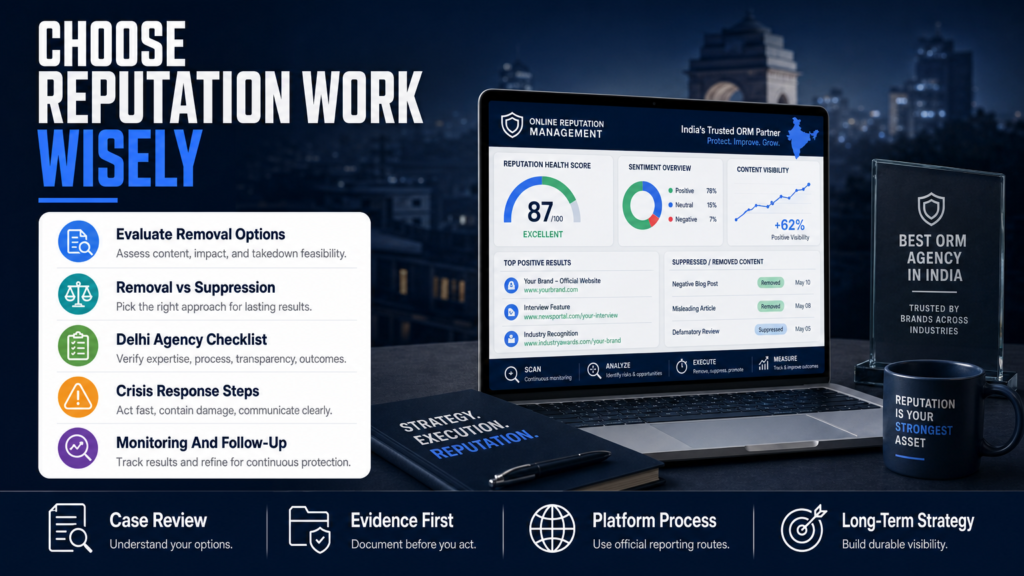
There’s no single ‘best’ agency for every case — the right Delhi firm depends on the problem type, budget, timelines, and whether you need local legal coordination. Evaluate agencies on specific capabilities (legal coordination, platform takedowns, SEO authority, and crisis response) rather than headline awards.
Look for firms that can show process, not promises: documented reporting procedures, escalation paths for platform decisions, and experience with the exact platforms where you’re being harmed (Google Maps, YouTube, industry review sites, data brokers).
- Define the problem and the desired outcome (removal vs suppression vs response).
- Request a documented plan with phases and estimated ranges of time and resource needs.
- Verify references focused on similar platform challenges (reviews, news, mugshots).
- Confirm contractual terms: confidentiality, reporting cadence, and termination rights.
- Reputation and transparency: ask for a sample reporting dashboard and a redaction/data handling policy.
- Platform experience: which platforms have they successfully navigated (not guaranteed) in previous work?
- Legal relationships: do they coordinate with Indian or international counsel when required?
- Technical capacity: can they produce and rank authoritative content for suppression?
Quick due‑diligence checklist for Delhi agencies
Ask for references and examples that map to the same platform type and problem. Confirm they use official platform reporting routes and have experience coordinating with legal counsel for India‑jurisdiction matters.
- Sample project plan addressing removal AND suppression
- Clear pricing bands for monitoring, takedown attempts, and SEO campaigns
- Defined escalation process for unverifiable publishers
Removal versus suppression: which should you hire for?
Deciding between removal and suppression changes the scope of work and the agency skill set you need. Removal seeks to have the content taken down by the publisher or platform; suppression accepts it may remain and uses SEO to bury it behind positive or neutral pages.
A prudent ORM provider evaluates both paths and recommends a hybrid: attempt removal where policies or legal claims apply, while simultaneously building authoritative content to reduce visibility if removal is denied or delayed.
- Map each target item to its legal and policy vulnerabilities.
- Open removal reports where appropriate and document all responses.
- Start suppression content immediately: 4–10 authoritative pages or profiles to target for ranking.
- Monitor SERPs weekly and adapt keyword targets based on progress.
- Removal attempts: platform abuse policies, privacy/defamation claims, direct publisher outreach, legal notices.
- Suppression work: content creation, domain authority building, link building, social profiles, and internal site SEO.
- When removal is unlikely (public records, truthful reporting), suppression and correction are primary options.
Tools and platforms used for suppression
Common tactics: optimize LinkedIn, About pages, YouTube channels, and press releases; publish targeted blog posts; create location pages for businesses; and use structured data where possible. These are intended to improve the visibility of content you control.
- Authoritative platforms: LinkedIn, Medium, YouTube, PRNewswire-type services
- Technical SEO: canonical tags, schema, and link‑building to owned assets
- Monitoring: Google Alerts, platform webhooks, and human review
How agencies handle review disputes, fake reviews and listings
Reviews on Google, Yelp, and industry sites are often the highest-impact items for small businesses. Agencies should offer a multitier approach: review policies and reporting, public response strategy, and non-deceptive reputation repair (generating legitimate positive reviews and improving service).
If you need tactical context, see our review-focused analysis in When Google Reviews Become a Brand’s Biggest Crisis. That piece explains response templates and escalation paths for Google and the major review sites.
- Collect evidence: order history, IP logs (if available via your platform), and screenshots.
- File a platform report with the documented evidence.
- Post a templated, factual public response and offer to resolve offline.
- If the platform denies removal, pursue suppression and reputation-building as fallback.
- Verify: are reviews genuine customers, competitors, or bots?
- Report: follow platform-specific abuse flows with documented evidence.
- Respond: professional public replies to show care without inflaming the situation.
- Repair: request lawful opt-outs with data brokers if contact details are exposed.
Platform-specific notes
Google reviews and Maps listings have their own escalation paths and often require repeated documentation. Industry sites (like Healthgrades or Avvo) have different policies — confirm each site’s reporting process before escalating.
- Google: use the business owner flows and the ‘remove content’ reports; escalate via support if necessary.
- Yelp: their content guidelines are strict; evidence of employer retaliation or fake accounts helps.
- Industry sites: often require more formal documentation or legal letters to change factual listings.
What to do when removal is NOT available
Some content is effectively non-removable: truthful news reporting, public records, court filings, or content hosted on a nonresponsive site outside your legal reach. When removal isn’t available, the agency should shift to mitigation and rebuilding.
Mitigation focuses on reducing the visibility and impact of the negative content on the audiences that matter (prospective patients, clients, partners). This is an honest, legally safe approach that relies on SEO, PR, and customer experience improvements.
- Identify the keywords and queries that surface the negative item.
- Build 5–12 high-authority assets you control (LinkedIn, YouTube, About pages, press, blog posts).
- Optimize those assets to target the same branded queries.
- Monitor and adjust keyword targeting every 30–90 days; expect gradual SERP shifts rather than instant removal.
- Create and optimize authoritative pages for your name and brand.
- Publish corrective or explanatory content where appropriate (blog posts, press statements).
- Use structured citations and consistent NAP (name, address, phone) data to strengthen desired pages.
- Use targeted paid campaigns when time-sensitive visibility is critical (with disclosure as required).
When PR helps more than takedown attempts
If the negative item is newsworthy, issuing a carefully worded statement or pursuing balanced coverage through credible outlets can change context and sentiment. Agencies should offer PR coordination when a reputational narrative needs reframing.
- Crisis statements drafted with legal review
- Placement with industry publications
- Long-form content to provide context and counterbalance the original story
How pricing, contracts and timelines usually work
ORM pricing in India ranges widely. Expect monthly retainers for monitoring and suppression work, discrete fees for takedown attempts and legal coordination, and project fees for content creation and PR. Good contracts specify deliverables and reporting frequency instead of guaranteeing results.
Timelines are variable: some platform removals may occur in days, others take weeks or longer; SEO suppression typically requires months. A trustworthy agency will provide estimated ranges and milestones but will not promise fixed outcomes or deadlines.
- Get a written scope that matches the problem (number of target URLs, platforms, and keywords).
- Ask for sample reports and expected checkpoints (30, 60, 90 days).
- Build an exit clause allowing termination if the agency is not delivering agreed activities.
- Monitoring-only plans: lower monthly fees (often $200–$1,000 USD equivalent).
- Takedown/legal coordination: discrete fees, sometimes billed hourly or per action.
- Suppression campaigns: monthly retainers covering content, SEO, and link work.
- PR and crisis response: expedited service fees for rapid outreach.
Red flags in pricing and contracts
Be wary of firms that guarantee removal, claim legal authority they don’t have, or ask for untraceable payments. Insist on written invoicing and a clear scope of work.
- Removal guarantees or fixed-time promises
- No documented reporting or vague deliverables
- Requests for questionable tactics such as fake reviews or covert suppression
Monitoring, reporting and the first 30–90 days playbook
A good onboarding creates a monitoring baseline, documents all affected keywords and URLs, and executes a prioritized plan for the first 30–90 days. This phase is about evidence collection, opening removal reports, and starting suppression assets.
Expect clear weekly or biweekly reports with activities, platform responses, and next steps. If you don’t get that cadence in writing, that’s a sign the engagement may be more tactical than strategic.
- Sign an engagement letter with defined reporting cadence.
- Provide access to accounts (owner access to GMB, social profiles) through secure sharing methods.
- Approve suppression content before publication; require citations and compliance checks.
- Week 1–2: full discovery, evidence collection, and immediate platform reports where applicable.
- Week 3–6: begin content publication for suppression; respond to reviews publicly where appropriate.
- Month 2–3: evaluate platform responses, adjust suppression targets, and escalate to legal if needed.
Security and confidentiality during onboarding
Sensitive intake data should be transferred securely. Agencies typically use encrypted file transfer, limited-access dashboards, and non‑disclosure provisions in contracts. Ask how they store credentials and whether they use role‑based access controls.
- Encrypted channels for credential sharing
- Least-privilege access to accounts
- Documented retention and deletion policies for sensitive files
When to involve legal counsel and how agencies coordinate
Legal escalation is appropriate if content appears to be defamatory, reveals private data, or involves impersonation and the publisher is nonresponsive. An ORM agency should be able to coordinate with your counsel, prepare evidence packages, and advise on the types of claims that may be available.
We do not provide legal representation; however, coordination between counsel and the agency speeds evidence gathering and presents a unified escalation to platforms and publishers.
- Notify your attorney early if the content could lead to legal action.
- Have the agency compile the evidence packet usable by counsel.
- Coordinate public statements with counsel before publishing anything that could affect the legal posture.
- Agency prepares a packet: URL list, timestamps, archived copies, and correspondence history.
- Counsel reviews for defamation or privacy claims and advises on jurisdictional options.
- Agency pursues technical and PR mitigation while counsel handles legal notices or litigation.
What agencies cannot do legally
An agency should not provide legal advice or represent you in court. They should not claim special relationships with platforms or hint at guaranteed legal outcomes. All legal questions should be referred to a qualified attorney.
- Does not provide legal representation
- Does not promise legal results
- Refers legal questions to qualified counsel
Removal vs Suppression: Quick Comparison
Five factors to compare when deciding which approach to prioritize.
| Removal (Takedown) | Suppression (SEO & PR) |
|---|---|
| Goal | Reduce visibility |
| Primary method | Publish and rank owned content |
| Best for | Policy violations, privacy, impersonation |
| Control | Lower — depends on publisher/platform |
| Typical timeframe | Days to months (highly variable) |
| Cost profile | Discrete fees + possible legal costs |
| Risk | Platform refusal; must use suppression fallback |
Hypothetical: Clinic With A Viral Complaint — End‑to‑End
Scenario: A private clinic in Delhi sees a 1,200‑word blog post alleging malpractice surfacing on page 1 for its brand name. The piece quotes a former patient and links to a social post. The clinic needs to limit patient loss and correct inaccuracies.
Process outline below is hypothetical and anonymized; it shows the coordination between the clinic, the chosen ORM agency in India, and legal counsel.
- Day 0–7: capture evidence, file platform/host reports, and notify counsel.
- Day 7–30: agency begins publishing suppression assets and runs paid visibility campaigns where necessary; counsel sends formal notice if removal is viable.
- Month 2–4: evaluate SERP shifts, refine content, and consider additional link building. If host refuses removal, continue suppression and PR.
- Ongoing: monitoring with alerting, monthly reporting, and a plan to refresh suppression content every 3–6 months.
- Discovery: agency captures the article, archives it (Wayback/HTML capture), and documents referrals from social media.
- Evidence: clinic provides patient records where legally allowed and identifies inaccuracies for counsel to evaluate.
- Removal attempt: agency submits a takedown request to the host citing defamation/privacy concerns while counsel prepares a legal notice.
- Suppression: simultaneously, the agency publishes six targeted assets (About page, LinkedIn updates, a press statement, three blog posts, a patient‑testimonial page) optimized for the clinic’s brand queries.
- Monitoring: daily SERP checks and weekly client reports; PR outreach to two industry outlets to publish a corrective statement.
Common Mistakes Companies Make When Hiring an ORM Firm
These mistakes are common and avoidable with the right questions in the procurement phase.
Mistake 1 — Chasing Guarantees
Why it happens: clients under pressure want quick promises. Why it’s wrong: no reputable agency can guarantee removals or search rankings because platforms and search engines control outcomes.
What to do instead: insist on documented process, KPIs that measure activity (not guaranteed outcomes), and realistic estimated ranges.
- Avoid vendors who promise guaranteed removal or fixed timelines
- Ask for sample reports showing historical activity (not claimed results)
Mistake 2 — Hiring for Awards Over Experience
Why it happens: awards look impressive. Why it’s wrong: awards often reflect marketing, not platform‑specific takedown or legal coordination experience.
What to do instead: ask for references and examples that map specifically to your platform and problem type.
- Request case examples for review removal, mugshot removal, and SEO suppression
- Confirm the named references handled the same platform (Google, YouTube, industry sites)
Mistake 3 — Ignoring Contract Details
Why it happens: urgency leads to skimmed contracts. Why it’s wrong: missing details create scope creep and billing surprises.
What to do instead: insist on scope, reporting cadence, confidentiality clauses, and an exit clause in writing.
- Ensure a written scope with deliverables
- Confirm confidentiality handling and credential storage methods
Mistake 4 — Relying Only on One Tactic
Why it happens: belief that one magic tactic exists. Why it’s wrong: most real problems need layered responses — removal attempts, suppression, review management, and PR.
What to do instead: demand a hybrid plan and phased budget that covers both removal attempts and suppression.
- Insist on a hybrid plan with fallback options
- Allocate budget to both technical/SEO work and content/PR
Mistake 5 — Skipping Legal Review When Needed
Why it happens: cost or belief that the agency will handle everything. Why it’s wrong: agencies don’t provide legal representation, and legal issues need counsel.
What to do instead: involve counsel early if content could give rise to defamation or privacy claims.
- Ask the agency about typical coordination with counsel
- Make sure evidence collection is litigation‑grade if you may sue
Best Practices When Engaging an ORM Agency in India
Follow these durable, actionable practices whether you hire locally or internationally.
Be Specific About Outcomes
Define the problem and the audience that matters (patients, partners, investors). An agency should map tactics to those audiences and define KPIs tied to visibility and business impact.
- Define target queries and stakeholders
- Place visibility KPIs alongside activity KPIs
Insist on Platform‑by‑Platform Plans
Each platform (Google, YouTube, Facebook, industry review sites) has its own policies and escalation mechanisms. The agency must show platform‑specific workflows.
- Request documented reporting flows for Google, YouTube, and major review sites
- Confirm capacity to escalate to platform support and to coordinate with counsel
Require Secure Onboarding
Credentials and sensitive documents should be shared securely and access must be limited. Ask for their security controls before sharing anything.
See our service‑level approach to brand visibility in The First Page of Google Is Your Real Homepage for how suppression plans tie to search intent.
- Use encrypted transfer for credentials
- Set role-based access and time-limited permissions
Plan For Ongoing Work
Reputation work is not always one-off. Once an item is suppressed or removed, monitoring and occasional content refreshes are necessary to prevent re-emergence.
Budget for ongoing monitoring and periodic content updates.
- Monthly monitoring retainers
- Quarterly content refreshes for suppression assets
Choose Firms That Play Well With Counsel and PR
An effective ORM engagement coordinates legal steps, platform reports, and PR statements. That multidisciplinary coordination prevents mixed messages and preserves legal options.
For SaaS and developer‑story issues see our companion piece When a GitHub Issue Becomes Your SaaS Company’s Headline for platform-specific triage examples.
- Confirm council coordination workflow
- Confirm PR alignment and approval steps
Expert Tips
- Always archive hostile pages immediately — screenshots plus an HTML capture are critical evidence.
- Do not ask for or purchase fake positive reviews; legitimate review generation is the only safe approach.
- Keep public responses factual and offer offline resolution rather than emotional rebuttals.
- If a publisher is unresponsive, prepare a public clarification while you pursue legal avenues privately.
- Use LinkedIn and About pages as primary suppression assets for professionals — they rank quickly for name searches.
- Audit who has admin access to your profiles at least quarterly; rogue admins cause many reputation problems.
- Ask any prospective agency for a sample 90‑day plan tied to your specific keywords and URLs.
- Retain copies of all correspondence with platforms and publishers; record dates and support ticket numbers.
Conclusion
Picking the Best ORM agency in India is about matching skills to your problem, insisting on documented process, and planning for both removal attempts and long-term suppression. No agency can promise removal or permanent suppression; your procurement should focus on evidence of capability, platform experience, and clear reporting.
If you need immediate triage, prioritize secure evidence capture, platform reporting, and a suppression plan that includes owned content and PR. Agencies that integrate legal coordination and measurable monitoring will give you the best chance of reducing the real-world harm while preserving legal options.
Why Businesses Choose Your Reputation Agency
Managing your reputation takes more than monitoring reviews or publishing the occasional blog post. It takes a strategy built around your situation, your industry, and what is actually showing up in search.
Your Reputation Agency works with businesses, executives, healthcare professionals, attorneys and growing brands. Our services include:
- Remove defamatory content and false posts (news, blogs, listings)
- Remove or challenge negative reviews (Google, Yelp, TripAdvisor, industry sites)
- Mugshot and arrest record removal
- Remove videos, images, and other multimedia that damage reputation
- Remove personal data from people‑search and data‑broker sites (opt‑outs)
- Search result suppression (SEO to bury negative links)
- Social media takedowns and impersonation removal
- Rapid online crisis management and incident response
- Ongoing monitoring and alerting of reputation signals
- Coordination with legal counsel and use of legal tactics when required
Frequently Asked Questions
1. Which ORM agency is the best in Delhi?
There is no single ‘best’ agency for every case. Choose a Delhi firm based on demonstrated experience with the specific platform and problem you face, documented processes, secure onboarding, and clear coordination with legal counsel when required.
2. What is ORM in company?
ORM in a company means the coordinated set of activities—monitoring, platform reporting, SEO suppression, PR, and legal coordination—aimed at controlling what the public sees about a brand or person online.
3. How long does ORM work take to show results?
Timelines vary: some platform removals can happen in days, others take weeks or months; SEO suppression is typically measured in months. A reputable agency will provide estimated ranges and milestones, not guaranteed dates.
4. Can an agency remove a mugshot or arrest listing?
An agency can evaluate whether a mugshot or arrest listing might qualify for removal under platform or publisher policies and pursue opt‑outs or takedown requests. Removal depends on the publisher, the site’s policies, jurisdiction, and the factual circumstances; when removal is unavailable, suppression is an alternative.
5. What should I ask before hiring an ORM agency?
Ask for a sample 90‑day plan tied to your specific URLs and keywords, platform‑specific workflows, security procedures for credentials, references for similar work, and contract terms that spell out reporting cadence and deliverables.
6. Will an ORM agency handle legal claims?
ORM agencies coordinate with legal counsel and prepare evidence packets, but they do not provide legal representation. For defamation, privacy, or other legal remedies, consult a qualified attorney.
7. Is suppression ethical and legal?
Suppression uses lawful SEO and content strategies to reduce the visibility of negative items. It is ethical when it relies on accurate, authoritative content you control and does not involve deceptive or fake tactics.
8. Can I manage ORM myself or should I hire an agency?
Smaller or straightforward issues can be managed in‑house if you have SEO knowledge and time. Complex situations—multi‑platform incidents, potential legal claims, or high stakes like licensure—benefit from a specialist agency that coordinates technical, legal, and PR work.
9. How do agencies report progress?
Agencies typically provide dashboards and written reports showing activities (platform reports filed, content published), SERP snapshots for target queries, and recommended next steps. Confirm reporting cadence and metrics before you sign.
This content provides general information and does not constitute legal advice. The available options and likely outcomes depend on the facts, evidence, platform policies, applicable law, jurisdiction, and public-interest considerations.
Past examples do not guarantee future results. Removal, correction, deindexing, and search-position changes depend on third parties and circumstances outside Your Reputation Agency’s control.