When a GitHub issue affects SaaS reputation
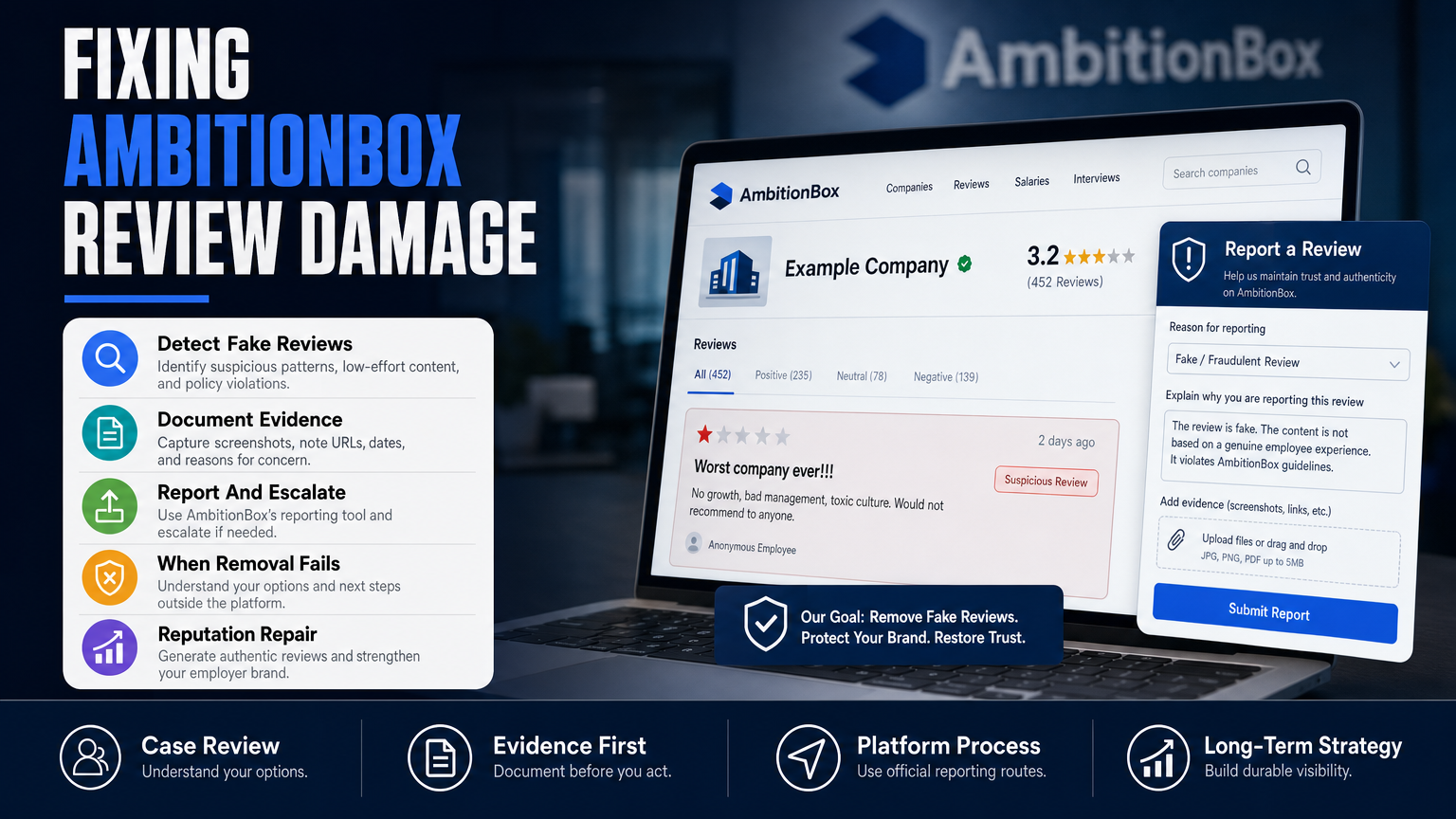
A SaaS GitHub issue reputation crisis can develop when a bug report, security concern, licensing dispute, or maintainer conflict becomes the top branded search result. Developers expect evidence, timelines, and visible follow-through.
Seven response steps
- Preserve the issue, commits, comments, dates, and linked discussions.
- Reproduce the technical claim and publish what is known.
- Separate confirmed impact from speculation.
- Assign an owner and provide a realistic update schedule.
- Fix the root cause and link to the relevant release or advisory.
- Moderate only under clear project rules, not to hide criticism.
- Publish a postmortem and monitor search and community discussion.
Transparent technical evidence is usually more persuasive than marketing language. If the issue involves a vulnerability, coordinate disclosure carefully so users can protect themselves before exploit details spread.
Online reputation management for SaaS companies: Online reputation management for SaaS companies spans review sites, GitHub issues, product communities, status pages, social media, security discussions, and branded search results. Technical credibility depends on responding with evidence and documenting fixes, not merely suppressing criticism.
Online Reputation Management for SaaS Companies
- Monitor branded search, reviews, forums, and repositories.
- Triage security, outage, billing, and support complaints separately.
- Publish accurate status and incident updates.
- Respond to GitHub issues with reproducible facts.
- Correct outdated documentation and directory listings.
- Report impersonation, spam, and harassment under platform policies.
- Turn recurring feedback into product and support improvements.
Use current platform policies, preserve evidence, and avoid guarantees about outcomes controlled by third parties.
You just found a public thread, issue, or review that sits on page one for your product name — and it’s costing demos, deals, or investor confidence. SaaS leaders call this the worst kind of discovery: technical detail turned into a headline.
This article answers what online reputation management for saas companies in usa orm buddy actually is, how it compares to other ORM options, what a realistic cost range looks like, and the exact first 48 hours of actions you should take.
We cover platform-specific tactics (GitHub, Product Hunt, Trustpilot, Google Reviews, Reddit), removal vs suppression tradeoffs, and a staged playbook for immediate containment plus long-term repair.
Read this if your product, CEO, or company name has become a search result problem and you need clear, practical options — not promises.
Table of Contents
- What is online reputation management ORM Buddy?
- What is ORM — online reputation management — for SaaS companies?
- What is the best online reputation management company?
- How much does an ORM typically cost?
- When removal is not available: mitigation and suppression strategies
- Platform-specific threats for SaaS: where problems actually show up
- Rapid response playbook for a SaaS viral incident
- Long-term reputation program for SaaS: prevention and recovery
- DIY vs Agency: Which route for a SaaS reputation problem?
- Hypothetical scenario: a repo issue that climbed to page one
- Common mistakes SaaS companies make when handling reputation incidents
- Best practices for SaaS reputation management
- Expert Tips
- Conclusion
- Why Businesses Choose Your Reputation Agency
- Frequently Asked Questions
What is online reputation management ORM Buddy?
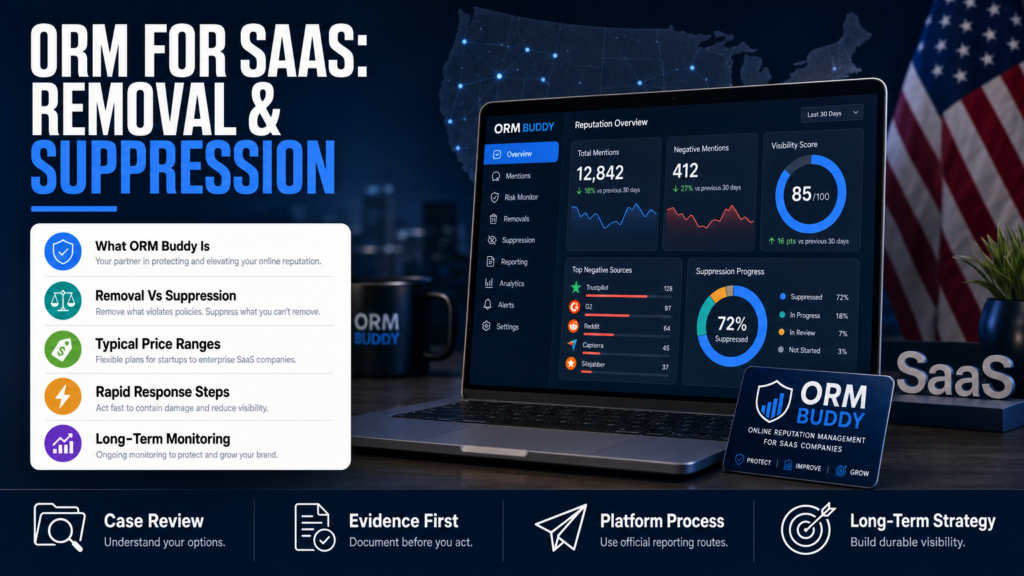
ORM Buddy is a brand name used for tools and services that combine monitoring, automated reporting, and workflows aimed at detecting and addressing reputation issues. In the context of online reputation management for saas companies in usa orm buddy typically refers to platforms or vendors positioning themselves as turnkey solutions for monitoring and mitigation.
That can mean automated alerts when your company name appears on review sites, an interface for filing takedown or dispute requests, and integrations with platforms like Google, Trustpilot, or GitHub. Whether a particular ‘ORM Buddy’ product is legitimate depends on its features, vendor transparency, and whether its processes follow platform policies and US law.
Important: an ORM tool or vendor can accelerate discovery and paperwork, but it cannot unilaterally ‘remove’ truthful public records or guarantee search rankings. We evaluate whether content may qualify for removal or review and pursue the legal, technical, platform-based, and reputational options available.
- Assess the vendor features: which platforms are covered and what manual support is included.
- Check transparency: do they publish processes, escalation paths, and pricing?
- Request references and a sample action plan for a SaaS-specific incident before paying.
- Monitoring + workflows: alerts, dashboards, and assigned follow-ups
- Platform actions: dispute forms, review flags, impersonation reports
- Automation limits: platforms still make final decisions
- Vendor differences: some focus on software; others combine software with agency services
What is ORM — online reputation management — for SaaS companies?
ORM for SaaS is a combination of three activities: detection (monitoring and alerts), remediation (removal requests, review disputes, impersonation takedowns), and visibility work (SEO, content creation, and review generation) designed to influence what prospects, partners, and regulators find when they search your company or product.
For SaaS companies, damage often looks different than for consumer brands: a single detailed bug report, a leaked support transcript, or a developer forum thread can disproportionately affect enterprise prospects. That’s why an effective program blends fast technical containment with careful public messaging.
Search-engine work is usually part of ORM for SaaS but never a promise: we develop SEO reputation strategies intended to improve the visibility of relevant and credible information, but search results may change because algorithms and third-party publishers are outside our control.
- Run a rapid search-audit for company and product strings across Google, YouTube, GitHub, Reddit, and major review sites.
- Classify hits as opinion, factual allegation, privacy leak, platform policy violation, or public record.
- Prioritize actions by impact (page-one content first) and actionability (removal likely vs mitigation required).
- Detect: product name, founder names, common misspellings, and competitor-sourced attacks
- Remediate: platform report, publisher outreach, legal review if warranted
- Mitigate: SEO suppression, authoritative content, corrected documentation
- Protect: monitoring, access controls, and doxxing mitigation
Why SaaS needs hybrid tech + comms
A technical fix (patch or takedown) without coordinated messaging leaves customers confused; a public statement without technical remediation can inflame technical audiences. Effective ORM pairs both.
- Patch the issue if it’s a security defect or leak
- Prepare a technical brief for customers when appropriate
- Coordinate a short, factual public statement to avoid speculation
What is the best online reputation management company?
There is no single ‘best’ company for every SaaS — the right vendor depends on scope (removal vs suppression), industry risk (healthcare, fintech), required legal coordination, and responsiveness. Evaluate providers on documented processes, platform experience, and measurable SLAs for response times and escalation.
Look for companies that publish methodology, demonstrate experience with developer ecosystems (GitHub, Stack Overflow), and show clear coordination with counsel when matters cross into defamation, harassment, or privacy law.
If the issue centers on reviews or a product complaint, a targeted specialist that understands review-site policies and dispute processes may outperform a generalist tool. For broader crisis response, you want a firm that can integrate PR, legal, and SEO actions quickly.
- Request a technical sample plan for a hypothetical GitHub issue that surfaces in search.
- Compare vendor scope: only software vs software + managed services.
- Check whether they can assist with review dispute workflows and press corrections.
- Assess experience with your primary platforms (Trustpilot, G2, GitHub, Product Hunt)
- Ask for a staged action plan for a page-one negative result
- Confirm they coordinate with legal counsel when needed
- Prefer vendors that can show redaction and suppression workflows (not promises)
Where to look for reputable options
Public vendor lists, reviews, and specific case studies help but require scrutiny. For a discussion of how the first page of search effectively becomes your company’s homepage, see The First Page of Google Is Your Real Homepage.
How much does an ORM typically cost?
Costs vary widely depending on urgency, channel complexity, and whether you hire software-only or a full-service agency. Typical ranges for US-focused SaaS companies are below, with the caveat that every case is unique.
We provide these as ballpark ranges to set realistic expectations — timing and outcomes depend on platform decisions, legal complexity, and evidence, and no vendor should promise specific removals or ranking outcomes.
- If you have one page-one crisis, budget for a focused incident response engagement first; then decide whether to retain ongoing monitoring.
- Ask vendors for a written scope with deliverables, estimated timeline ranges, and escalation procedures.
- Confirm which costs are recurring (monitoring, content production) and which are one-time (research, takedown requests).
- Monitoring software (SaaS): $50–$500/month depending on alerts and seat count
- Targeted takedown campaigns (agency-managed): $3,000–$15,000 engagement fee for a single incident
- Ongoing managed ORM (monthly retainer): $2,000–$10,000/month depending on scope and response SLAs
- Complex legal cases (coordination with counsel): legal fees billed separately; expect consultancy retainers
When removal is not available: mitigation and suppression strategies
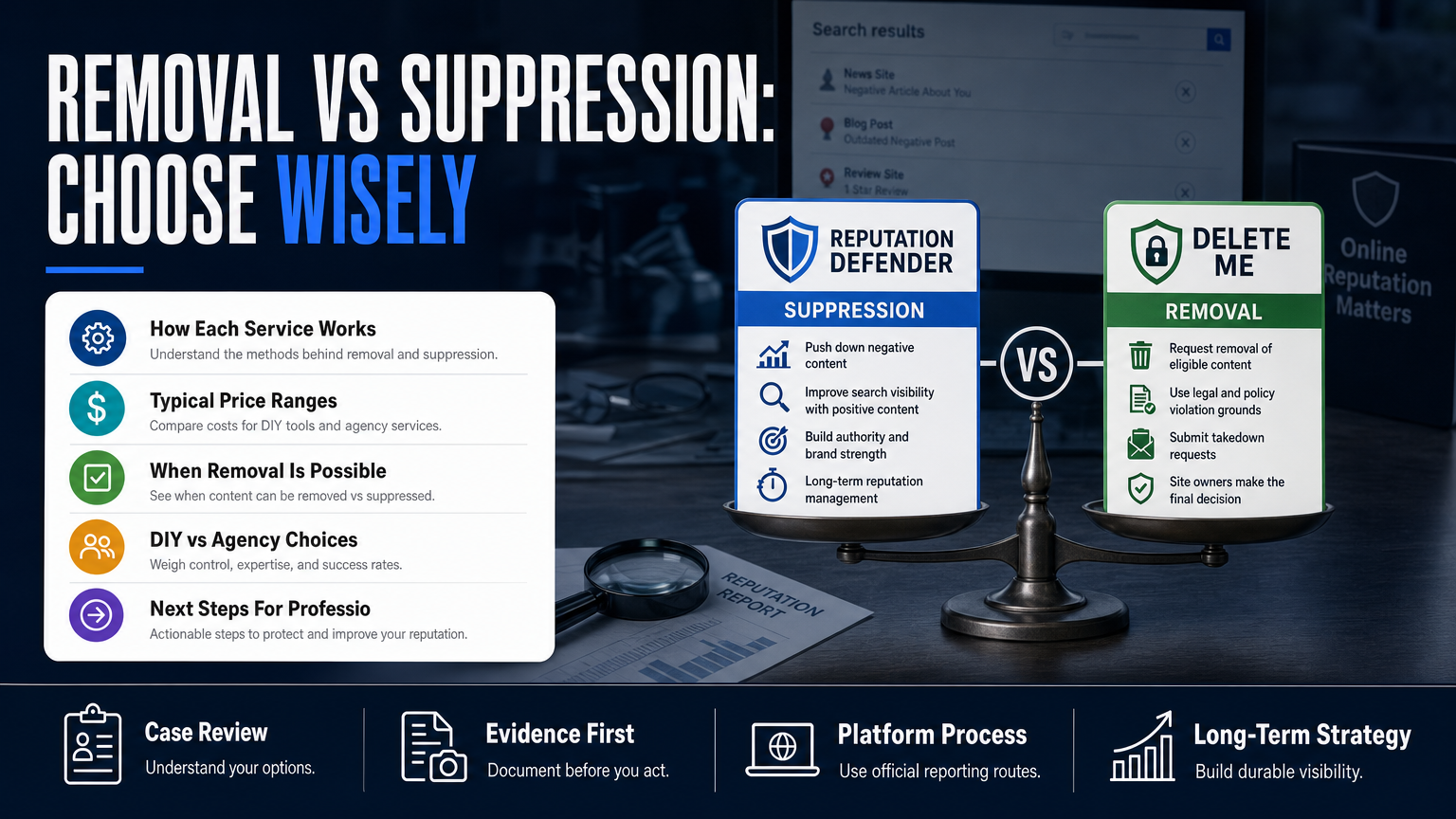
Not all content is removable — truthful reporting, public records, and some opinion pieces frequently fall outside platform takedown policies. When removal is unavailable, the primary options are correction, mitigation, and search-result suppression.
We pursue corrections and publisher relationships when factual errors exist and develop SEO strategies to reduce the visibility of harmful items. We develop SEO reputation strategies intended to improve the visibility of relevant and credible information, but results vary according to the strength of the negative content and the authority of competing sources.
- Document factual inaccuracies and assemble supporting evidence for publisher outreach.
- Publish a concise, evidence-based company statement on your domain and amplify it via owned channels.
- Launch an SEO suppression plan: prioritized content calendar, targeted link outreach, and technical SEO fixes.
- Publisher outreach: request factual corrections or context from the author or editor
- Correction pages: publish authoritative responses on your domain and push them with link-building
- SEO suppression: create and promote high-quality pages (docs, blog posts, press, case studies) to outrank the negative result
- Reviews strategy: solicit legitimate, timely reviews from verified customers
- Paid channels: prioritized paid search and social ads can temporarily reduce exposure while organic work proceeds
When the negative item came from a contractor or freelancer
If a dispute originates with a former freelancer or contractor, document contracts, NDAs, and correspondence. Sometimes the best path starts with contractual remedies or a direct request for correction. For a look at freelancer-driven issues and search fallout, see When a Freelancer Becomes a Company’s Main Search Result.
Platform-specific threats for SaaS: where problems actually show up
SaaS companies commonly see reputation damage surface on a predictable set of platforms. Each requires a tailored approach.
Recognizing the platform and its policy levers speeds response.
- Map each damaging URL to the correct internal owner (engineering, product, legal, comms).
- Use platform reporting for privacy leaks and doxxing immediately.
- Prioritize removal requests for items that contain personal data or violate platform rules.
- GitHub/Issue trackers: technical bug threads and leaked credentials — focus on takedown, sensitive data removal, and repo hygiene
- Product review sites (G2, Capterra): negative reviews — use documented dispute processes and verified-customer flags
- Trustpilot, Google Reviews, and app stores: consumer‑facing reviews — escalate with documented purchaser evidence
- Reddit, Hacker News, and Stack Overflow: community discussion — moderation depends on site rules and community norms
- Social media & video (Twitter/X, YouTube, LinkedIn): rapid spread — use platform reporting for policy violations and coordinate messaging
Rapid response playbook for a SaaS viral incident
A clear, prioritized 48‑hour playbook limits damage. The steps below are practical actions you can take in the short term; a deeper follow-up plan should run in parallel.
Timing depends on platform workflows and legal review — an estimated timeline can be provided after assessment.
- Hour 0–2: Triage — identify the worst page-one items and whether they contain private data or actionable policy violations.
- Hour 2–8: Containment — remove exposed keys, rotate credentials, pull affected services into safe modes; file platform reports for privacy/data breaches.
- Day 1: Messaging — prepare a short factual internal brief for customers and a holding statement for public channels; avoid speculation.
- Days 1–3: Remediation requests — submit removal/dispute reports with evidence, and open publisher outreach with a correction request.
- Day 3+: Mitigation — begin SEO suppression content, coordinate legal review for potential claims, and launch monitoring alerts.
- Contain technical exposure first, then manage external communications
- Document everything: screenshots, timestamps, and user IDs
- Coordinate roles: assign a single spokesperson and a technical lead
Who should be involved
Assign the following: an incident lead (product/engineering), a comms lead (PR or designated spokesperson), a legal point of contact (internal counsel or external), and an ORM lead to coordinate platform requests.
- Incident lead: technical fixes and evidence collection
- Comms lead: customer notifications and public statements
- ORM lead: platform reporting, dispute workflows, and SEO suppression
- Legal: advise on defamation, privacy, and takedown authorities
Long-term reputation program for SaaS: prevention and recovery
Long-term reputation work is a mix of hygiene, signals, and storytelling. Build on immediate fixes with structural work so a future incident is less likely to become a search problem.
A sustainable program includes monitoring, content, review generation, and technical security improvements.
- Quarterly search audits for core company and product strings.
- Implement automated review prompts after key milestones (successful onboarding, 30 days active).
- Maintain an incident runbook and test it annually with tabletop exercises.
- Continuous monitoring: owned-name alerts, backlink tracking, and social listening
- Content strategy: authoritative docs, customer case studies, and executive thought leadership
- Review operations: automated review requests to verified users integrated into onboarding
- Security hygiene: secrets management, vulnerability disclosure program, and bug-bounty or coordinated vulnerability disclosure
- Legal & policy: templates for takedown requests and vendor contacts
Measuring progress without promises
Track changes in page-one composition, average sentiment of mentions, and referral conversions from branded search. Remember: we develop SEO reputation strategies intended to improve visibility, but search results may change for reasons outside your control.
DIY vs Agency: Which route for a SaaS reputation problem?
Quick comparison to help you decide whether to handle ORM in-house or hire a specialist.
| DIY (In‑House) | Agency / Vendor |
|---|---|
| Lower hourly cost for staff time | Higher upfront fee, predictable scope |
| Faster for internal fixes | Faster escalation on platform disputes |
| Requires internal legal coordination | Often provides legal coordination processes |
| Limited platform relationships | Processes tailored to platform requirements |
| Good for small, technical issues | Better for complex, multi‑channel crises |
| Requires sustained monitoring setup | Monitoring and reporting often included |
Hypothetical scenario: a repo issue that climbed to page one
A mid‑stage B2B payments SaaS notices a GitHub issue alleging a security bug. Within 48 hours, the issue is referenced in a Hacker News thread and appears on page one for the company name, harming sales calls.
The company follows a staged response: containment, evidence collection, removal requests where policy applies, publisher outreach, and SEO suppression.
- 1. Hour 0–8: Patch and rotate credentials; collect screenshots and logs.
- 2. Hour 8–24: Prepare a short, factual customer notice and an internal incident memo.
- 3. Day 1–3: Open platform reports and submit a correction request to the forum author.
- 4. Day 3–14: Execute SEO suppression content and start targeted PR outreach.
- 5. Week 3+: Monitor search results and measure movement; continue outreach and content production.
- Triage the issue: confirm whether the report includes sensitive data or functional exploit code.
- Containment: patch the vulnerability, rotate keys, and make a public technical post explaining what was fixed (without revealing secret details).
- Platform action: file GitHub takedown only if the issue includes private data or violates policy; otherwise request issue closure or a corrective comment from the reporter.
- Publisher outreach: contact the Hacker News thread OP and the linked blog for corrections, offering a short technical note and evidence.
- SEO work: publish a detailed incident report on your domain, promote with links from partner sites, and create FAQ pages to own related search terms.
Common mistakes SaaS companies make when handling reputation incidents
Avoid these frequent errors — each one amplifies damage or reduces your options.
1) Treating the symptom, not the cause
Fixing a search result without addressing the underlying bug, policy issue, or customer complaint invites repetition. Always pair remediation with a root-cause fix.
2) Overly defensive public statements
Emotional or speculative statements escalate community backlash. Use short, factual, and attributed language: what happened, what you fixed, and what steps you’ll take next.
3) Relying solely on platform flags
Platform reports can be slow or rejected. Combine reporting with publisher outreach, documented corrections, and SEO mitigation to increase the chance of meaningful change.
4) Buying fake reviews or engagements
Paid or fake reviews violate platform rules and can make matters worse legally and reputationally. Invest in legitimate review operations tied to verified customers instead.
5) Not documenting evidence early
Screenshots, timestamps, and logs collected immediately are often the difference between a successful dispute or legal action and a lost opportunity. Preserve evidence even if you hope to resolve quietly.
Best practices for SaaS reputation management
These durable actions reduce the chance that a single incident becomes an existential problem.
Audit and classify search results quarterly
Run a scheduled audit of branded search terms and classify results by severity, platform, and actionability so you know where to act first.
- Track page-one composition and get monthly alerts for new high‑severity mentions
Maintain an incident runbook
Document roles, rapid contact lists, and templated evidence packages to speed response during a crisis.
- Include legal and PR contact points and a technical escalation checklist
Invest in security hygiene
Secrets management, bug-bounty programs, and faster patch cycles reduce the likelihood of public security incidents that damage reputation.
- Rotate keys on a schedule and implement code scanning in CI
Build authoritative content to own search
High-quality docs, case studies, and executive commentary create positive assets that can outrank negative items over time.
- Prioritize pages that answer likely search queries associated with the incident
Use verified review workflows
Automate review requests post-onboarding and keep the process transparent; that makes your review profile resilient to isolated negative reviews.
- Link review asks to verified user milestones, not discounts or incentives
Expert Tips
- Treat page-one remediation as both a technical and editorial problem.
- Always collect and preserve evidence before asking a publisher or platform to take action.
- For developer-facing incidents, publish a short technical post with timelines and fixes; developers respect detail.
- Use paid search temporarily to control the narrative for brand queries during a crisis.
- Automate alerts for founder and product-name misspellings — attackers exploit typos.
- Never buy or fabricate reviews; build review volume ethically tied to verified customers.
- Create a lightweight legal checklist so counsel can be looped in fast when defamation or data exposure is suspected.
- Run annual tabletop exercises that simulate a public technical incident and test your runbook.
Conclusion
SaaS reputation problems rarely begin as PR issues — they start as a technical incident, a policy dispute, or a dissatisfied customer. The right response combines fast technical containment, disciplined evidence collection, and targeted outreach to publishers and platforms.
Whether you evaluate ‘ORM Buddy’ tools or hire a managed agency, ask for transparent processes, platform expertise, and an evidence-driven plan. If removal isn’t available, focus on correction, authoritative content, and measured SEO suppression while maintaining legal and ethical boundaries.
Why Businesses Choose Your Reputation Agency
Managing your reputation takes more than monitoring reviews or publishing the occasional blog post. It takes a strategy built around your situation, your industry, and what is actually showing up in search.
Your Reputation Agency works with businesses, executives, healthcare professionals, attorneys and growing brands. Our services include:
- Remove defamatory content and false posts (news, blogs, listings)
- Remove or challenge negative reviews (Google, Yelp, TripAdvisor, industry sites)
- Mugshot and arrest record removal
- Remove videos, images, and other multimedia that damage reputation
- Remove personal data from people‑search and data‑broker sites (opt‑outs)
- Search result suppression (SEO to bury negative links)
- Social media takedowns and impersonation removal
- Rapid online crisis management and incident response
- Ongoing monitoring and alerting of reputation signals
- Coordination with legal counsel and use of legal tactics when required
Frequently Asked Questions
1. What is online reputation management ORM buddy?
ORM Buddy is a label some vendors use for monitoring and response tools that detect and manage reputation issues. For SaaS, it usually means alerts, dispute workflows, and integrations with platforms. Legitimacy depends on features and vendor transparency; the tools can accelerate workflows but cannot guarantee removals.
2. What is ORM online reputation management?
ORM is the set of practices that detect, remediate, and mitigate harmful search results — monitoring, takedown or dispute attempts, SEO suppression, and public messaging. For SaaS it also includes technical containment and coordination with engineering teams.
3. What is the best online reputation management company?
There is no single best company for every situation. Choose a provider based on platform experience (e.g., GitHub, Trustpilot), documented processes for evidence and escalation, and the ability to coordinate with legal counsel when issues are complex.
4. How much does an ORM typically cost?
Costs range widely: monitoring tools can be $50–$500/month, one-off incident engagements often run $3,000–$15,000, and ongoing managed programs typically start around $2,000/month and scale up. Exact pricing depends on urgency, channels, and legal complexity.
5. Is ORM Buddy legit for enterprise SaaS?
Some ORM Buddy products are legitimate monitoring tools; others are marketing labels. Evaluate whether the product covers your key platforms, provides manual support, and follows platform policies. Always ask for a sample plan and references.
6. What should I do first if a GitHub issue or Reddit thread becomes a top search result?
Prioritize containment: remove exposed secrets, patch vulnerabilities, and collect evidence. Then file platform reports for privacy violations, prepare a concise customer notice, and start publisher outreach. Simultaneously begin mitigation with authoritative content on your domain.
7. Can you guarantee removal of negative content?
No reputable provider can guarantee removal. We evaluate whether the content may qualify for removal or review and pursue the legal, technical, platform-based, and reputational options available. Platform decisions and legal outcomes depend on evidence, jurisdiction, and policy.
8. Should I handle ORM in-house or hire an agency?
If you have internal expertise and capacity to run monitoring, platform disputes, and SEO, in‑house can work for small incidents. For complex, multi‑channel crises or when fast escalation is needed, a specialist agency provides process, platform experience, and coordination with PR and legal.
9. What if removal is impossible because the content is a truthful public record?
When removal is unavailable, focus on correction, publishing authoritative responses, SEO suppression, and targeted PR to provide context. We may recommend mitigation, correction, or reduced visibility when removal is not an option.
This content provides general information and does not constitute legal advice. The available options and likely outcomes depend on the facts, evidence, platform policies, applicable law, jurisdiction, and public-interest considerations.
Past examples do not guarantee future results. Removal, correction, deindexing, and search-position changes depend on third parties and circumstances outside Your Reputation Agency’s control.