Your Google first page reputation is your real homepage
Your Google first page reputation includes search results, reviews, news, profiles, images, and automated summaries. People often form an opinion from that mix before they visit your official website.
Seven ways to improve the first page
- Audit branded searches on desktop, mobile, images, and news.
- Correct inaccurate facts at their original source.
- Keep official names, biographies, locations, and profiles consistent.
- Publish useful pages that answer real customer questions.
- Earn relevant coverage and links from credible organizations.
- Respond professionally to reviews and recurring concerns.
- Monitor changes and refresh outdated owned content.
Strong search visibility is not created by flooding the web with thin pages. Google recommends helpful, reliable, people-first content that demonstrates genuine experience and expertise.
You’re reading this because a search result, review or social post in Melbourne is doing real damage — costing clients, trust, or sleep. This article explains what options are realistically available and how the process works.
We cover cost ranges and service tiers for online reputation management melbourne, what firms actually do, and how to decide between takedown, suppression and active reputation building. You’ll get clear next steps you can take today.
We also explain platform-specific realities (Google, Yelp, Facebook, YouTube, review sites and people-search databases), legal constraints in Australia and practical timeframes — and what to do when removal isn’t an option.
If you need to act fast, the checklist and the step-by-step sections will give you an operational plan to present to counsel, an in-house marketer, or an agency.
Table of Contents
- How much does online reputation management cost?
- How much does an ORM typically cost?
- What are online reputation management services?
- Which SEO company is considered the best in Australia?
- When removal is not available: suppression and mitigation
- DIY vs hiring an agency in Melbourne
- Typical ORM process: from audit to monitoring
- Removal vs Suppression: Which to Prioritise?
- Hypothetical Melbourne clinician: arrest page and three negative reviews
- Common mistakes we see in Melbourne ORM cases
- Best practices for Melbourne professionals and SMBs
- Expert Tips
- Conclusion
- Why Businesses Choose Your Reputation Agency
- Frequently Asked Questions
How much does online reputation management cost?
There’s no single price because scope varies: a single defamatory blog post is different from a months-long review campaign or a viral social video. Costs reflect the mix of legal, technical, SEO and PR work required.
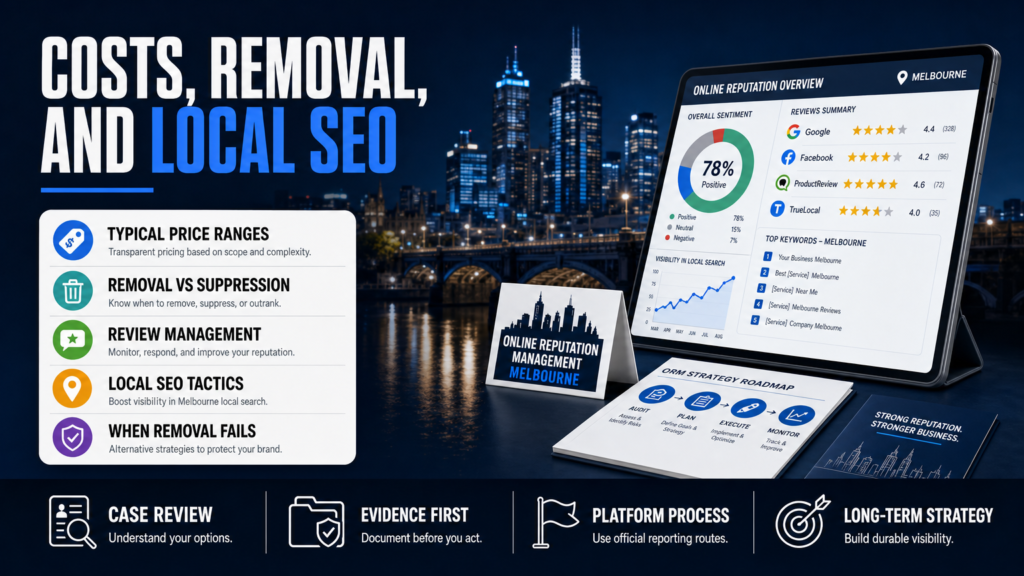
Typical ranges in Melbourne for professional services are: one-off takedown or DMCA-style requests (A$500–A$3,000), targeted removal plus small SEO push (A$2,000–A$8,000), and full-service ongoing management and monitoring (A$3,000–A$15,000+ per month).
- Get a scoped audit: identify the harmful items, platforms, and legal risks.
- Prioritise by impact: legal risks and highly visible Google-first-page items come first.
- Choose a mix of platform reports, publisher outreach, legal review, and SEO suppression.
- One-off manual takedown attempts: A$500–A$3,000
- Removal + suppression package for a single issue: A$2,000–A$8,000
- Comprehensive ongoing ORM (monthly): A$3,000–A$15,000+
Where the price goes
Labor: evidence-gathering, publisher contact, repeated platform escalations and appeals.
Legal work: attorney review, cease-and-desist letters, and court filings when necessary (and only if advised).
Technical and SEO work: content creation, link-building, on-site SEO, and structured data to push negative results down.
PR and communications: media responses, corrective content, or reputation narratives to rebuild trust.
- Preparation and evidence preservation
- Platform reporting and escalations
- Publisher negotiation or legal letters
- SEO content creation and link acquisition
- Ongoing monitoring and alerts
How much does an ORM typically cost?
If you ask ‘typical’ for ongoing ORM, most Melbourne firms price monthly retainers because reputation is never a fully one-time fix. Expect onboarding fees plus a retainer proportional to risk.
Lower-cost monthly services (A$800–A$2,500) usually focus on monitoring, basic review responses, and limited content pushes. Higher tiers (A$3,000–A$15,000+) add sustained SEO, legal coordination and proactive PR.
- Ask for a breakdown: what is deliverable each month and expected outcomes.
- Confirm escalation paths and legal coordination (not legal advice unless the firm partners with counsel).
- Insist on reporting cadence and specific KPIs tied to visibility and sentiment.
- Monitoring-only packages: A$300–A$1,000/month
- Monitoring plus reactive remediation: A$800–A$3,000/month
- Full-service proactive ORM: A$3,000+/month
Questions to ask a vendor
Request sample reports and the cadence of updates. Ask how they handle review removals on Google and industry sites (e.g., Healthgrades/RateMDs).
Clarify whether they will coordinate with a lawyer if the content appears to be actionable defamation, privacy breach or doxxing.
- What platforms are included in monitoring?
- What is the escalation process for urgent incidents?
- Who handles the technical SEO work — in-house or subcontracted?
- How do they measure ‘success’?
What are online reputation management services?
Online reputation management services combine platform reporting, publisher outreach, technical SEO, content creation, review management and legal-tactical work to correct, remove or mitigate harmful content.
Services vary by firm; top providers will offer takedown attempts, search-engine suppression campaigns, removal work on review sites, social impersonation takedowns, and monitoring/alerts.
- Audit: map everything that appears for your name and brand across Google, social, review and news.
- Takedown assessment: evaluate whether content violates platform rules or is legally actionable.
- Mitigation: file reports, request removals, and when needed create authoritative content to outrank the negative item.
- Monitoring: set up alerts and reporting to catch reappearances or copycats.
- Content evaluation and prioritisation
- Publisher outreach and DMCA or policy-based takedown requests
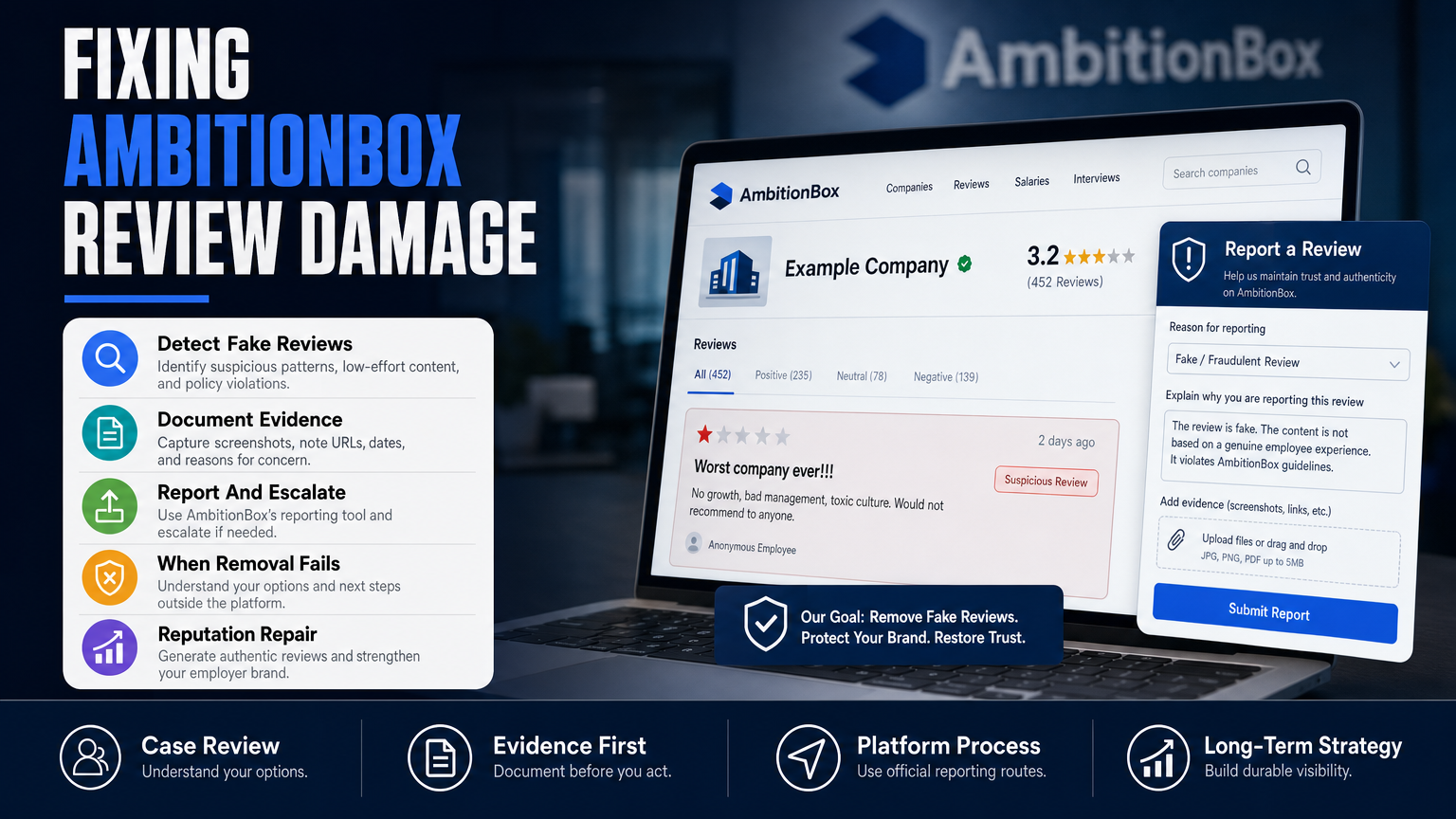
- Review remediation: identifying fake reviews and submitting evidence
- Search suppression through SEO content and authority building
- Monitoring, alerts and crisis PR
Where legal and technical work intersect
We evaluate whether content may qualify for removal or review and pursue the legal, technical, platform-based, and reputational options available.
A qualified attorney can determine whether a legal claim may be available; we coordinate with counsel when evidence suggests legal steps are appropriate.
- Takedown requests depend on platform policy and evidence
- Court orders may be required for some publishers or for sensitive personal information
- Technical SEO reduces visibility but does not delete content
Why reviews require special handling
Reviews are governed by platform-specific policies and often require documented evidence to remove. Genuine negative reviews that reflect a consumer’s experience are rarely removable absent policy violations.
For acute crises, see When Google Reviews Become a Brand’s Biggest Crisis for a detailed discussion of escalation and response strategies.
- Fake reviews can sometimes be removed with platform evidence
- Review response strategy often reduces reputational damage faster than removal attempts alone
- Documented resolution and customer outreach can convert a negative review into a neutral outcome
Which SEO company is considered the best in Australia?
There’s no single ‘best’ SEO or ORM company — the right choice depends on your needs (local vs national, medical vs hospitality), proof of competence in the specific platforms you need, and transparent processes.
Look for firms with local Melbourne case experience, explicit processes for review platforms, demonstrated technical SEO ability, and willingness to coordinate with legal counsel where necessary.
- Assess fit by scope: ask for examples of similar challenges they handled (not claims or testimonials).
- Evaluate tools: do they use bespoke monitoring, manual outreach, or third-party removal services?
- Validate legal coordination: do they have a process to work with qualified attorneys?
- Check platform expertise (Google My Business, YouTube, industry review sites)
- Request references relevant to your sector (e.g., healthcare, legal, hospitality)
- Avoid firms promising guaranteed removals or first-page dominance
How to compare Australian firms objectively
Use criteria you can verify: local experience, scope of technical SEO, review-platform knowledge and escalation protocols. Comparative claims should rely on neutral, documented criteria.
If you need a primer on why your search results are your frontline, read The First Page of Google Is Your Real Homepage for a focused explanation of first-page strategies.
- Local presence or demonstrable local results
- Clear pricing and scope
- Transparent escalation to legal counsel if needed
When removal is not available: suppression and mitigation
Removal depends on the content, publisher, platform policies, evidence and jurisdiction. When removal is unavailable or unlikely, suppression (burying the result with stronger, neutral/positive content) and mitigation are the primary tools.
Suppression is an SEO-driven process that aims to create and boost alternative pages so the harmful item falls off page one or is less visible in brand searches.
- Audit the first two pages of Google to identify what needs to be suppressed.
- Create 5–10 strong pages targeting branded queries and relevant long-tail phrases.
- Build high-quality links and social signals to those positive properties.
- Monitor rankings and adjust content and link-building for performance.
- Create authoritative content pages (biographies, press, resource pages)
- Use targeted SEO to rank those pages for branded queries
- Leverage social profiles, profiles on industry sites, and directory listings
- Consider paid search as a temporary surface-level mitigation
When suppression should be the first plan
Suppression is often preferable when the publisher is anonymous, located in a different jurisdiction, or when the content is a truthful public record (e.g., some court documents) that is unlikely to be removed.
You should view suppression as an ongoing program — algorithms, competitors and new content can change rankings over time.
- Useful for old content that is technically permissible to remain
- Necessary when the publisher refuses removal or is immune to jurisdiction
- Combined with reputation PR to restore trust
DIY vs hiring an agency in Melbourne
Some issues are suitable for DIY action — filing a spam/fake-review report, reporting an impersonation on a platform, or setting up Google Alerts. Complex matters (defamation, doxxing, multipart review campaigns) benefit from professional help.
An agency brings procedural experience, relationships with technical specialists and a playbook for multi-channel suppression; but DIY plus counsel can limit costs for straightforward problems.
- Start with an audit (DIY or paid) to understand the scope.
- Attempt platform reports and publisher outreach yourself for straightforward cases.
- Engage an agency when the issue spans multiple platforms, has legal complexity, or when you need a coordinated SEO/PR response.
- DIY is reasonable for single, platform-policy violations and basic monitoring
- Hire an agency for cross-platform crises, legal escalation, and SEO suppression at scale
- Agencies add value in documentation, escalation persistence and coordinated PR
Cost-benefit questions to ask
Estimate internal hours needed versus agency retainer. Consider the reputational and revenue impact of inaction.
If you will be repeatedly escalating with platforms or publishers, agency persistence and access to experienced technical SEO often produce faster operational progress.
- What will you save in time by outsourcing?
- How long will it take to see measurable change?
- Can your internal team document and preserve evidence correctly?
Typical ORM process: from audit to monitoring
A resilient process reduces surprises and keeps stakeholders aligned. Typical phases are audit, prioritisation, remediation attempts (platform/publisher), suppression, PR and ongoing monitoring.
For teams operating under time pressure, a clear sequence helps: triage urgent items, preserve evidence, start parallel takedown and suppression work, and keep counsel in the loop where needed.
- Collect screenshots, URLs, dates and context; preserve any deleted comments through caching tools.
- Submit initial platform reports and publisher outreach letters; escalate if no response.
- Build and publish positive authoritative content and promote it via appropriate channels.
- Set up monitoring tools and a reporting cadence for stakeholders.
- 1. Audit and evidence preservation
- 2. Prioritise by impact and legal risk
- 3. Platform reports and publisher outreach
- 4. SEO suppression and content creation
- 5. Reputation PR and stakeholder communication
- 6. Continuous monitoring and re-audit
Why ongoing monitoring matters
Reputation is dynamic: mirror pages, reposts, and copycat sites can reintroduce problems. Continuous monitoring triggers faster responses and limits long-term damage.
For more on the business case for ORM, see Why Online Reputation Management Is Important for Businesses and Professionals.
- Catches re-posts and syndicated content
- Identifies review campaigns early
- Feeds data for legal and PR decisions
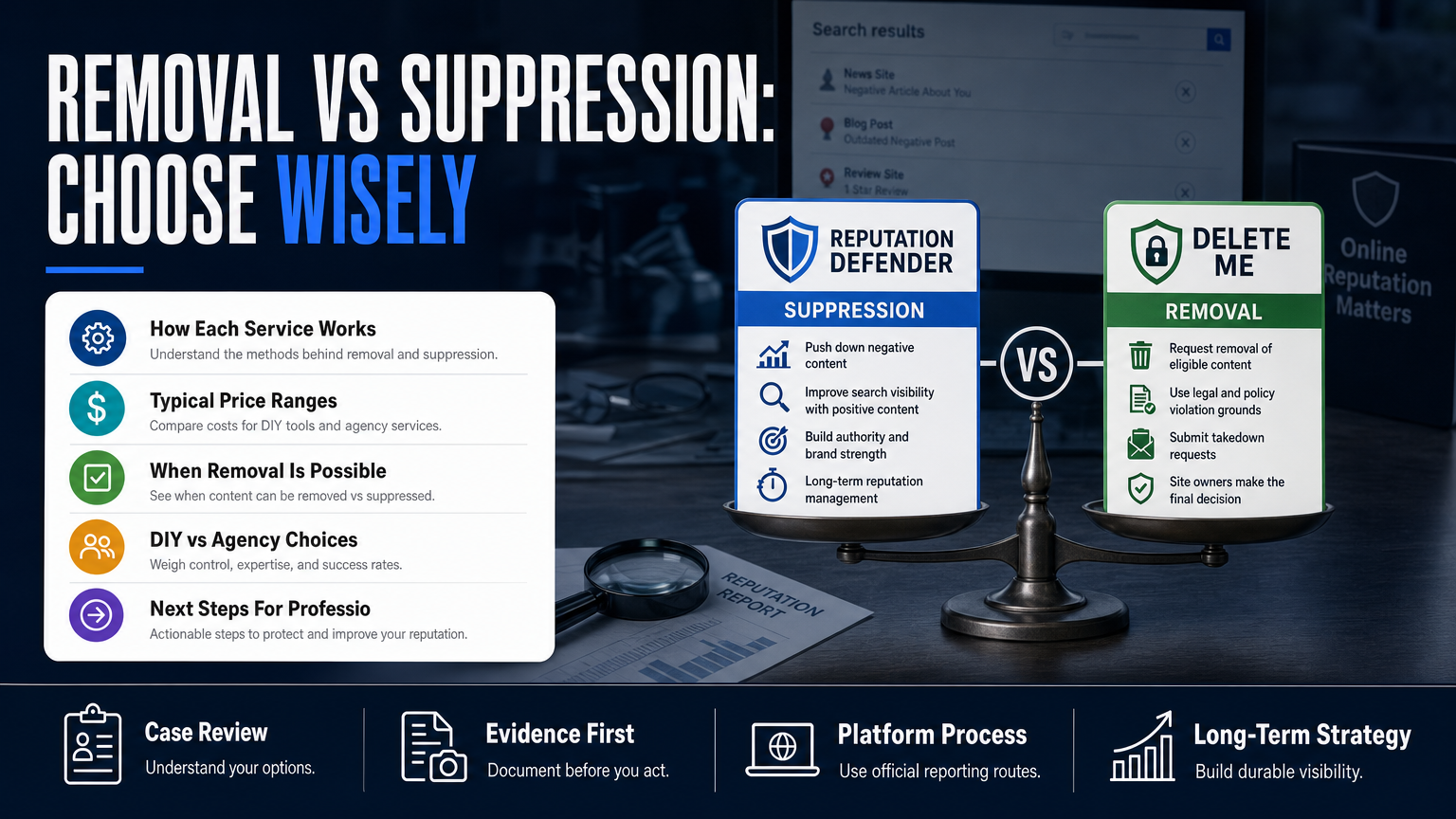
Removal vs Suppression: Which to Prioritise?
A short comparison to help decide the initial tactic based on visibility, evidence and publisher control.
| Removal (Takedown) | Suppression (SEO & PR) |
|---|---|
| Goal: content disappears or is delisted | Goal: content remains but ranks lower |
| Best when platform policy or law is violated | Best when content is lawful or publisher refuses removal |
| Requires evidence, legal or policy basis | Requires content creation and link-building |
| Faster if successful but less predictable | Slower but more consistently achievable |
| May require legal escalation or court orders | Relies on organic and paid search tactics |
| Can be all-or-nothing | Reduces visibility incrementally |
Hypothetical Melbourne clinician: arrest page and three negative reviews
Scenario: A Melbourne clinic’s lead clinician finds an old arrest-record aggregator and three negative Google/industry reviews appearing prominently for their name. The clinician wants the arrest page removed and reviews gone.
Process summary: scope → takedown assessment → publisher outreach → platform reporting → suppression and reputation rebuilding while coordinating with legal counsel.
- 1) Immediate: preserve evidence (screenshots, cached copies) and document dates and contributors.
- 2) Assessment: evaluate whether the arrest page contains private data or inaccuracies that might qualify for removal; review policies of aggregator and hosting provider.
- 3) Platform reports: submit review challenges to Google with evidence where reviews are demonstrably fake or violate policy.
- 4) Publisher outreach: send polite, documented takedown requests to the aggregator and host, escalate to the hosting provider if content includes sensitive personal data.
- 5) Parallel suppression: create authoritative clinician profiles on hospital, medical board, and professional directories; publish news-style biographies and patient-education content to outrank the aggregator.
- 6) Monitor and iterate: track rankings daily for the first two weeks, then weekly; log all platform responses for legal review.
- Audit finds arrest aggregator on page one, two Google reviews with no policy violations, one industry review with hostile language.
- Publisher is offshore and unresponsive to standard requests; platform policies for reviews require documented proof for removal.
Common mistakes we see in Melbourne ORM cases
Mistakes usually cost time and reduce the chance of a successful outcome. Below are common errors and how to avoid them.
1. Acting without preserving evidence
Deleting or altering your own content, or failing to capture screenshots and cached URLs, weakens any later legal or platform claim. Always preserve evidence before attempting removal or asking someone else to take action.
- Use full-page screenshots and note timestamps
- Save cached copies and URLs
- Record any communication with platforms or publishers
2. Chasing immediate removals only
Aggregators, news sites and some publishers will not remove content even when it’s inaccurate. Focusing only on takedowns wastes time; combine removal attempts with suppression strategies.
- Prioritise by impact not emotion
- Plan for SEO and content replacement if removal fails
3. Public emotional responses
Responding publicly in anger can amplify the issue and create new searchable content. Use measured, documented responses or have counsel/PR draft public statements.
- Avoid public feuds on social media
- Use private channels and official statements
4. Paying for fake removals or black‑hat services
Some services promise guaranteed removal or to manipulate search results using deceptive methods. These can cause long-term harm and violate platform terms.
- Decline services that ask you to create fake personas or spam links
- Insist on transparent methods and documented workflows
5. Ignoring specialised review platforms
Industry-specific sites (Healthgrades, RateMDs, RealSelf, Vitals) often have different policies and are overlooked. Ignoring them leaves visible problems in niche searches.
- Audit industry review sites relevant to your field
- Treat each site with its own escalation and evidence requirements
Best practices for Melbourne professionals and SMBs
Adopt durable processes that protect you from the next incident as well as the current one.
1. Start with a full-scope audit
Map Google first-page results, social profiles, review sites and people-search databases for your name and business. That map becomes your recovery blueprint.
- Include variations (misspellings, title + surname, clinic name)
- Identify high-impact items (page one, images, videos)
2. Preserve evidence and document everything
Before you ask for removal or respond publicly, capture screenshots, cached versions and correspondence. Documentation is critical for platform appeals and legal review.
- Archive copies with timestamps
- Log all platform ticket numbers and responses
3. Use a mixed approach: takedown, suppression, PR
Combine platform-based removals with SEO suppression and strategic communications. One tactic rarely solves complex reputation issues alone.
- Prioritise urgent legal risks
- Simultaneously publish authoritative content to outrank negatives
4. Monitor continuously and set alerts
Set up Google Alerts, review monitoring and social listening for your name and brand. Early detection shortens response time and limits spread.
- Daily checks in the first 2–4 weeks after an incident
- Weekly or monthly checks for maintenance
5. Coordinate with legal counsel when needed
Some content may warrant legal review. A qualified attorney can evaluate defamation, privacy breaches and court-ordered takedowns. Agencies should coordinate with counsel as needed.
- Legal steps depend on evidence and jurisdiction
- Do not rely on the agency to provide legal advice unless they explicitly partner with counsel
Expert Tips
- Always capture screenshots before you take any action — platforms remove evidence too.
- If a review is genuine but harmful, respond professionally and offer to resolve offline; that often reduces escalation.
- Prioritise items on page one of Google; they generate the most visibility and most immediate harm.
- Use authoritative, niche platforms (medical boards, industry directories) as anchors to outrank aggregator pages.
- Paid search can act as a short-term buffer while organic suppression takes effect.
- Keep a public FAQ or statement on your official site for common incidents — it gives journalists and clients a single, authoritative source.
- Don’t mix legal threats and public rebuttals without counsel; poorly worded demands can escalate publicity.
- If impersonation occurs, document it, report quickly to the platform and inform any stakeholders (clients, employer) who might be misled.
Conclusion
Online reputation management in Melbourne is strategic work: some items can be removed or reviewed, many can be suppressed, and all require ongoing vigilance. The right mix of legal, technical and PR responses depends on the content, publisher and platform.
If you’re facing urgent damage, start with an evidence-preserving audit and prioritise items that are visible on page one or cause regulatory risk. When removal is unlikely, suppression plus a consistent content strategy and monitoring is the practical path forward.
Why Businesses Choose Your Reputation Agency
Managing your reputation takes more than monitoring reviews or publishing the occasional blog post. It takes a strategy built around your situation, your industry, and what is actually showing up in search.
Your Reputation Agency works with businesses, executives, healthcare professionals, attorneys and growing brands. Our services include:
- Remove or challenge defamatory content and false posts across news sites, blogs and social platforms
- Remove negative reviews from Google, Yelp, Facebook, Trustpilot, Glassdoor and industry review sites (e.g., Healthgrades, RateMDs, RealSelf, Vitals, Angi)
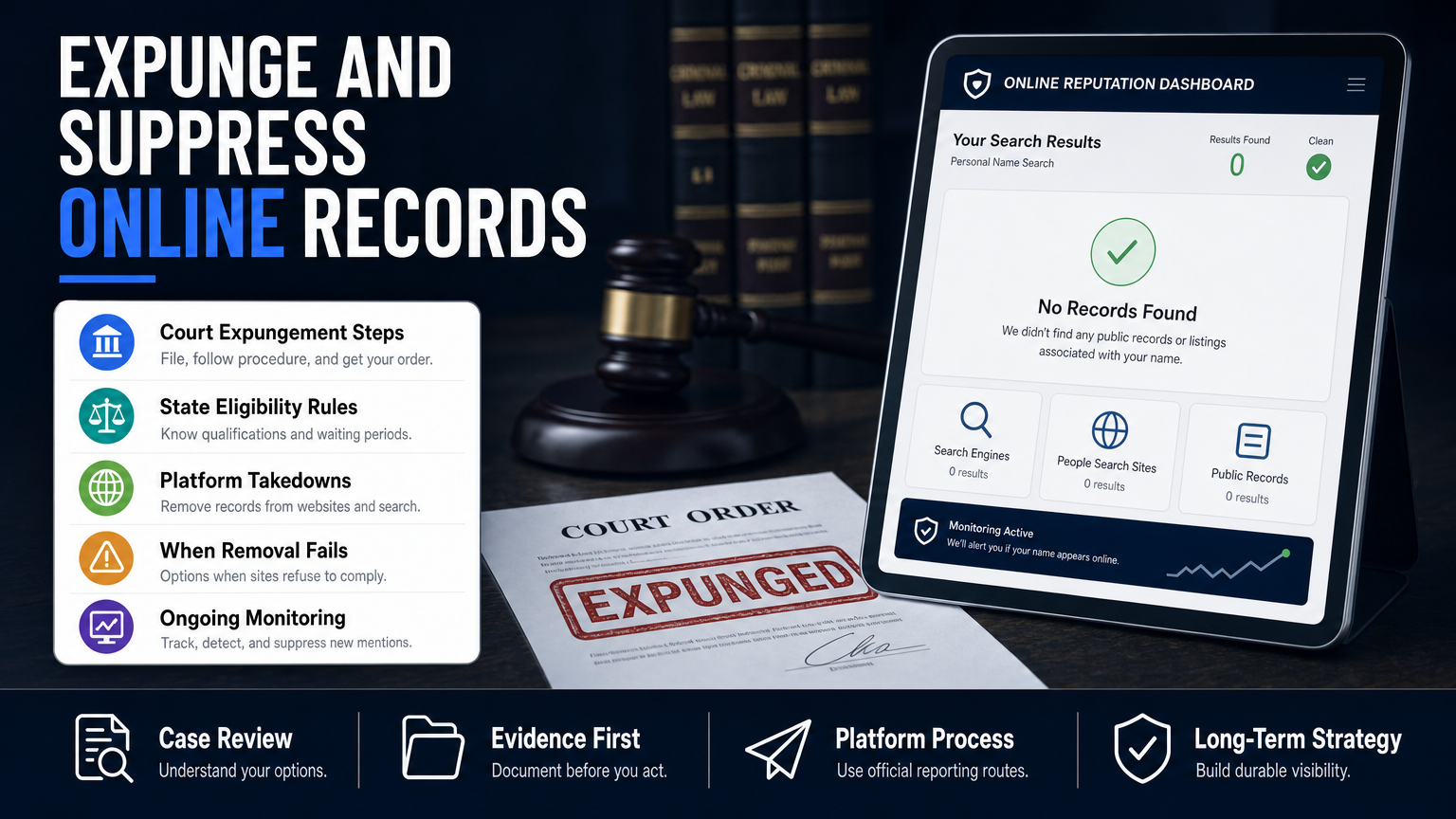
- Mugshot and arrest-record removal and remediation
- Remove or takedown negative videos, YouTube content, TikTok clips and other harmful multimedia
- Remove or suppress negative search results and implement search-engine suppression strategies (SEO to bury bad results)
- Remove personal information and opt-out from people-search and data-broker sites (address, phone, phone number removal)
- Social media impersonation and fake account takedown (reporting and removal on Facebook, Instagram, Twitter/X, LinkedIn, TikTok)
- Reddit and community forum post/comment removal and visibility reduction
- Online crisis management and reputation PR to respond to viral incidents
- Monitoring and alerting for negative content, fake reviews and emerging reputation threats
Frequently Asked Questions
1. How much does online reputation management cost?
Pricing varies by scope. One-off takedown attempts often cost A$500–A$3,000; packages that mix removal and SEO commonly run A$2,000–A$8,000; ongoing retainers for full-service ORM range A$3,000–A$15,000+ per month. Exact pricing depends on platform complexity, legal needs and the number of items to address.
2. How much does an ORM typically cost?
A typical ongoing ORM retainer in Australia is A$1,000–A$10,000 per month depending on inclusions. Lower tiers focus on monitoring and reactive remediation, while higher tiers include proactive SEO, legal coordination and PR. Get a scope-based quote before committing.
3. What are online reputation management services?
ORM services include audits, platform reporting, publisher outreach, legal-tactical options, review management, SEO suppression, content creation, social account restoration and ongoing monitoring. They combine technical SEO, communications and platform-specific escalation protocols.
4. Which SEO company is considered the best in Australia?
There’s no universally accepted ‘best’ company. Choose firms with relevant local experience, transparent processes for review platforms and demonstrable technical SEO capability. Compare firms on verifiable criteria rather than marketing claims.
5. Can you guarantee removal of a negative article or review?
No reputable firm can guarantee removal. We evaluate whether the content may qualify for removal or review and pursue the legal, technical, platform-based, and reputational options available. Platform and publisher decisions remain under their control.
6. How long does it take to see results?
Timing depends on the platform, publisher, evidence and SEO strength of competing pages. Some platform responses happen in days; suppression campaigns may take weeks to months. An estimated timeline can be provided after an individual assessment.
7. What should I do if removal isn’t possible?
When removal is not available, pursue suppression: publish authoritative content, optimise for branded queries, use industry profiles and structured data, and consider temporary paid search to reduce visibility. Combine this with monitoring and PR to rebuild trust.
8. Can I remove fake Google reviews?
You can challenge fake reviews through Google’s reporting processes; removal depends on evidence and whether the review violates policies. If Google won’t remove it, a documented response strategy and reputation-building often reduce harm more effectively than endless appeals.
9. Do agencies act as lawyers in ORM cases?
No. Agencies coordinate with qualified legal professionals when a matter requires legal analysis. The content may warrant legal review; a qualified attorney can determine whether a legal claim may be available and advise on jurisdictional questions.
This content provides general information and does not constitute legal advice. The available options and likely outcomes depend on the facts, evidence, platform policies, applicable law, jurisdiction, and public-interest considerations.
Past examples do not guarantee future results. Removal, correction, deindexing, and search-position changes depend on third parties and circumstances outside Your Reputation Agency’s control.