Information exists about you online across search engines, social profiles, people-search sites, public directories, images, and old accounts. This guide explains how to locate that data carefully and decide whether it should be corrected, secured, or removed.
Find personal information online by checking search engines, social profiles, people-search sites, public directories, images, and old accounts connected to your name. This guide explains how to perform that audit carefully and what to do with the results.
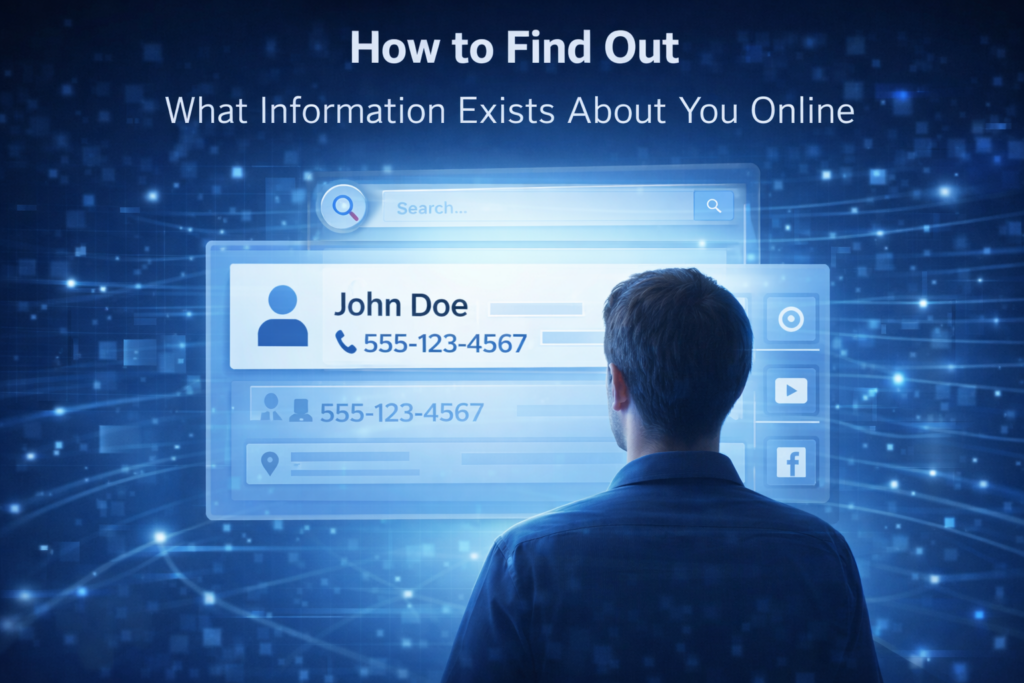
Most people have no idea how much personal information about them is floating around the internet.
From public records to social media, data broker websites, and even old subscriptions, your personal data can be accessed by anyone—sometimes without your consent.
Knowing exactly what information exists about you is the first step to protecting your privacy and preventing identity theft, scams, or reputation damage.
This guide shows you how to uncover your online footprint—and why professional help can save you time and frustration.
Step 1: Start With a Google Search
The simplest first step is searching your own name:
- Use quotes around your full name: “John Doe”
- Search variations: include middle initials, nicknames, and maiden names
- Search your phone numbers, email addresses, and past addresses
Review at least the first 3–5 pages of results. Anything from public records, people search websites, or old forum posts counts.
Step 2: Check Social Media Profiles
Social media often exposes more than we realize:
- Facebook, LinkedIn, Instagram, and Twitter can show your location, workplace, and contacts
- Old posts, photos, or public group memberships may reveal personal info
- Privacy settings are often overlooked
Take notes of anything that could compromise your privacy or reputation.
Step 3: Review People Search Websites
Sites like Spokeo, Whitepages, BeenVerified, and others aggregate public and purchased information.
- Search for your profile on each site
- Note which details are displayed: phone numbers, addresses, family connections, employment history
- These listings often remain online long after you remove them from social media
Step 4: Check Breach Databases
Your data may already be compromised through breaches:
- Use tools like Have I Been Pwned to check your email addresses
- Monitor for leaked passwords or personal info
Even a single breach can expose your data to scammers, hackers, and data brokers.
Step 5: Document Everything
Make a master list of all personal information found, including:
- Website URLs
- Exact data displayed
- Screenshots (optional, for proof)
This will be crucial for removal requests or for a professional service handling the cleanup.
Why Doing This Yourself Can Be Overwhelming
The internet never forgets, and your data spreads quickly:
- Data brokers repackage information
- Search engines cache pages long after they’re deleted
- New platforms continuously publish personal information
Manually tracking everything takes hours or days every week—and most people never catch it all.
Take Control of Your Online Footprint
Finding out what information exists about you is only the first step.
If your data appears on people search sites, public records, or social media—and you want it removed safely and permanently—professional negative content removal services are the fastest, most reliable solution.
Learn more about negative content removal and how to protect your online reputation
Final Thoughts
Your online footprint can impact your privacy, safety, and even your reputation.Understanding what’s out there is critical, but manual removal alone is often insufficient. A professional approach ensures that your personal information is not just found—but removed completely and maintained securely.
How to Find Personal Information Online
To find personal information online, search your full name in quotation marks, then repeat the search with your city, employer, email address, phone number, and common username variations. Review standard web results, images, news, social profiles, public directories, and people-search listings. Record the exact URL and the date for anything inaccurate, outdated, or unnecessarily exposed.
Finding a result is only the first step. Identify whether the information is hosted by a social network, data broker, public-record source, publisher, or search engine. Removal must usually begin with the source website. The Federal Trade Commission’s online privacy guidance explains practical ways to reduce exposure. You can also follow our guide to removing personal information from the internet after completing your audit.
Repeat this process every few months because new profiles and cached references can appear. A consistent monitoring routine makes it easier to find personal information online early, preserve evidence, and request corrections before exposure creates a larger privacy or reputation problem.