How to Rebuild Your Reputation After Online Defamation
In a digital world where a single post can reach thousands within minutes, Rebuild Your Reputation after online defamation has become one of the most pressing challenges for professionals, entrepreneurs, and public figures in the United States.
A false review, manipulated video, or defamatory post can harm years of hard-earned credibility in a matter of hours.
For many Americans, especially those working in high-visibility sectors like healthcare, politics, and real estate, recovering from a reputational attack is not only about image — it’s about survival in a highly connected economy.
The Federal Trade Commission (FTC) has reported that misinformation complaints rose by nearly 30% in 2023, with a significant portion tied to social media.
In major markets such as New York City, Los Angeles, and Dallas, cases of online defamation have forced professionals to take decisive legal and digital steps to repair their credibility and protect future business.
The question many face is: where do you start when your good name has been damaged online?
Understanding the Real Impact of Online Defamation
Defamation isn’t just an online inconvenience — it’s a direct threat to reputation, trust, and financial stability. Whether it’s a baseless accusation on TikTok or a false article shared across Facebook, the ripple effects are profound.
Professionals who once enjoyed public confidence may suddenly find themselves scrutinized by clients, employers, and even regulators.
Consider a medical specialist in Miami who faced a viral accusation from a fake patient account.
Although the claim was false, it led to appointment cancellations and negative media attention, including damaging reviews that later required Google review removal to stabilize her online presence. With professional help and a clear digital strategy, she managed to Rebuild Your Reputation within six months, combining legal removals with positive SEO campaigns that highlighted verified testimonials and press coverage.
These situations reveal that defamation is not only about public image — it’s about power dynamics in a digital age.
In the United States, where consumers rely heavily on online research before making decisions, reputation is currency.

Real Cases and Lessons from Across the United States
In Los Angeles, a restaurant owner learned firsthand how online defamation can devastate business. A competitor posted a false claim that the establishment violated health codes.
Within days, the business’s Google rating plummeted. Yet through a combination of digital forensics, legal reporting, and coordinated PR—including negative review removal—the owner was able to Rebuild Your Reputation — recovering both trust and clientele.
Similarly, in Chicago’s political scene, a city council candidate faced defamatory rumors about campaign funding.
Rather than engaging in public confrontations, the campaign used verified financial disclosures, media partnerships, and a digital reputation team to reframe the narrative.
This transparent, fact-based approach is what ultimately helped Rebuild Your Reputation and demonstrate accountability — a lesson that extends beyond politics into every industry.
How to Strategically Rebuild Your Reputation?
The first step in Rebuild Your Reputation after online defamation is documentation. Save every screenshot, URL, and timestamp of defamatory material.
Evidence is essential if legal action becomes necessary under state defamation laws.
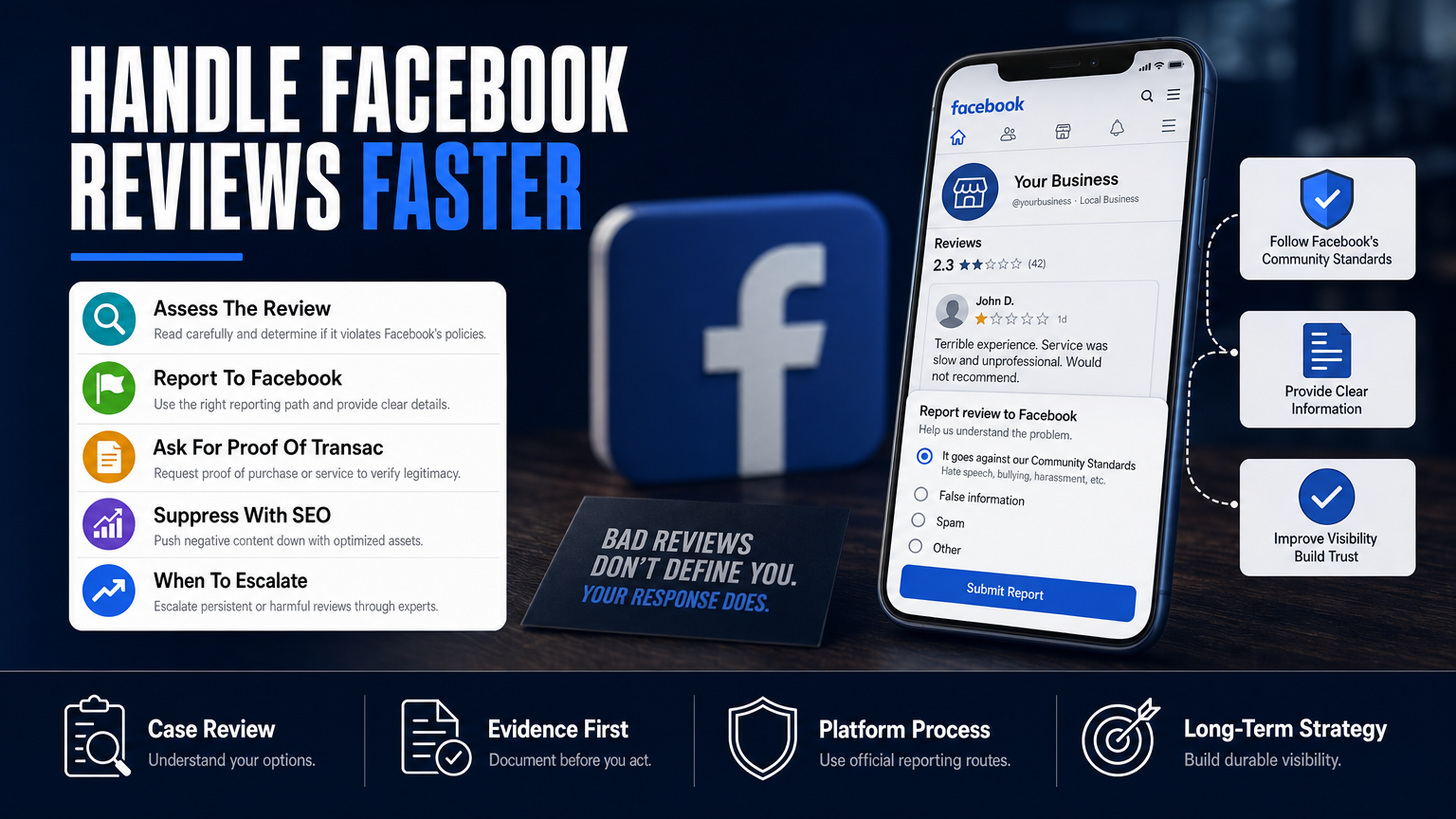
The second step is removal. Platforms such as Meta and Google offer defamation reporting systems that allow users to request takedowns of harmful or false content, including formal Facebook content removal and Instagram content removal processes when platform policies are violated.
For example, Facebook’s “Defamation and Misinformation Report” and Google’s “Content Removal Request” are critical tools for individuals facing public attacks.
However, removal alone isn’t enough. The most effective strategies to Rebuild Your Reputation combine content suppression with digital rebuilding — producing truthful, verifiable, and high-quality content that outranks the defamatory materials.
This is where search engine optimization (SEO) plays a transformative role. By publishing accurate articles, interviews, and client testimonials, you don’t just hide falsehoods — you replace them with truth.
Professional assistance from reputation management firms can accelerate this process. These teams utilize Natural Language Processing (NLP) algorithms and Latent Semantic Indexing (LSI) keywords to ensure new, positive content ranks prominently on Google, Yahoo, and Bing, helping individuals and businesses recover their digital authority faster.

Frequently Asked Questions
1. How long does it take to Rebuild Your Reputation after online defamation?
Recovery times vary depending on case severity. On average, digital restoration campaigns take three to six months.
2. Can I sue someone for online defamation?
Yes. Under U.S. defamation law, you can pursue legal action if the statements are false, damaging, and made publicly with negligence or malice.
3. How do I start removing defamatory content?
Begin by reporting it to the hosting platform (Facebook, TikTok, Google, etc.). If removal fails, consult a legal professional or a digital reputation agency.
4. Will positive content really help suppress defamatory material?
Absolutely. SEO-optimized, verified content helps push false materials lower in search results, allowing accurate information to dominate visibility.
5. Should I publicly address the defamatory claims?
It depends on the context. In most cases, responding privately through official statements or third-party validation is more effective than public confrontation.
The Path Forward: Turning Damage into Opportunity
Rebuilding isn’t about erasing the past; it’s about controlling the narrative going forward. To Rebuild Your Reputation effectively, transparency and consistency matter as much as legal action. In the United States’ fast-paced digital economy, reputation is no longer static — it’s dynamic, shaped by every click, post, and share.
While the damage from online defamation can be painful, recovery is possible — and often, it becomes a turning point for long-term brand growth. By embracing strategic communication, legal precision, and digital visibility, you don’t just restore credibility — you strengthen it.
At Your Reputation Agency, we specialize in helping individuals and organizations Rebuild Your Reputation through tailored strategies that combine legal expertise, content optimization, and online visibility management.
From CEOs in Silicon Valley to doctors in Houston, our mission is to help you reclaim control of your digital narrative and protect it for the future.
Don’t let defamation define your story. Contact Your Reputation Agency today to Rebuild Your Reputation, remove harmful content, and restore your good name across all digital platforms.
Follow us on social media:
Don’t forget to read our blog. Here is a link to our previous post: Reporting defamation: step by step guide for Meta