Understanding the Difference Between Criticism and Defamation: The Fine Line Between Opinion and Harm
In today’s digital America, where every opinion can be published, shared, and magnified within seconds, understanding the difference between criticism and defamation has become a vital skill for professionals and businesses alike — especially as reputations are shaped across social platforms that often require cross platform reputation management.
From New York journalists to Silicon Valley entrepreneurs, reputations are made—and unmade—online. The line between expressing a personal opinion and making a damaging accusation has never been thinner.
In a society that values freedom of speech as deeply as the United States does, it’s easy to confuse open dialogue with permissible harm.
But when a comment crosses into falsehood, the law steps in. Knowing where this boundary lies isn’t just a legal necessity—it’s a survival skill in the digital age.
The Legal and Social Importance of This Distinction
At its core, criticism is protected by the First Amendment. Americans are free to voice opinions—even harsh ones—about public figures, companies, or services.
For example, saying, “That restaurant in Chicago has terrible service” is considered fair opinion. However, when someone claims, “That restaurant serves contaminated food and cheats customers,” without evidence, that’s where defamation begins — often leading to removal requests similar to negative review takedowns.
In the United States, defamation law varies by state. In California, courts have ruled that even social media posts can constitute defamation if they include false statements presented as fact.
Meanwhile, in Texas, small businesses have increasingly filed suits to combat false online reviews that lead to financial harm.
The challenge lies in distinguishing between freedom of expression and reputational damage. As Americans grow more reliant on digital platforms, understanding the difference between criticism and defamation has become essential for both content creators and their audiences.

Examples from Across the U.S.: When “Opinions” Turn Dangerous
Consider a small law firm in Miami, recently targeted by a former client who claimed on TikTok that the attorneys mishandled her case and “stole” her money.
The statement was false, but the video gained traction, reaching thousands within hours. The firm suffered reputational harm and lost clients before they could legally respond — a situation that often requires defamatory TikTok content removal.
In Los Angeles, a freelance designer faced similar issues when a competitor publicly accused her of copying work. The accusation, made without evidence, resulted in contract cancellations.
Once again, what seemed like “criticism” became actionable defamation when false claims caused quantifiable harm.
These stories show that the question isn’t whether people can criticize—of course they can—but whether they can spread falsehoods under the guise of opinion.
Courts across the U.S. are adapting to this modern reality, weighing the balance between expression and accountability in the age of viral communication.
How to Tell the Difference: Opinion vs. Falsehood
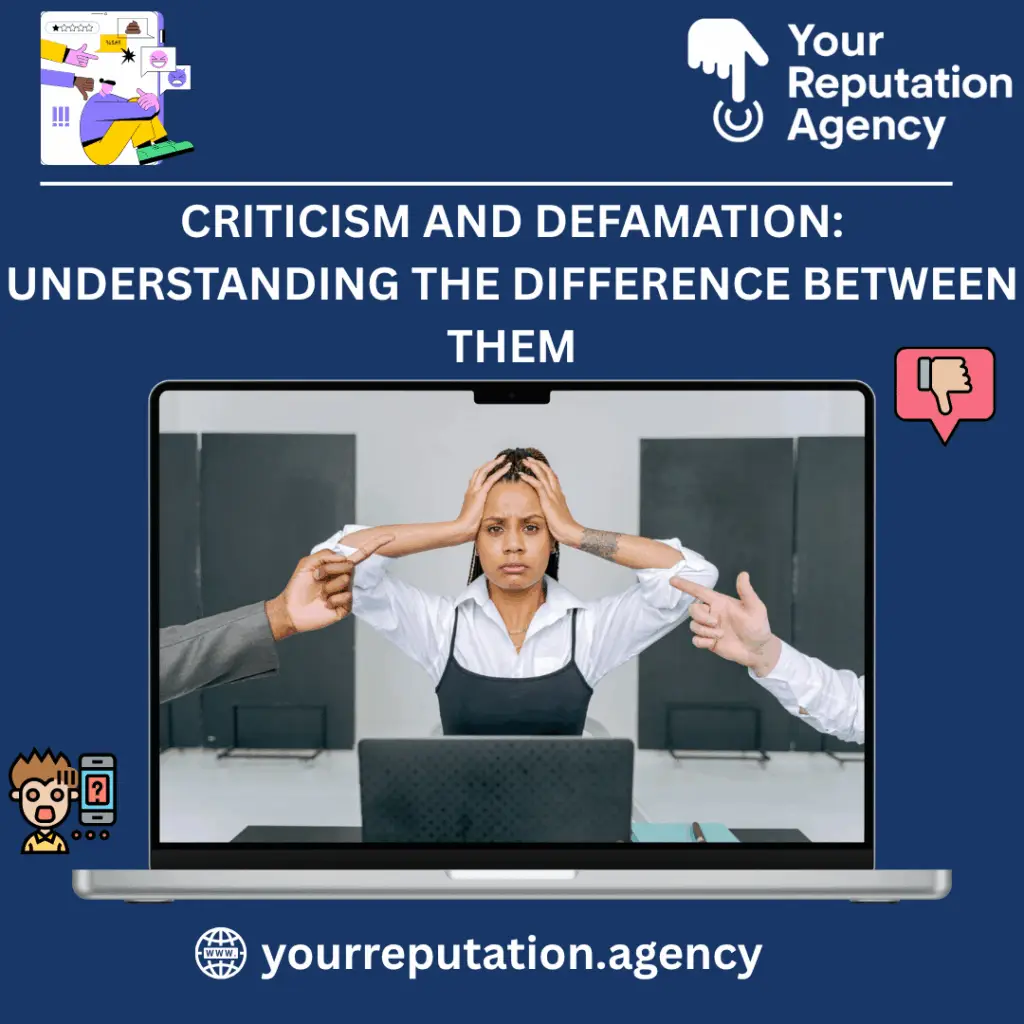
The key to understanding the difference between criticism and defamation lies in intent, evidence, and impact. Criticism, even if harsh, is subjective and opinion-based.
Defamation, on the other hand, involves factual claims that can be proven false.
For instance, stating “This politician’s ideas are outdated” is protected speech. But claiming “This politician accepted illegal donations” without evidence is defamatory.
The difference may seem small—but legally, it’s enormous.
Platforms like Facebook, Instagram, and TikTok have blurred these distinctions further. A sarcastic post or viral meme can sometimes have the same impact as a false news article.
That’s why individuals and businesses must be proactive—monitoring mentions, archiving evidence, and engaging legal or reputation management experts before the damage spreads.

5 Frequently Asked Questions About Understanding the Difference Between Criticism and Defamation
1. Can I be sued for posting a negative review?
Not if your review is truthful and based on personal experience. However, false claims that harm a business’s reputation can lead to defamation suits.
2. What counts as opinion versus defamation?
Opinions are subjective statements, while defamation involves false factual assertions that can be proven untrue.
3. Can social media posts be used as evidence in court?
Yes. Screenshots, timestamps, and archived copies are admissible in defamation cases across the U.S.
4. What should I do if I’m defamed online?
Collect evidence immediately, avoid responding emotionally, and consult with a digital reputation management or legal expert.
5. Is defamation harder to prove for public figures?
Yes. Under U.S. law, public figures must also prove “actual malice”—that the false statement was made knowingly or with reckless disregard for the truth.
The Cultural Context: Freedom of Speech and Responsibility in the U.S.
The United States has always celebrated open discourse. Yet, the internet has transformed free speech into an unpredictable force.
In Washington D.C., debates about regulating misinformation continue to shape policy. Meanwhile, industries from healthcare to entertainment face daily battles against false claims that spread faster than official corrections.
Understanding the difference between criticism and defamation is now not only a matter of legal defense—it’s about preserving integrity in a society overwhelmed by noise.
Americans have the right to express, but also the duty to do so responsibly.
Reflection: The Future of Accountability and Truth
As the U.S. navigates the complexities of digital communication, the question isn’t whether we can speak freely, but how we can do so without destroying reputations unjustly.
Understanding the difference between criticism and defamation reminds us that truth is not only moral—it’s strategic.
Reputation, once lost, is difficult to rebuild. The future will favor those who balance authenticity with accountability.
In a landscape dominated by content, credibility remains the ultimate currency.
At Your Reputation Agency, we help clients across the United States protect their digital image, remove defamatory content, and navigate public crises with integrity and precision.
Your voice matters—make sure it speaks truth, not harm.
Visit yourreputation.agency today to safeguard your name and your business.
Follow us on social media:
Don’t forget to read our blog. Here is a link to our previous post: Can You Sue for Defamation on TikTok or Instagram?