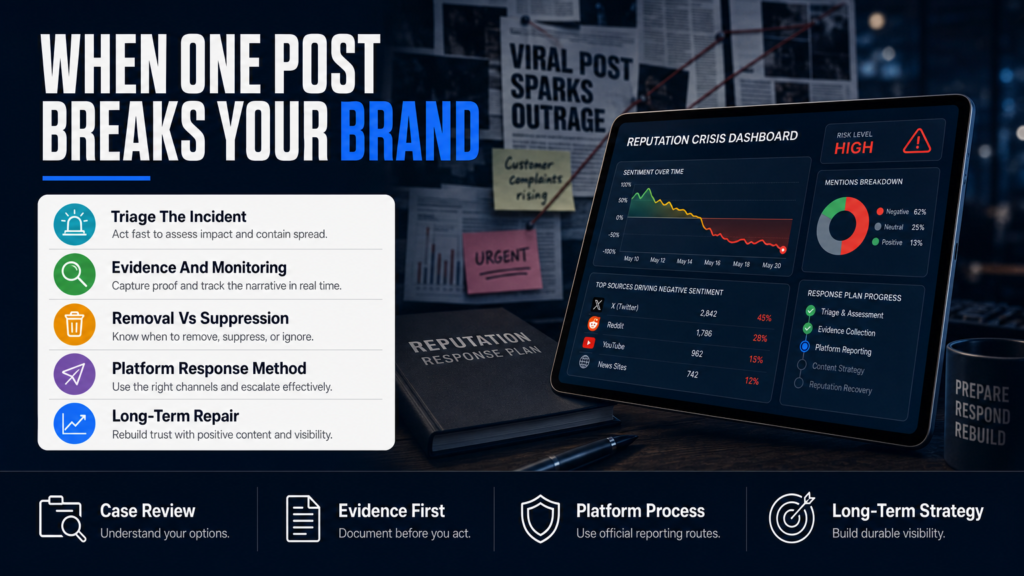
You just found a negative story, viral post, or a stream of one‑star reviews that suddenly dominates searches for your company. Phone calls and DMs are coming in. Hiring managers and partners will see the first page of Google before they hear your explanation.
This article explains how brand reputation crisis management works in real situations: what to do in the first 24–72 hours, how to collect evidence, which platform and legal options to consider, and what to do when removal isn’t available.
We give concrete, platform‑specific steps (Google, Yelp, TikTok, Reddit, review sites), a decision checklist for legal vs. PR action, and a suppression workflow you can start immediately to reduce visibility and restore trust.
If you need immediate guidance, the steps here are intended to help you act clearly and quickly; timing and outcomes depend on the platform policies, the publisher, evidence, and jurisdiction.
Table of Contents
- What brand reputation crisis management actually covers
- The early hours: how to respond in the first 24–72 hours
- Legal, platform, and PR options — which to use when
- When removal is not available: mitigation, correction, and SEO suppression
- Monitoring and evidence collection: what to track immediately
- Repair phase: restoring trust over weeks and months
- Platform‑specific tactics: Google, review sites, social, and forums
- Choosing between DIY and hiring a reputation agency
- Removal vs. Suppression — When to Pick Each
- Hypothetical scenario: a viral customer complaint and the coordinated response
- Common mistakes teams make during a brand crisis
- Best practices for managing and recovering from a brand crisis
- Expert Tips
- Conclusion
- Why Businesses Choose Your Reputation Agency
- Frequently Asked Questions
What brand reputation crisis management actually covers
Brand reputation crisis management is the coordinated set of actions—legal, technical, PR, and SEO—used to limit the impact of damaging online content and to restore trust. The term ‘brand reputation crisis management’ describes both the emergency response and the follow‑through work that reduces visibility and corrects record where possible.
This is not a promise of removal or a guaranteed ranking outcome. We evaluate whether content may qualify for removal or review and pursue the options available: platform takedowns, publisher corrections, legal routes when warranted, and SEO suppression when removal is unlikely.
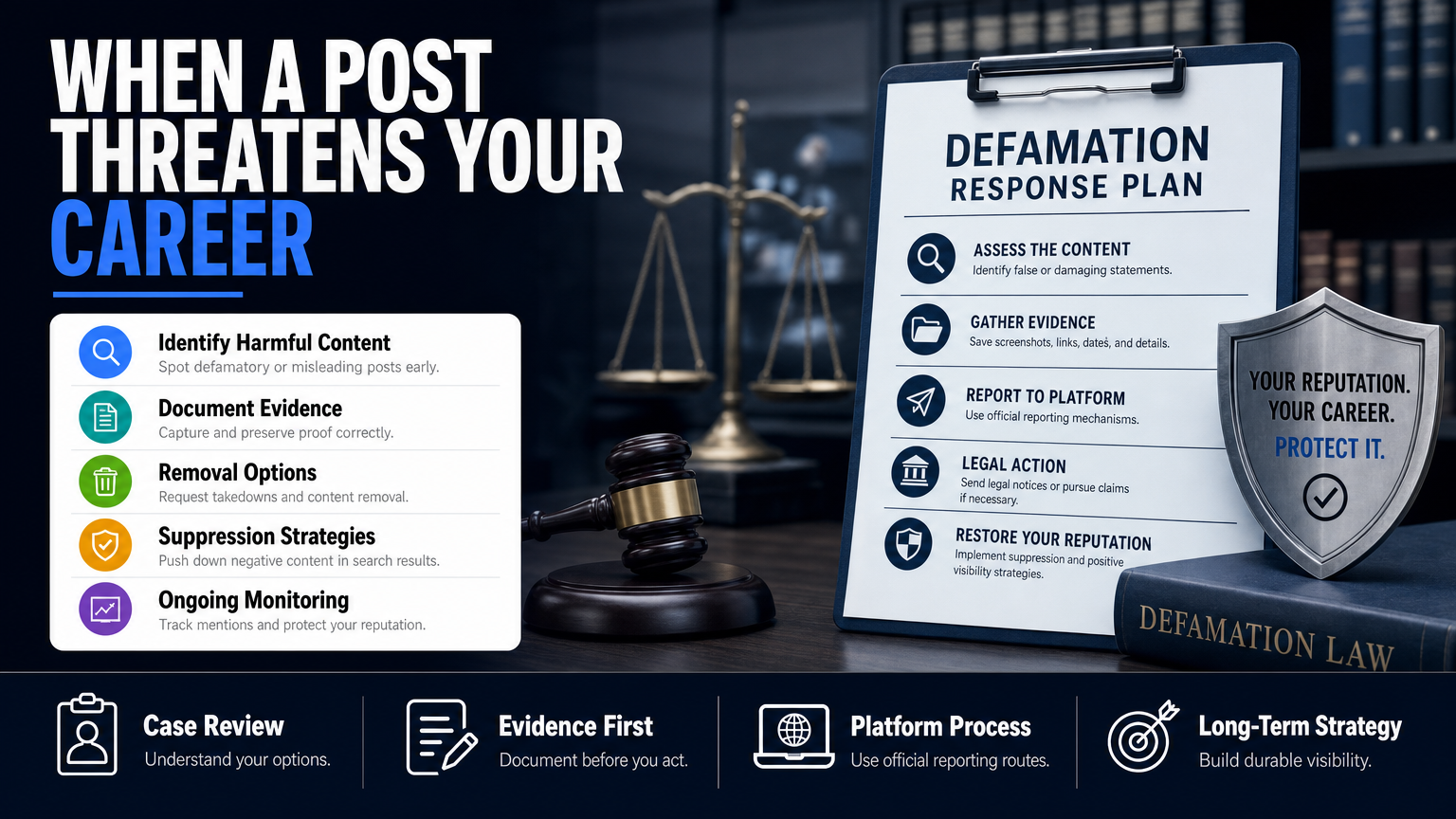
- Identify the core damaging content and where it appears (search results, review sites, social).
- Assess whether the content is false, a privacy violation, harassment, or protected opinion.
- Decide who is the spokesperson and prepare a short, factual holding statement.
- Triage and messaging: who speaks and what they say in the first hours
- Platform actions: report, appeal, or request correction per site rules
- Legal review: whether the content may support a defamation, privacy, or other claim
- Reputation SEO: create high‑quality countercontent to push negative items down
- Monitoring and remediation: ongoing surveillance and corrective measures
How this differs from routine reputation work
A crisis requires immediate triage and an integrated response across channels. Routine reputation management is proactive—optimizing profiles and generating positive content—while crisis work prioritizes containment and evidence preservation.
- Emergency monitoring vs. periodic checks
- Rapid legal triage vs. long‑term contracts with counsel
- Centralized messaging vs. regular marketing communications
The early hours: how to respond in the first 24–72 hours
The first 24–72 hours are about triage: stop further damage, preserve evidence, and control the narrative. Brand reputation crisis management in this window is tactical—respond to urgent harms while avoiding moves that escalate the situation.
If a public apology or statement is being considered, evaluate whether it will help or make the situation worse (see the linked discussion for when apology videos backfire).
- Collect and archive screenshots, links, timestamps, and user profiles immediately.
- Categorize the incident: inaccurate allegation, privacy leak, review‑bombing, impersonation, or harassment.
- Decide whether a public acknowledgement, correction request to the publisher, or silence is the least harmful initial option.
- Assemble a small response team (legal, communications, operations) and name one spokesperson.
- Publish a holding statement on owned channels if the incident is public and affecting customers.
- Suspend or lock implicated accounts to prevent further harm (with documented reasons).
A note on apologies and video statements
An apology can help when it’s sincere, narrowly focused, and accompanied by action. But a high‑production or defensive video posted to TikTok or elsewhere can amplify the story and create new search results. For empirical reasons and platform dynamics, consider expert counsel before producing a public video response.
- Measure audience: will the apology reach the impacted customers or primarily new viewers?
- Keep language factual and remedial; avoid admitting liability unless counsel advises.
- Test a short holding statement internally before posting publicly.
Legal, platform, and PR options — which to use when
Choose actions based on the type of content, the publisher, and jurisdiction. Some content qualifies for platform removal; other content may merit a legal demand, publisher correction, or a combination.
We coordinate with qualified legal professionals when a matter requires legal analysis. The content may warrant legal review, but the availability and advisability of legal remedies depend on the evidence and applicable law.
- Report using the platform’s official process and keep records of submissions.
- Send a documented correction request to the publisher with evidence and a deadline.
- If warranted, ask counsel to evaluate a legal demand or court filing.
- Platform takedowns: best for policy violations (doxxing, impersonation, explicit privacy breaches).
- Publisher corrections and retractions: suitable when the story contains false factual claims.
- Legal cease‑and‑desist or defamation claims: used when correction requests fail and evidence supports legal action.
- Reputation SEO and suppression: used when removal is not possible or would be slow.
How platforms differ
Facebook, Instagram, X, TikTok, Reddit, Google Search and Maps, and review sites each have different policies and counters. We use the official reporting and review processes made available by platforms. Platform decisions remain under the platform’s control.
- Google: search indexing and Maps reviews require requests to Google and publisher corrections.
- Yelp and Trustpilot: have review‑removal and mediation processes but rely on evidence.
- TikTok/YouTube: appeals are possible but visibility can spike with pushback.
- Reddit/forums: moderators or admins can remove posts, but content often persists via screenshots.
When removal is not available: mitigation, correction, and SEO suppression
Many damaging items are opinion, lawful reportage, or truthful public records and cannot be removed. Brand reputation crisis management includes a clear plan for these scenarios: correct where possible, create authoritative countercontent, and reduce visibility with SEO suppression.
Suppression is not a guarantee; search results change because algorithms, competitors, publishers, and user behavior are outside our control. We develop SEO reputation strategies intended to improve the visibility of relevant and credible information.
- Inventory all owned assets (sites, profiles, directories) and ensure they are optimized.
- Create prioritized content (response page, FAQ, corrected article) aimed at the keywords the negative item ranks for.
- Track ranking movement weekly and adjust the content plan based on which assets gain traction.
- Publish clear, authoritative content (press release, FAQ, leadership bio) on high‑authority domains you control.
- Amplify owned content via social channels and earned media to build signals.
- Use structured data, canonical tags, and timely content to nudge search engines toward preferred pages.
- Consider paid placements or promoted content for immediate visibility when appropriate.
Quick suppression playbook
Target three things first: 1) an owned response page with facts and corrective details, 2) authoritative third‑party content (guest post, interview), and 3) optimized social profiles that rank for the brand name.
- Owned response page with clear headline and metadata
- Press outreach to secure one or two high‑authority articles
- SEO‑optimized bios for executives on corporate and third‑party sites
Monitoring and evidence collection: what to track immediately
Good monitoring is the foundation of an effective response. Brand reputation crisis management requires immediate evidence capture and ongoing surveillance to detect amplification, copycats, and new posts.
We handle matters confidentially and apply appropriate privacy and security controls while collecting and preserving records for platform appeals or legal review.
- Capture evidence on an air‑gapped device or secure network when possible.
- Export reports from platforms (where available) that include moderation IDs.
- Share evidence with counsel or your crisis team as part of the intake packet.
- Take time‑stamped screenshots and save page source (HTML) for all offending content.
- Record URLs, author handles, and any metadata (IDs, timestamps, comment threads).
- Set up keyword alerts (Google Alerts, Talkwalker, platform notifications) for early detection.
- Use a central case log to record all outreach, responses, and internal decisions.
Essential evidence list
Preserve copies of every relevant page, the account profiles, links to related posts, and any direct communications (emails, DMs) that relate to the incident.
- Screenshots with visible timestamps and URLs
- Archived copies via the Internet Archive or site downloads
- Correspondence with platforms and publishers
- Internal notes of customer complaints or operational impacts
Repair phase: restoring trust over weeks and months
After containment, recovery focuses on restoring trust with customers, partners, and employees. That work is strategic and requires patience: a repair campaign typically runs weeks to months and mixes earned media, customer outreach, and continued SEO work.
Recovery is a measured program: you should expect incremental improvements rather than instant erasure, and maintain transparent documentation of the steps you take.
- Draft a remediation timeline with milestones and responsible owners.
- Launch a content calendar for positive, authoritative material aligned to keywords.
- Measure sentiment and search visibility monthly and adjust tactics.
- Customer outreach: targeted communication to affected clients with remediation steps.
- Operational fixes: publicize policy or product changes to show corrective action.
- Third‑party validation: independent audits, customer testimonials, or certifications.
- Ongoing monitoring to spot recurrence or related content.
When to reintroduce paid marketing
Resume paid campaigns when owned messaging is stable and landing pages reflect the corrected narrative. Paid placements can accelerate visibility for authoritative content but should not go live while the issue is unresolved.
- Ensure landing pages answer the questions users are seeing in search results
- Use narrow geo or audience targeting initially to limit exposure
- Monitor click‑through and sentiment metrics closely after launch
Platform‑specific tactics: Google, review sites, social, and forums
Each platform has its own rules and practical tactics. For immediate guidance, follow the platform’s official reporting process and prepare evidence. Platform decisions remain under their control.
Below are the practical steps and caveats for the most common platforms encountered in brand crises.
- Prioritize platforms by reach and impact (search results first, then reviews, then social),
- Use platform native reporting, then escalate to publisher corrections if necessary.
- Monitor replicated content on smaller sites; one original post can spawn dozens of copies.
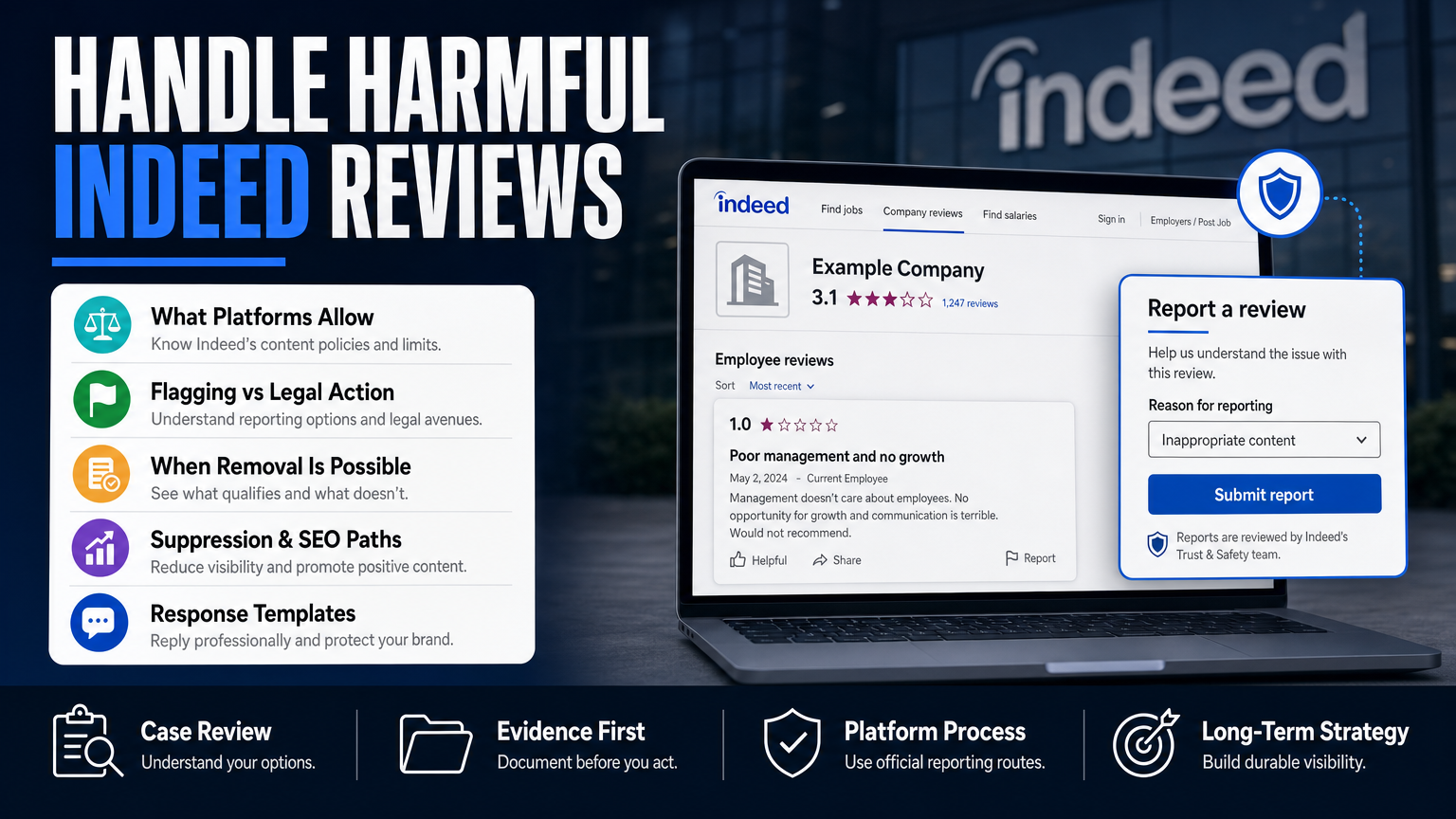
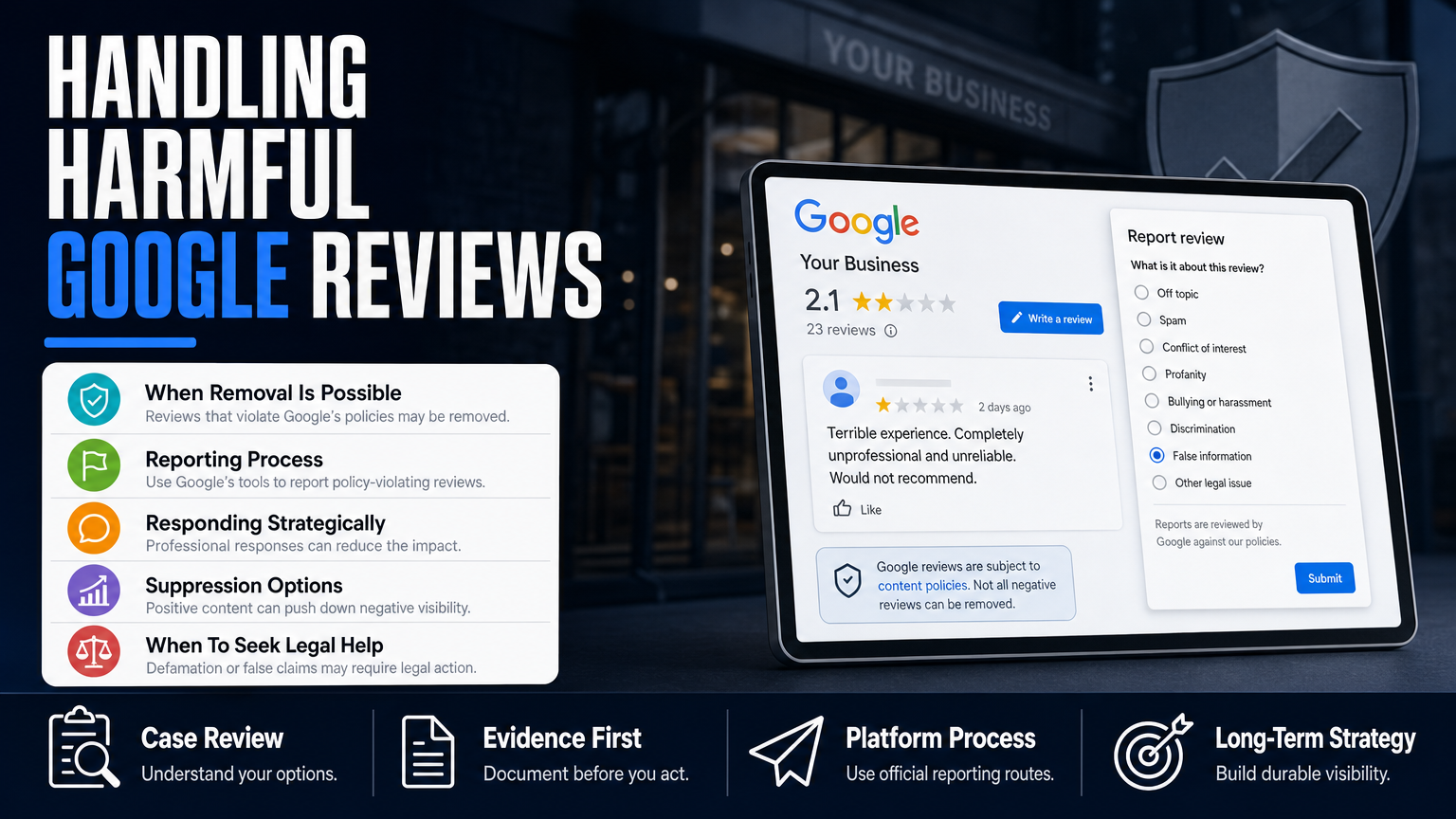
- Google Search and Maps: request delisting or corrections from the publisher; use Search Console for owned sites; submit legal removal requests when a clear legal basis exists.
- Yelp and Trustpilot: gather proof of moderation violation or purchase verification issues; follow site dispute processes.
- TikTok and YouTube: appeals can be submitted, but viral posts often create new visibility; consider content that answers or corrects rather than only reacting.
- Reddit and niche forums: contact moderators or admins, but assume screenshots will continue to circulate.
When to involve an agency vs. DIY
If the crisis affects hiring, revenue, or regulatory risk—or if multiple platforms and jurisdictions are involved—engaging experienced reputation professionals speeds coordination. When the problem is a small-scale review or a single factual error, a disciplined in‑house response may suffice.
If you’re evaluating vendor support, read postmortems and ask for process details rather than guaranteed outcomes.
- Agencies handle cross‑platform appeals, SEO suppression, and publisher outreach at scale.
- DIY makes sense for clear factual fixes and low‑volume incidents.
- If using external partners, understand billing, confidentiality, and escalation paths.
Choosing between DIY and hiring a reputation agency
Deciding between a DIY response and hiring outside help depends on bandwidth, complexity, and risk. An agency typically offers coordinated platform appeals, SEO suppression expertise, ongoing monitoring, and relationships with third‑party publishers—though no agency can promise removal or special access.
If you’re using or vetting outside providers, pay attention to their documented processes and ask for references that demonstrate crisis coordination (not specific results). For more on potential pitfalls with outsourced services, see the agency analysis on white‑label review handling.
- List the assets and platforms affected and estimate internal capacity to manage them.
- Ask prospective agencies for a written scope, escalation plan, and sample workflows (not promises).
- Choose the path that balances speed, legal risk, and resource availability.
- DIY pros: lower cost, direct control, faster small fixes.
- DIY cons: can lack scale, legal coordination, and SEO expertise.
- Agency pros: integrated multi‑channel responses, monitoring infrastructure, experience with publishers and platforms.
- Agency cons: cost, slower onboarding, and variable quality—ask for documented playbooks.
Warning: white‑label services and review handling
Some vendors resell reputation services through white‑label arrangements. If you depend on a white‑label partner for review remediation, you should understand who is performing the work and how claims are documented. See an independent breakdown of issues that can arise with resold review services for more context.
- Confirm the partner’s escalation policies and who has platform credentials
- Require transparent reporting of outreach and moderation outcomes
- Avoid vendors who promise guaranteed removals or hidden platform access
Removal vs. Suppression — When to Pick Each
A pragmatic comparison to help select the right approach based on content type and control.
| Removal (Platform/Publisher/Legal) | Suppression (SEO & PR) |
|---|---|
| Appropriate when content violates policy or is demonstrably false | Appropriate when content is lawful, opinion, or public record |
| Can be fast for clear policy breaches | Often faster to implement but may take weeks to affect rankings |
| Relies on platform or publisher decision | Relies on content quality, domain authority, and promotion |
| May involve legal costs and jurisdictional complexity | Requires content creation, SEO, and ongoing monitoring |
| Outcome uncertain and not guaranteed | Outcome varies; movement depends on competitive content and algorithms |
Hypothetical scenario: a viral customer complaint and the coordinated response
Situation: A local clinic receives a viral social post alleging poor patient care. The post appears in search results for the clinic’s name and spawns negative comments and several one‑star reviews. The clinic loses appointment requests over 72 hours.
This anonymized scenario walks through the triage, platform action, legal triage, and suppression steps a response team would take—nothing here portrays an actual client.
- Triage (Hour 0–24): Assemble response team; capture screenshots and URLs; post a brief holding statement explaining that the clinic is investigating and will share updates.
- Platform actions (Day 1–3): Report doxxing content or explicit policy violations; request removals where the post contains identifying patient information; flag impersonation if accounts are fake.
- Legal and publisher outreach (Day 2–7): Send a documented correction request to the original poster and the largest syndicating blog; ask counsel to evaluate whether the post contains actionable false statements or privacy violations.
- Suppression (Week 1–8): Publish an FAQ and official response on the clinic site; secure a local news interview and guest column from the medical director; optimize staff bios and Google Business Profile pages to push negative links lower.
- Monitoring and repair (Month 2+): Maintain crisis monitoring, respond to legitimate patient concerns offline, collect new testimonials, and document policy changes publicly.
- Immediate impact: drop in inbound calls, increased DM volume, at least two copied articles on local blogs.
- Primary risks: reputational damage to clinicians, regulatory attention, and lost revenue.
Common mistakes teams make during a brand crisis
Avoid these predictable missteps—each one can amplify harm or slow recovery.
1. Speaking without a single coordinated message
Multiple spokespeople posting different messages causes confusion and fuels the story. Centralize approvals and use a single brief holding statement until you have facts.
- Designate one spokesperson
- Limit public posts until legal and communications have reviewed
2. Demanding deletions as the only tactic
Focusing solely on removal overlooks mitigation strategies. Removal may be appropriate in some cases, but you should simultaneously prepare suppression content and customer outreach.
- Pursue platform/publisher requests while building countercontent
- Document everything in case legal action becomes necessary
3. Ignoring evidence collection
Failing to archive posts, screenshots, and metadata undermines appeals and potential legal claims. Preserve records from the outset.
- Save HTML and screenshots with timestamps
- Export platform reports when available
4. Overreacting with a defensive public statement
A defensive or blaming statement can validate the story and generate further coverage. Keep early public messages factual, empathetic, and remedial.
- Avoid inflammatory language
- Focus on next steps and remediation
5. Relying on a single channel for recovery
Recovery needs multiple signals: owned content, third‑party validation, and social proof. Relying only on one tactic (e.g., buying ad placements) rarely restores trust fully.
- Combine SEO, PR, outreach, and operational fixes
- Measure sentiment and adjust across channels
Best practices for managing and recovering from a brand crisis
Adopt a disciplined, documented, and multi‑channel approach. The following durable practices reduce risk and accelerate recovery.
1. Run tabletop exercises and create a crisis playbook
Prepare realistic scenarios and assign roles in advance. A documented playbook reduces confusion when time is short.
- Include escalation thresholds and legal contact information
- Practice the holding statement and approval workflow
2. Preserve evidence and maintain a single case log
Use a secure repository for screenshots, correspondence, and platform IDs so every action is auditable.
- Record timestamps, names, and moderator responses
- Share evidence only on a need‑to‑know basis
3. Prioritize transparency with stakeholders
Communicate directly with harmed customers and internal teams. Honest, remedial steps rebuild trust faster than evasive messaging.
- Deliver targeted communications to affected customers
- Provide employees with a guidance memo and talking points
4. Combine platform reporting with SEO countermeasures
File appeals and publisher corrections while launching an SEO plan to push authoritative content into the first page results.
- Optimize titles and meta descriptions for owned pages
- Seek placements on high‑authority sites for corrective coverage
5. Track metrics and adapt the plan
Set measurable objectives (search visibility, sentiment, conversion lift) and review weekly. Modify tactics based on what moves the needle.
- Use rank tracking, social listening, and CRM indicators
- Report progress to leadership regularly
Expert Tips
- Prioritize archiving every piece of content immediately; deleted content can still be used in appeals.
- Designate one internal inbox for crisis communications to avoid duplicated responses.
- When a publisher refuses correction, ask for a clarifying editor’s note rather than a full retraction.
- Use canonical tags and schema on new pages to help search engines index corrective content faster.
- If a review platform offers mediation, engage—mediation can lead to removal or revision without legal expense.
- Avoid emotional responses on social platforms; wait for the approved messaging.
- Document all offers or payments and route them through counsel to avoid creating liability.
- Set up boolean search queries for brand + common misspellings to catch disguised attacks early.
Conclusion
A reputation crisis is a systems problem as much as a communications problem. Acting quickly matters, but so does acting with a process: evidence, coordinated messaging, platform action, legal triage, and sustained content work.
If removal is available, pursue it through the correct platform and publisher channels with documented evidence. When removal is not available, focus on mitigation—accurate countercontent, third‑party validation, and measured outreach often achieve the most durable recovery.
Use the checklist and playbook in this article to triage the immediate threat, protect stakeholders, and start rebuilding trust. Brand reputation crisis management is about reducing harm and restoring confidence over time—there are no instant fixes, only disciplined responses.
Why Businesses Choose Your Reputation Agency
Managing your reputation takes more than monitoring reviews or publishing the occasional blog post. It takes a strategy built around your situation, your industry, and what is actually showing up in search.
Your Reputation Agency works with businesses, executives, healthcare professionals, attorneys and growing brands. Our services include:
- Remove or suppress negative search results and news articles from Google
- Review removal and remediation (Google, Yelp, Facebook, Trustpilot, industry sites)
- Data broker and people-search opt-outs to remove personal information
- Mugshot and arrest-record removal or suppression
- Takedowns of defamatory, false, or malicious posts (social, blogs, forums)
- Online crisis management and rapid-response reputation repair
- Impersonation and fake account removal on social platforms
- Reputation monitoring, alerts, and ongoing surveillance
- First-page SEO and suppression strategies to bury negative content
- Digital security audits and privacy hardening to prevent future exposure
Frequently Asked Questions
1. What is brand reputation crisis management?
Brand reputation crisis management is the coordinated set of actions—legal review, platform reporting, communications, and SEO—used to limit damage from harmful online content and restore trust. It covers immediate triage and longer‑term recovery steps.
2. How fast should I respond to a reputation crisis?
Begin triage within the first 24 hours: assemble a small response team, preserve evidence, and publish a short holding statement if public. Timing for platform outcomes varies and depends on the publisher, platform policies, and jurisdiction.
3. Can harmful content always be removed?
No. Removal depends on whether content violates platform policy or the law. We evaluate whether the content may qualify for removal or review and pursue the legal, technical, and platform options available. When removal is unavailable, suppression and correction strategies are alternatives.
4. Should I issue a public apology or video?
An apology can help in some cases, but high‑visibility videos can sometimes amplify the issue. Assess whether an apology will reach affected stakeholders and be narrowly focused and remedial; consult communications and legal counsel before publishing.
5. How do I decide between DIY vs. hiring an agency?
Choose DIY for small, clear‑cut incidents and when you have internal bandwidth. Hire an experienced agency for multi‑platform crises, cross‑jurisdictional issues, or when you need coordinated SEO and publisher outreach. Evaluate vendors by process and documentation rather than promises.
6. What should I collect as evidence?
Save time‑stamped screenshots, page source (HTML), URLs, author handles, and any correspondence with the publisher or platform. Export moderation IDs or reports when available and log every outreach and response.
7. How long does recovery typically take?
Recovery timelines vary. Some platform actions or corrections can happen in days; meaningful SEO and trust reconstruction often takes weeks to months. An estimated timeline can be provided after an individual assessment.
8. When should I involve legal counsel?
Have counsel review the case if the content contains demonstrably false factual claims, privacy violations, extortion, or significant business loss. A qualified attorney can determine whether a legal claim may be available and advise on jurisdictional strategy.
9. Where can I learn more about crisis reputation processes?
For an operational overview of incident workflows and business guidance, consult the agency resource on crisis reputation management for companies seeking a deeper process discussion.
This content provides general information and does not constitute legal advice. The available options and likely outcomes depend on the facts, evidence, platform policies, applicable law, jurisdiction, and public-interest considerations.
Past examples do not guarantee future results. Removal, correction, deindexing, and search-position changes depend on third parties and circumstances outside Your Reputation Agency’s control.