You discovered a post, review, or news item that accuses you of wrongdoing or repeats demonstrably false facts. It sits on the first page of Google and is costing you clients, interviews, or trust. This article explains how to fight online defamation? with clear, practical next steps.
We walk through what online defamation (and online slander) means in legal and platform terms, when removal is feasible, and what to do when you cannot get content taken down. You’ll get platform-specific tactics for Google, Facebook, Yelp, and forums, plus evidence checklists and sample timelines.
The goal is not to promise removal — we evaluate whether the content may qualify for removal or review and pursue the available legal, technical, and platform-based options. When removal is unavailable, the article gives suppression and reputation-repair strategies that professionals and brands can deploy immediately.
Table of Contents
- What is defamation in cyberspace?
- What is online slander called?
- Is it worth it to sue someone for defamation?
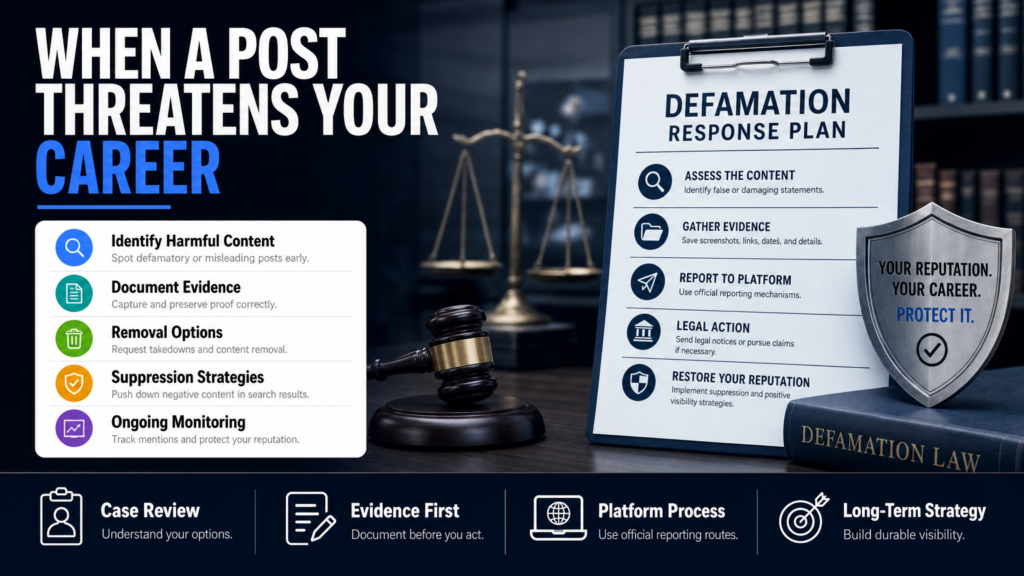
- How to deal with online defamation? A step-by-step action plan
- Platform-specific tactics: Google, review sites, social networks, forums
- When removal is NOT available: mitigation, suppression, and damage control
- Evidence, documentation, and legal coordination
- Rebuilding reputation and monitoring long-term
- DIY vs Agency: Which route fits your case?
- Hypothetical: A physician and a false allegation on a local blog
- Common mistakes people make when fighting online defamation
- Best practices for professionals and businesses
- Expert Tips
- Conclusion
- Why Businesses Choose Your Reputation Agency
- Frequently Asked Questions
What is defamation in cyberspace?
Defamation online is the publication of a false statement presented as fact that injures a person’s or business’s reputation. In the U.S., the two common legal labels are libel (written) and slander (spoken); online statements are usually treated as libel because they are fixed in a tangible form.
What counts as defamation depends on the content, the speaker, your status as a private or public figure, and whether the statement is demonstrably false. Opinion, parody, or statements of belief are often protected; false factual claims that harm reputation can be actionable.
Platform rules, criminal statutes (rarely), and civil defamation law overlap but do not perfectly align. A platform may remove content for policy violations even when a court wouldn’t find defamation, and vice versa.
- Identify the precise statement you believe is defamatory.
- Separate factual claims (e.g., ‘X embezzled funds’) from opinion (‘I think X is untrustworthy’).
- Check whether the publisher is an identifiable person, a news outlet, or an anonymous forum.
- Libel = published false statement of fact that harms reputation
- Public figures face higher proof thresholds (actual malice)
- Opinion and hyperbole are usually protected speech
- Platform removal and legal remedy are separate tracks
How online defamation differs from offline
Online posts are persistent, searchable, and sharable; they can be replicated and cached across platforms, magnifying harm.
Because of search indexing and social sharing, a single post can behave like ongoing publication, which affects statute of limitations and notice considerations in some jurisdictions.
- Persistence: copies and screenshots prolong harm
- Scale: social amplification multiplies impact
- Searchability: first-page results are especially damaging
What is online slander called?
Online slander is most commonly referred to as online defamation or libel. In casual conversation people may say ‘slander’ but legally the written form is libel.
Different platforms and communities may use other labels — e.g., ‘false review’, ‘fake news’, ‘defamatory post’ — but the core legal concept is the same: a false factual claim harming reputation.
- If the content is audio/video, treat it as published (libel) if it’s recorded or hosted.
- Classify the item: review, news article, social post, forum thread, or blog — each has a different removal route.
- Slander = spoken defamation; Libel = written/online defamation
- Common terms: online defamation, cyber-defamation, defamatory post
- Review sites handle false reviews separately under their content policies
Why the distinction matters
Legal standards, damages, and available remedies vary depending on how the content is formatted and where it’s hosted. For example, a fake Yelp review is governed by Yelp’s policies and U.S. defamation law in parallel.
Understanding what the platform calls the content helps you pick the correct takedown path and build evidence for legal review if needed.
- Different evidence is required for news articles vs anonymous forum posts
- Review-platform policies can be faster than civil litigation
Is it worth it to sue someone for defamation?
Short answer: sometimes. Whether it’s worthwhile depends on damage, proof, identity of the speaker, jurisdiction, and cost. Litigation can produce judgments, discovery, and subpoenas that force removal; but suits are costly, public, and take time.
We recommend evaluating legal options alongside non-litigation tactics. You can pursue platform takedowns, private demand letters, or correction and mitigation before or instead of filing a lawsuit.
- Document harm (lost clients, terminated opportunities, screenshots, timestamps).
- Ask a lawyer about jurisdiction, statute of limitations, and whether disclosure via discovery would justify filing.
- Consider targeted pre-suit letters demanding removal and retraction when identity is known.
- Suing may be appropriate when the publisher is identifiable and the false statements are provable
- Consider cost, likelihood of collecting a judgment, and the risk of further publicity
- A qualified attorney can determine whether a legal claim may be available
Alternatives to litigation
Many cases are resolved without court: platforms remove content after reports; site owners agree to take down false material; or reputational SEO suppresses the content’s visibility.
Read our walkthrough on handling defamation without litigation for practical non-litigation steps.
- Platform reports and appeals
- Formal retraction or correction requests to publishers
- Reputation management and targeted SEO suppression
How to deal with online defamation? A step-by-step action plan
Immediate, ordered action reduces long-term harm. The following sequence is designed for professionals and businesses facing urgent reputation damage.
You should adapt the steps to your circumstances; for example, healthcare providers and licensed professionals may need to notify boards, while businesses may prioritize customer-facing corrections.
- 1) Secure evidence: take time-stamped screenshots, URLs, and copies; preserve source HTML and Google cache links.
- 2) Audit exposure: search your name, business, and related terms across Google, Bing, and social platforms to map the damage.
- 3) Report to platforms: file reports using official channels (Facebook, X/Twitter, YouTube, Yelp, Trustpilot, LinkedIn). Platforms maintain their own review processes and criteria.
- 4) Contact the publisher: for blogs, local news sites, and forums, request correction or removal—keep correspondence professional and document all replies.
- 5) Send a legal demand if warranted: a lawyer can draft a targeted letter; this sometimes leads to voluntary removal without filing suit.
- 6) Deploy mitigation: create and amplify authoritative content (press release, LinkedIn article, professional bio pages) to push harmful items down in search.
- 7) Monitor and escalate: set alerts and be prepared to use discovery or subpoenas if identity is hidden and a suit is pursued.
- Prioritize safety and immediate client-facing steps first
- Simultaneously gather evidence and open platform takedown paths
- Use mitigation (suppression and corrective content) if removal is unlikely
Evidence checklist
Good evidence is the difference between a successful platform report, a pre-suit demand, and a court case. Collect everything promptly.
Preservation is crucial: once deleted, content can still be recovered through archives or subpoenas, but having your own copies speeds response.
- Full-page screenshots with timestamps
- Direct URLs, author profiles, and post IDs
- Copies of replies, DMs, and emails related to the incident
- Records of lost business (invoices, cancelled contracts, lost applicant notes)
Who to notify first
If the post contains threats, doxxing, or immediate safety risks, notify law enforcement and your security/HR teams first. For reputational content, platforms and publishers are the priority.
For licensed professionals, notify your malpractice insurer and any regulatory body that requires reporting—but seek counsel before making statements that could affect legal strategy.
- Law enforcement for threats or doxxing
- Platform abuse/reporting teams for impersonation or policy violations
- Insurer or compliance team for professional repercussions
Platform-specific tactics: Google, review sites, social networks, forums
Each platform has distinct policies, evidence requirements, and escalation routes. Use the platform’s official reporting tools first, then plan mitigation if removal isn’t granted.
Google controls search results but not third-party content; you can request removal of content that violates Google’s policies (like doxxing or explicit images), and you can pursue suppression via SEO. See our deeper treatment of how Google search behavior can end a professional’s career and what to do about it.
- For Google: submit removal requests for privacy or legal issues; pursue search suppression with authoritative content.
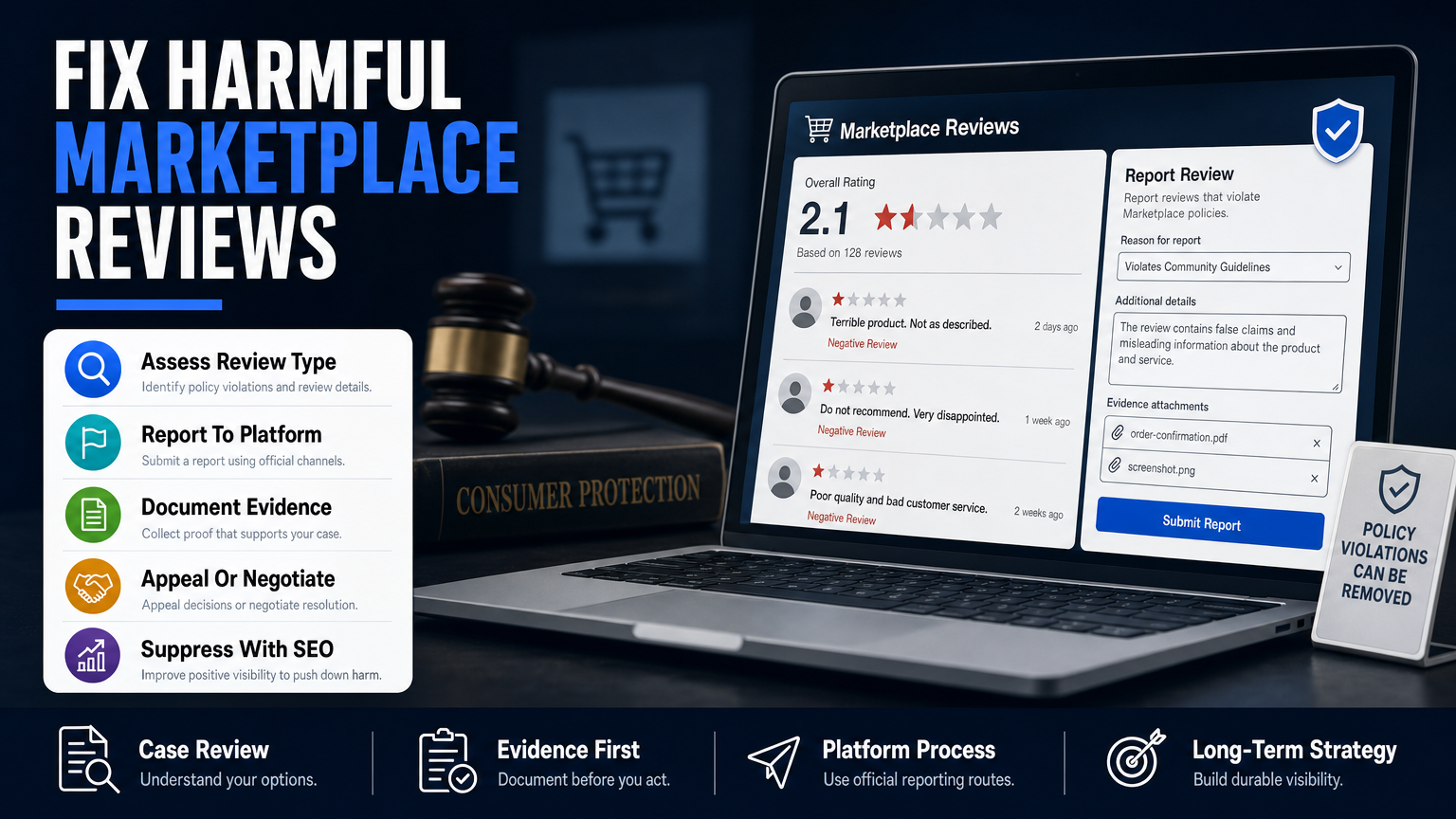
- For reviews: use the site’s business owner dispute process and collect evidence of transactions or policy breaches.
- For social posts: report for policy violations such as doxxing, harassment, or impersonation and follow up with appeals.
- Google: removal requests for privacy violations, legal removal for court orders, and suppression via SEO
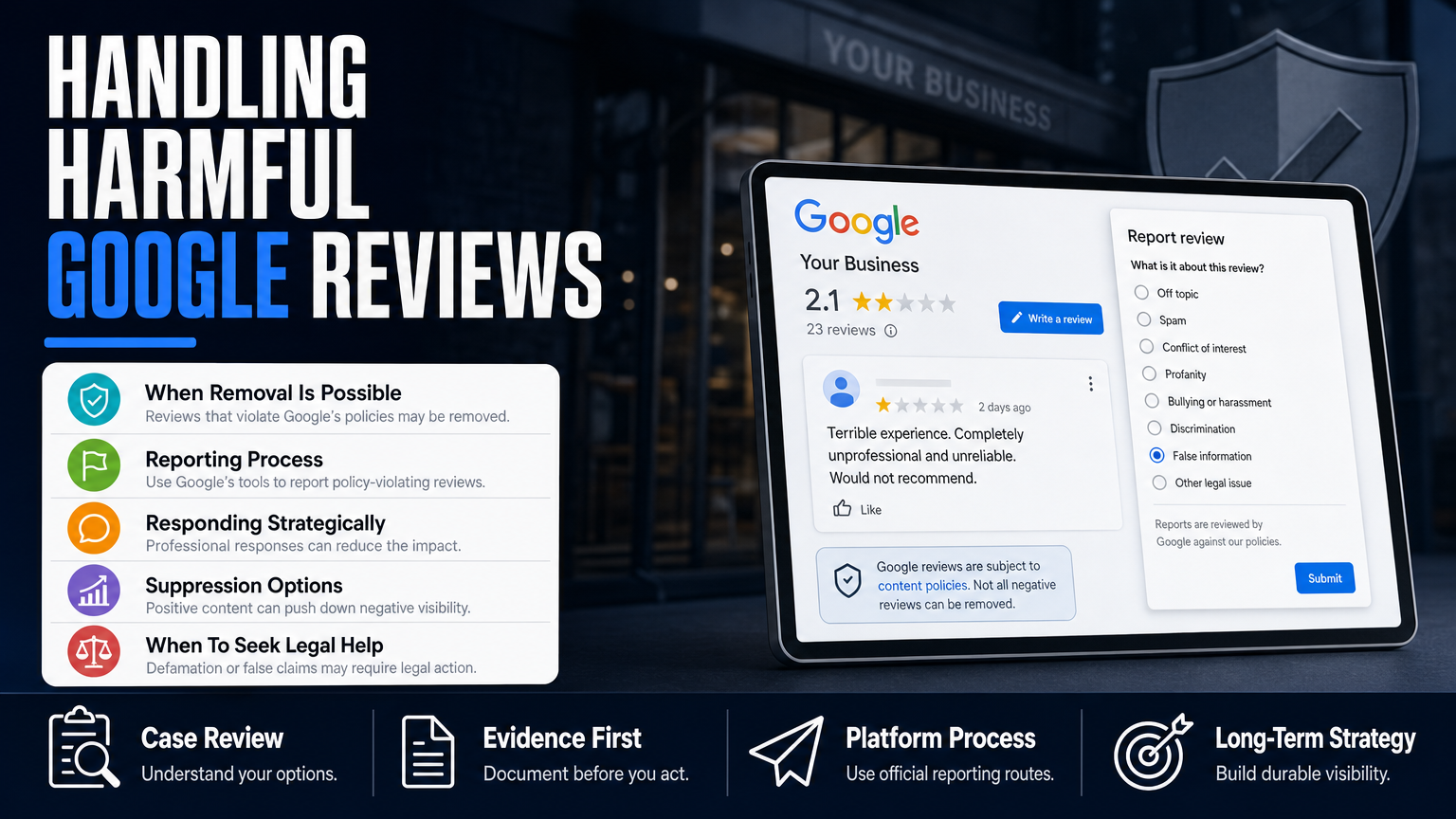
- Yelp/Trustpilot/Google Reviews: follow verified-report and content policy forms; respond publicly when appropriate
- Facebook/Instagram/X/YouTube: use abuse forms and appeal workflows; impersonation and fake accounts often have separate fast-track options
- Forums/Reddit/Blogs: contact moderators or the hosting site; public corrections sometimes persuade small publishers to remove content
How to handle a defamatory Google result
Google will not remove content simply because it’s negative; removals are limited to specific policy categories (personal information, sexually explicit content, legal removals with court orders). When removal is not an option, suppression and authoritative content are the main tools.
If a single search result is causing disproportionate harm to your career, read our guidance on targeted remediation for such cases to learn practical suppression tactics and publisher engagement strategies.
- Use official Google removal forms for privacy or legal content
- Engage the source publisher for corrections or retractions
- Publish and promote accurate, authoritative pages to outrank the harmful link
When removal is NOT available: mitigation, suppression, and damage control
Not all defamatory or damaging content will be taken down. Platform policies, political or public-interest exceptions, or truthful but harmful content can block removal. When that happens, the practical question is how to limit visibility and repair reputational damage.
Suppression and remediation tactics aim to reduce the harmful content’s visibility in search and to provide context for readers who do encounter it.
- Build authoritative pages: corporate site profiles, LinkedIn, industry directory listings, and reputable guest articles.
- Optimize those pages for target name and keywords, then promote via social shares and earned media.
- Use legal letters selectively to obtain retractions or corrections from publishers when factual errors are provable.
- Suppression uses SEO, owned content, and link-building to push harmful results off the first page
- Corrective content (statements, press releases, third-party validations) provides context and authoritative facts
- Public responses should be carefully drafted—apologies or denials can backfire without counsel
Case tactics for a hijacked first page
If a single story dominates the first page, coordinated publication of accurate materials across high-authority sites helps. This is a measured approach intended to improve the overall search narrative.
Learn how a viral accusation can hijack your first page and the remediation options available in our practical guide on targeted online defamation removal.
- Publish on high-authority domains (industry outlets, professional associations)
- Use stable, canonical pages (your law firm bio, clinic profile) as anchors
- Leverage structured data and consistent NAP (name, address, phone) for local businesses
Evidence, documentation, and legal coordination
Good documentation both improves your chances with platforms and strengthens any potential legal claim. Preservation and proper chain-of-custody practices matter if litigation becomes necessary.
We coordinate with qualified legal professionals when a matter requires legal analysis; a lawyer can advise about defamation thresholds, jurisdiction, and whether discovery could reveal an anonymous poster’s identity.
- 1) Store evidence in a secure, timestamped folder. 2) Track all audience and revenue impact. 3) Ask counsel about subpoenas to unmask anonymous posters if identity is essential.
- Document: screenshots, raw HTML, cached pages, and outreach records
- Preserve: use archive.org, Perma.cc, or local timestamped copies
- Coordinate: choose counsel experienced in internet defamation when evidence supports a claim
When do you need an attorney?
Consult an attorney when the statement is clearly false, publisher identity is known or obtainable, and damages are significant. A lawyer also helps assess the risk of a counterclaim and whether litigation’s publicity is acceptable.
If you prefer to avoid court, read our resource on how to handle online defamation without going to court for alternative processes and escalation steps.
- Legal counsel for demands, subpoenas, and drafting precise takedown requests
- Non-litigation counsel for negotiation and mediated corrections
Rebuilding reputation and monitoring long-term
Removal or suppression is often the midpoint — sustained work is required to restore trust. That means consistent content, transparent client communication, and ongoing monitoring for recurrence.
Reputation monitoring alerts you to new mentions and shows whether suppression efforts are working. Effective programs combine manual audits, Google Alerts, and paid monitoring tools.
- 1) Implement monitoring (daily alerts for high-risk names). 2) Publish regular positive content (case studies, press mentions). 3) Review and update mitigation strategy quarterly.
- Set up alerts for name, business, and key search phrases
- Maintain an evergreen library of authoritative content
- Respond publicly to legitimate complaints and correct factual errors promptly
When to disclose and when to stay silent
Deciding whether to respond publicly depends on the facts and counsel. A short, factual clarification can be effective for minor errors, while detailed rebuttals can amplify exposure.
Work with communications or legal advisors to craft messages that limit further damage and clarify the record without repeating false allegations unnecessarily.
- Use brief factual corrections rather than long defenses
- Avoid repeating the defamatory claims verbatim in public messages
- Coordinate with PR to manage client and stakeholder communications
DIY vs Agency: Which route fits your case?
Compare the practical differences between self-managing a response and using a professional reputation agency.
| DIY | Agency |
|---|---|
| Cost | Upfront lower cost; variable long-term expense |
| Speed | Often slower due to learning curve |
| Platform knowledge | Established workflows and escalation contacts |
| Legal coordination | Can coordinate with counsel and draft formal notices |
| SEO suppression | Dedicated resources and content pipelines |
| Evidence preservation | Structured preservation and documentation practices |
Hypothetical: A physician and a false allegation on a local blog
Scenario: An anonymous post on a local blog alleges medical negligence by a physician. The piece is shared on Facebook and appears on the first page for searches of the doctor’s name. Patients begin canceling appointments.
Process applied: preservation, platform reports, publisher outreach, targeted suppression, and monitoring. This example is hypothetical and anonymized to illustrate the typical sequence of actions.
- 1) Secure evidence and notify relevant internal teams.
- 2) Use platform reporting channels for each place the post appears.
- 3) Request correction from the blog with a clear factual list and evidence.
- 4) If removal fails, publish and promote accurate content on high-authority sites and keep monitoring for re-shares.
- Day 0: Physician documents the post (screenshots, URL, author handle) and contacts clinic legal/PR.
- Day 1–3: Reports filed on Facebook and with the blog host; publisher sent a correction request with documentation.
- Week 1–6: Publisher refuses removal; medical board and insurer notified; agency deploys authoritative content (medical society bio, guest op-ed) to outrank the post.
- Month 2–4: Monitoring shows the blog post losing first-page visibility as authoritative pages gain traction; ongoing alerts detect new shares.
Common mistakes people make when fighting online defamation
Avoid these frequent errors — they waste time and can worsen exposure.
1 — Panicked public rebuttals
Posting a long emotional rebuttal often repeats the allegation and draws fresh attention. A tightly worded factual correction prepared with counsel or PR is usually safer.
- Don’t repeat the defamatory claim verbatim
- Keep public statements short and factual
2 — Ignoring platform processes
Skipping official reporting routes or failing to use appeals misses opportunities for removal. Follow each platform’s form and appeal timeline and document submissions.
- Use appeals if the first report is denied
- Provide clear evidence to platform reviewers
3 — Rushing to sue without identity or proof
Litigation is costly and may be impossible if the poster is anonymous and the publisher is overseas. Preserve evidence and consult counsel before filing.
Consider targeted subpoenas and tracing before initiating litigation.
- Confirm the poster’s identity and jurisdiction first
- Assess whether litigation’s publicity risk is acceptable
4 — Using deceptive or retaliatory tactics
Creating fake accounts, paying for fake positive reviews, or launching personal attacks are unethical and violate platform policies; they can lead to sanctions and legal exposure.
Stick to transparent, legal, and policy-compliant tactics for reputation repair.
- Avoid fake reviews or astroturfing
- Do not pursue harassment or doxxing in retaliation
5 — Failing to monitor after an apparent win
Content can reappear, be mirrored, or be quoted elsewhere. Continuous monitoring is required to detect and respond to recurrence quickly.
- Set recurring alerts and manual checks
- Keep evidence logs updated for any new mentions
Best practices for professionals and businesses
Adopt these durable habits to reduce risk and respond faster when damage occurs.
1 — Rapid evidence preservation
Use timestamped screenshots, archive links, and secure storage. Early preservation makes platform appeals stronger and preserves options for legal discovery.
- Save HTML sources and cached pages
- Store evidence in a secure, access-controlled system
2 — Follow platform procedures exactly
Read and follow each platform’s reporting form instructions. Provide the exact policy violations and attach evidence — that increases the chance of review.
If initial reports are denied, file an appeal with additional supporting evidence.
- Cite the specific platform policy you believe was violated
- Attach clear, labeled evidence
3 — Coordinate legal and PR strategies
Work with counsel and communications to ensure legal steps don’t create additional reputational risk. A coordinated message controls narrative and reduces inconsistent statements.
Legal letters can be effective but should be calibrated to the publisher’s size and the likely response.
- Use short, factual public statements when necessary
- Let counsel review demand letters and public responses
4 — Build and promote authoritative content
Create stable, well-optimized content that you control: company bios, practitioner profiles, and bylined articles on reputable sites. Over time these pages can outrank harmful listings.
This is a mitigation strategy when removal is limited or impossible.
- Publish on high-authority domains and maintain freshness
- Use consistent name formatting and schema where applicable
5 — Maintain ongoing monitoring and review
Set up alerts and quarterly reputation reviews. Early detection shortens response time and reduces audience reach of harmful posts.
If you work with a vendor, confirm monitoring thresholds, alert cadence, and response SLAs in writing.
- Daily alerts for high-risk cases; weekly for most professionals
- Quarterly strategy reviews and updates
Expert Tips
- Preserve evidence immediately—once gone, it’s harder to prove later.
- Never repeat a defamatory claim in a public post; summarize the correction instead.
- Use the exact platform policy language when filing reports to speed reviewer decisions.
- A concise, factual demand letter often yields quicker takedowns than litigation.
- If anonymous, consider subpoenas through counsel before spending on a full suit.
- Invest in at least one high-authority page you control that ranks for your name.
- Set up Google Alerts and a paid monitoring tool for critical name mentions.
- When in doubt, coordinate public responses with legal and PR advisors.
Conclusion
Fighting online defamation requires a realistic mix of immediate actions, careful documentation, and strategic remediation. Some content will be removable under platform rules or law; other material must be managed through suppression and reputation-building.
You should evaluate legal options alongside platform processes and mitigation tactics. We evaluate whether the content may qualify for removal or review, pursue the legal, technical, platform-based, and reputational options available, and coordinate with counsel when a legal course is appropriate.
Why Businesses Choose Your Reputation Agency
Managing your reputation takes more than monitoring reviews or publishing the occasional blog post. It takes a strategy built around your situation, your industry, and what is actually showing up in search.
Your Reputation Agency works with businesses, executives, healthcare professionals, attorneys and growing brands. Our services include:
- Remove or suppress negative search results and news articles from Google
- Review removal and remediation (Google, Yelp, Facebook, Trustpilot, industry sites)
- Data broker and people-search opt-outs to remove personal information
- Mugshot and arrest-record removal or suppression
- Takedowns of defamatory, false, or malicious posts (social, blogs, forums)
- Online crisis management and rapid-response reputation repair
- Impersonation and fake account removal on social platforms
- Reputation monitoring, alerts, and ongoing surveillance
- First-page SEO and suppression strategies to bury negative content
- Digital security audits and privacy hardening to prevent future exposure
Frequently Asked Questions
1. What is online slander called?
In legal terms, online slander is ordinarily called libel, because online statements are fixed in written or recorded form. In everyday language people may say ‘slander’ but platforms and law typically treat written online allegations as libel.
2. Is it worth it to sue someone for defamation?
Sometimes, but it depends on identity and evidence, the scale of harm, jurisdiction, and cost. Litigation can unmask anonymous posters and compel removal, but it is expensive and public; many cases resolve through platform reports, publisher corrections, or demand letters. Consult a qualified attorney to evaluate merits and risks.
3. What is defamation in cyberspace?
Defamation online means publishing false factual statements about a person or business that harm reputation. It includes false news articles, reviews, social posts, and forum claims. Whether a statement is defamatory depends on falsity, harm, and applicable legal standards for public figures versus private individuals.
4. How to deal with online defamation?
Take ordered action: preserve evidence, audit exposure, report to platforms, contact publishers for correction, consider legal demand letters, and deploy suppression if removal fails. Document financial and reputational harms and coordinate with counsel and PR as needed.
5. How long does it take to remove defamatory content?
Timing varies by platform, publisher, and legal complexity. Some platform removals happen within days, while publisher retractions or legal processes can take weeks to months. We can provide estimated timelines after reviewing the specific case, but no universal timeframe applies.
6. Can anonymous posters be identified?
Sometimes. Counsel can issue subpoenas to platforms or hosts to obtain IPs or account records if the poster’s identity is necessary and likely available. Success depends on platform logging, jurisdiction, and whether the poster used anonymizing tools; this process is governed by legal standards and court orders.
7. What if the post is true but harmful?
Truth is generally a defense to defamation. If the information is accurate but damaging, focus on mitigation: context, corrective content, communications strategy, and where appropriate, legal advice on privacy or professional remedies.
8. Can platforms always remove defamatory posts?
No. Platforms remove content that violates their policies but will not take down everything that is defamatory under law. Platform decisions remain under the platform’s control. We use official reporting and review processes and pursue legal options when necessary.
9. Where can I learn more about targeted removal and suppression?
For focused strategies on a high-impact search result, see our resource about when one Google result can threaten a professional’s career which outlines suppression tactics and publisher engagement strategies.
This content provides general information and does not constitute legal advice. The available options and likely outcomes depend on the facts, evidence, platform policies, applicable law, jurisdiction, and public-interest considerations.
Past examples do not guarantee future results. Removal, correction, deindexing, and search-position changes depend on third parties and circumstances outside Your Reputation Agency’s control.