You’ve found a negative article, a fake review, or a viral post that shows up whenever someone searches your name or business. If you’re reading this from Mumbai or deciding between local vendors, you need to know what an ORM agency in Mumbai can actually do—and what it can’t.
This article shows the specific services an ORM agency in Mumbai will offer, realistic timelines and costs, and a step-by-step approach for removal, suppression, and crisis response. It also answers common buyer questions such as which agencies to consider, the role of ORM in your company, and how much it costs to hire a social media manager in India.
You’ll get practical next actions you can take immediately, plus a hypothetical example that walks through the typical process from intake to visible results. We’ll be explicit about limits: platform decisions, legal complexity, and search behavior are outside any agency’s control.
Table of Contents
- Which ORM agencies stand out in India—and how to judge them
- Which companies in Mumbai are commonly listed as top options?
- What role does ORM play inside a company?
- What to do when removal is not available
- How much does it cost to hire a social media manager or ORM services in India?
- How to choose between DIY, local agencies, and national specialists
- Rapid incident checklist: first 72 hours
- How we evaluate probable removal routes
- DIY vs Local Agency vs National Specialist
- Hypothetical scenario: Clinic reviews and a viral blog post
- Common mistakes organizations make with ORM
- Best practices for working with an ORM agency in Mumbai
- Expert Tips
- Conclusion
- Why Businesses Choose Your Reputation Agency
- Frequently Asked Questions
Which ORM agencies stand out in India—and how to judge them
No single agency is ‘the best’ for every situation. Agencies differ by technical SEO strength, legal coordination capacity, PR experience, industry focus, and how they price services. When someone asks “Which ORM agency is the best in India?” the right answer depends on your needs: urgent takedowns, complex legal claims, long-term SEO suppression, or PR repair.
For professionals in regulated fields (doctors, lawyers, finance) prioritize firms with documented experience working with licensors and counsel. For consumer-facing businesses (restaurants, hotels) prioritize review-management and local-SEO experience.
- Collect examples of the content you want addressed (links, screenshots, timestamps).
- Request a written intake analysis that lists probable removal routes and SEO mitigation options.
- Ask for references from comparable clients or anonymized case outlines.
- Confirm the reporting cadence (weekly updates, dashboards) and escalation paths.
- Check demonstrable experience in your industry rather than broad claims of being the ‘best’.
- Ask for a breakdown of tactics (platform reports, legal escalation, SEO content creation).
- Confirm whether they coordinate with local counsel when needed.
- Look for transparent pricing and clear scopes: what is an analysis, what is a takedown attempt, what is ongoing suppression.
What to ask during the first call
Use a short checklist during the initial consult: What evidence do they need, which platforms will they contact first, do they recommend legal counsel, and how will they measure progress?
- Who will be the primary contact and what is their experience?
- Which platforms do they report to directly (Google, Facebook, YouTube, review sites)?
- Will they draft cease-and-desist or DMCA notices, and will they coordinate with my attorney?
- What are expected short-term actions versus longer-term SEO work?
Which companies in Mumbai are commonly listed as top options?
Search results and directories list many firms under ‘Top ORM Company in Mumbai’. Rankings alone aren’t sufficient: cross-check claims with recent work samples, public client lists (if available), and reviews.
A practical approach is to shortlist two local firms and one national firm with a reputation-management specialization, then compare proposals on tactics and measurable deliverables.
- Shortlist 3–5 agencies and request a brief intake and proposal.
- Compare scope: takedown attempts, review responses, content creation, monitoring.
- Evaluate price against deliverables and expected reporting frequency.
- Local firms: often better at quick platform escalations and local-SEO.
- National firms: may bring stronger content and backlink strategies for suppression.
- Boutique specialists: better for complex legal or high-risk personalities.
How to use listings and reviews
Treat listings and client reviews as one data point. Look for specificity: a review that praises an agency for handling Google News takedowns has more value than a one-line 5-star rating.
- Search for complaints about long delays or hidden fees.
- Check whether agencies publish methodology or whitepapers.
- Ask for a sample statement or removal request template to see their tone and legal awareness.
What role does ORM play inside a company?
ORM (online reputation management) protects and shapes how information about your company or professional practice appears online. That includes removal and mitigation of harmful content, creating positive authoritative content, monitoring reputation signals, and coordinating legal or PR actions when needed.
An effective ORM function integrates with legal counsel, communications/PR, customer service, and IT/security. It’s not just ‘fixing Google’—it’s a cross-functional response to reputational risk.
- Set clear internal roles: who approves public statements, who shares evidence with counsel, who handles customer complaints?
- Establish an incident playbook for viral events, doxxing, and fake reviews.
- Schedule quarterly reputation audits tied to business goals (hiring, licensure, bookings).
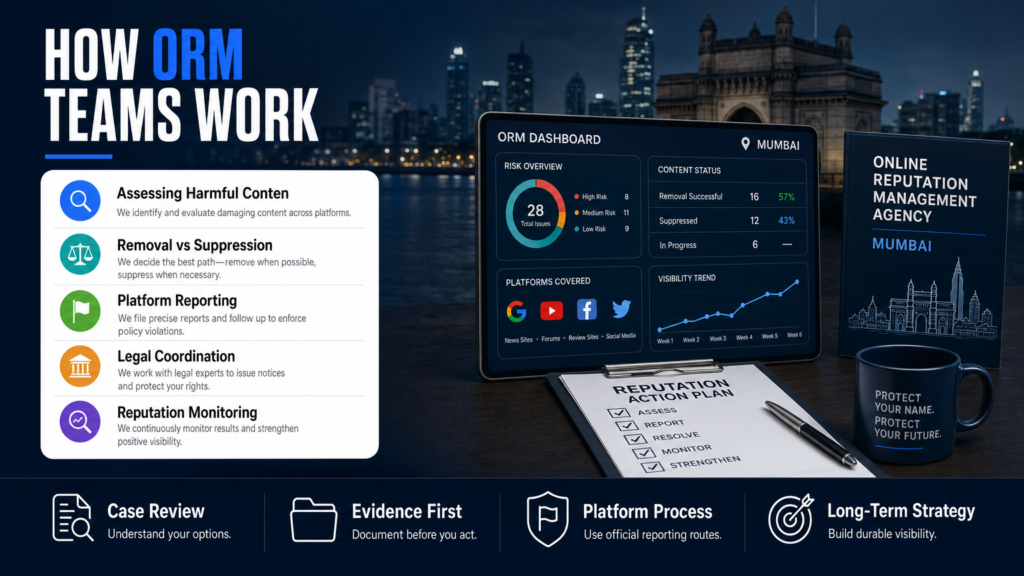
- Detection and monitoring: continuous alerts for new mentions and spikes.
- Assessment: classify issues as defamation, impersonation, privacy breach, review fraud, or public-interest reporting.
- Action: technical takedowns, platform reports, SEO suppression, or legal escalation.
- Recovery: public statements, corrected content, and trust rebuilding.
When to involve legal counsel
Legal involvement is appropriate where there are demonstrably false factual allegations, repeated impersonation, extortion/doxxing, or publisher refusal to remove protected personal data. A qualified attorney can advise whether a claim is viable under Indian or other applicable laws.
- Preserve evidence (screenshots with timestamps, archived URLs).
- Avoid public statements that could escalate the dispute without counsel.
- We coordinate with counsel when a matter requires legal analysis.
What to do when removal is not available
Removal is sometimes not an option: platform policies may permit the content, the publisher may refuse, or the content may be a truthful public record. When removal is unavailable, the pragmatic alternatives are suppression, correction, contextualization, and remediation.
Suppression uses SEO to push damaging links lower in search results by creating authoritative, relevant pages that rank above the unwanted content. Correction and contextualization involve publishing accurate information and working with journalists or review sites to add updates or owner responses.
- Audit which first-page slots are movable (author pages, unoptimized blogs, low-authority directories).
- Create a prioritized content plan: site pages, profiles, guest posts, and press outreach.
- Implement SEO and track keyword movement monthly; adapt based on results.
- Suppression through targeted content and high-quality backlinks.
- Requesting corrections or updates from the original publisher when factual errors exist.
- Using press releases, LinkedIn articles, and domain authority pages (company site, profiles) to occupy first-page slots.
- Ongoing monitoring to spot recurrences quickly.
How suppression timelines work
Expect wide variation. Some keyword positions can shift within weeks if you have strong assets and quick link-building; others may take months. Timing depends on search competition, the authority of the negative source, and the quality of replacement content.
- Short-term: owner responses, profile optimization, reporting to platforms.
- Medium-term (4–12 weeks): publish authoritative pages and earn links.
- Long-term (3–12+ months): sustained content and PR to re-shape results.
How much does it cost to hire a social media manager or ORM services in India?
Pricing varies by scope, experience, and whether you hire a freelancer, in-house social media manager, or an agency. If you’re comparing hiring a social media manager in India versus contracting an ORM agency in Mumbai, consider the difference between daily operational work and one-off or emergency remediation.
Typical market ranges (indicative, not guaranteed):
- Define scope: monitoring only, takedowns and suppression, or full crisis PR plus legal coordination.
- Request itemized proposals showing hours, deliverables, and reporting intervals.
- Budget for contingency: legal fees, paid media, or urgent SEO can add to baseline costs.
- Freelance social media manager: INR 15,000–60,000 per month depending on experience and scope.
- In-house social media manager: INR 25,000–120,000 per month depending on seniority and benefits.
- Specialist ORM agency retainers: INR 50,000–500,000+ per month depending on services (monitoring, takedown attempts, SEO, PR).
- Project-based takedowns or crisis responses often start with one-time fees (INR 20,000–250,000) plus hourly legal coordination if required.
Cost drivers to watch
High costs correlate with urgent timelines, legal intervention, large-scale review campaigns, and reputation rebuilding after a viral incident. Lower costs may suffice for routine monitoring and occasional review responses.
- Urgency: emergency response fees for 24–48 hour turnarounds.
- Publisher complexity: working with multiple international publishers increases effort.
- Evidence collection and legal drafting require experienced personnel and can drive price.
How to choose between DIY, local agencies, and national specialists
Decision factors include risk level, time-sensitivity, internal bandwidth, and budget. DIY is possible for basic review responses and profile cleanups. Local Mumbai agencies can be faster on local publishers and in-person coordination. National or international specialists often have stronger SEO and legal coordination teams for harder suppression cases.
Below is a short comparison to help decide which path to take.
- Map your priorities: speed, budget, legal risk, and scale of visibility damage.
- Request proposals tailored to your top three priorities.
- Start with a short paid audit if you can—most reputable agencies offer one.
- DIY: low cost, requires time, limited reach for takedowns and legal escalation.
- Local agency: moderate cost, quicker local escalation, useful for businesses tied to Mumbai markets.
- National specialist: higher cost, deeper SEO resources and legal coordination for complex removals.
When to hire an agency immediately
Hire an agency if the issue threatens licensure, revenue, hiring, or legal exposure; if the content is spreading across multiple platforms; or if you lack internal capacity for continuous monitoring.
- Viral allegations or doxxing.
- A pattern of coordinated fake reviews.
- Media coverage that amplifies a negative claim.
Rapid incident checklist: first 72 hours
When something goes viral or an urgent allegation appears, early containment actions matter. The checklist below is a practical, prioritized set of steps most ORM agencies in Mumbai follow during intake and triage.
These are immediate actions—legal or PR strategy will follow based on assessment.
- Hour 0–6: Triage and evidence preservation. Disable any exposed accounts or change passwords if security breach is involved.
- Hour 6–24: Submit platform reports and request expedited review where policy violations exist.
- Day 1–3: Draft an internal hold statement and prepare a controlled external response with counsel if necessary.
- Preserve evidence: screenshots, archived URLs, and metadata where possible.
- Limit public engagement: avoid reactive public posts without counsel.
- Initiate platform reports for impersonation, doxxing, or content that violates policies.
- Assemble a core response team: owner, a communications lead, legal counsel, and the ORM contact.
What to avoid in the first 72 hours
Do not attempt retaliatory posts, do not share confidential documents publicly, and avoid engaging directly with bad actors in ways that escalate the situation. Quick emotional responses commonly make issues worse.
- No public naming of alleged perpetrators without evidence.
- No threats to private individuals via comment threads.
- No deletion-only strategy without addressing copies and archives.
How we evaluate probable removal routes
When assessing whether content may qualify for removal or review, an agency will weigh platform policy, publisher type, the factual basis of the claim, whether personal data is exposed, and jurisdictional law. We pursue the legal, technical, platform-based, and reputational options available.
This evaluation determines whether the next step is a platform report, a legal notice, a takedown request, or suppression planning.
- Classify content: misinformation, opinion, review, news, or public record.
- Select channels: platform reporting, publisher outreach, legal notice, or SEO mitigation.
- Estimate effort and likelihood of action, then present options for client approval.
- Platform policy violations (harassment, privacy, doxxing, impersonation) are often quickest for takedown attempts.
- Factual inaccuracies can justify asking for corrections, but success depends on the publisher’s editorial standards.
- Public records and factual reporting are harder to remove and often require mitigation rather than removal.
Example reporting routes
Different platforms have different reporting mechanisms: Google’s legal removals center and DMCA tools, Facebook/Instagram’s impersonation and harassment flows, YouTube’s copyright and privacy reports, and review-platform dispute systems (Google My Business, Yelp, TripAdvisor). We use the official reporting and review processes made available by platforms.
- Google: Legal removal request, defamation policy reports, and search suppression via SEO.
- YouTube: Privacy or copyright claims, community guidelines.
- Review sites: owner responses, flagged reviews, and platform-specific dispute processes.
DIY vs Local Agency vs National Specialist
A practical two-column comparison to help choose the right path.
| DIY / In-house | Agency (Local or National) |
|---|---|
| Cost | Lower direct cost, variable hidden time cost |
| Speed | Faster for small fixes; slower for complex takedowns |
| Takedown ability | Limited; depends on platform forms and persistence |
| SEO suppression | Requires agency SEO and PR resources |
| Legal coordination | Requires hiring counsel; agency can coordinate |
| Reporting & monitoring | Depends on tools you buy; agencies include dashboards |
Hypothetical scenario: Clinic reviews and a viral blog post
A small Mumbai clinic finds a three-year-old blog post alleging malpractice appearing on page one for the clinic director’s name and local search term. A week later, several negative Google reviews appear, some matching claims from the blog post.
The clinic hires an ORM agency to evaluate options. The agency archives evidence, classifies the blog post as opinion with factual claims, and outlines probable actions: request corrections from the publisher, report policy violations to specific platforms where reviews appear, create authoritative clinic pages, and run PR outreach for corrective coverage.
- Week 1: Intake and triage. Archive evidence and send owner responses to reviews. Submit platform reports where reviews violate policies.
- Weeks 2–6: Publisher outreach for correction or update requests; publish clinic profiles (Google Business, Healthgrades-like sites), staff bios, and two authored articles clarifying procedures.
- Months 2–6: Execute SEO suppression using targeted content, local citations, and earned media; monitor movement and provide monthly reports.
- Preserve evidence: archive the blog post and screenshots of reviews.
- Assess: blog is opinion + factual claims; reviews may violate review policy.
- Action plan: publisher outreach, platform review reports, SEO content to suppress, and a monitored review-response campaign.
Common mistakes organizations make with ORM
Avoid these frequent errors—each one can prolong reputation damage or make removal harder.
1) Chasing deletion as the sole solution
Fixating only on deletion ignores suppression and correction tactics. Deletion attempts often fail or content gets archived; a combined strategy is safer and more reliable.
- Have a suppression plan ready if deletion is denied.
- Create authoritative content that ranks above the undesired item.
2) Public emotional responses
Reactive public posts can amplify the issue. Fast but considered responses crafted with counsel prevent escalation and preserve evidence.
- Draft a short holding statement and delay detailed responses until you have facts.
- Coordinate messaging with legal counsel if claims are factual disputes.
3) Ignoring monitoring after a ‘fix’
Many think the problem is solved once a page is removed. New copies, mirrors, and social shares can reintroduce the damage. Ongoing monitoring is essential.
- Set alerts for name and business variations.
- Schedule periodic audits of first-page search results.
4) Paying for fake positive reviews
Buying reviews violates platform policies and can lead to penalties. Genuine reputation recovery focuses on authentic feedback and high-quality content.
- Encourage verified customers to leave honest feedback.
- Use reputation strategies that build lasting trust, not short-term manipulation.
5) Not documenting everything
Failing to preserve timestamps, copies, and communications reduces legal options later. Documentation strengthens removal or legal claims.
- Use web.archive.org, screenshot tools, and maintain a chronological log.
- Keep records of publisher and platform correspondence.
Best practices for working with an ORM agency in Mumbai
Work with agencies that provide an evidence-based plan, clear reporting, and coordination with legal counsel when required. Below are durable, actionable practices to get better outcomes.
1) Start with a written intake and prioritized plan
Require a written assessment that lists options, probability estimates, and measurable milestones. This avoids open-ended retainers without deliverables.
- Ask for estimated effort ranges, not guarantees.
- Insist on a priority list: immediate takedowns, quick wins, and long-term suppression.
2) Preserve evidence before talking to publishers
Capture archived copies and screenshots before contacting publishers or leaving public responses. This preserves your position if the publisher later disputes the content’s origin.
- Use multiple archive sources and note timestamps.
- Record reviewer profiles when dealing with suspicious reviews.
3) Use professional responses to reviews and corrections
Owner responses on Google Business or review sites should be calm, factual, and request offline resolution. This signals professionalism and can reduce the impact of a negative review.
- Avoid admitting fault or making legal threats in public replies.
- Offer to discuss offline and correct factual errors politely.
4) Combine technical SEO with PR
Suppression works best when you combine high-quality site content, strategic guest posts, and earned media. PR can create authoritative content that ranks and restores context.
- Target profile pages and author bios for early wins.
- Use local press to create authoritative local-search assets.
5) Treat reputation as ongoing
Set up permanent monitoring and quarterly audits, not one-off fixes. Reputation is dynamic: new mentions and competitors will shift results over time.
- Schedule reviews of first-page search results every 90 days.
- Maintain a response playbook for reviews and social mentions.
Expert Tips
- Archive any harmful page immediately using multiple tools (web.archive.org, archive.today) and save browser metadata.
- When a former employee posts, see our analysis in When a Former Employee Becomes a Brand’s Biggest Search Result for steps to reduce harm.
- Use owner responses on Google Business to address reviews while preserving legal options.
- Prefer authoritative, long-form content for suppression (in-depth site pages, LinkedIn articles, press coverage).
- If a platform offers an expedited review for impersonation or doxxing, use it—then follow up with standard escalation paths.
- Do not purchase reviews; invest in verified feedback systems instead.
- Monitor variations of your name and business (misspellings and abbreviations) to catch copycats early.
- Read platform policy pages before filing reports so your requests align with the platform’s criteria.
Conclusion
Choosing an ORM agency in Mumbai is a practical decision: match the agency’s strengths to your immediate risk (takedowns vs suppression), legal exposure, and the speed you require. Expect a professional process with documented steps, not guarantees of deletion or rankings.
If removal is probable, pursue it; when it isn’t, prepare a suppression and correction strategy. Start with evidence preservation and a short paid intake so you have an explicit plan and estimated timeline tailored to your case.
Why Businesses Choose Your Reputation Agency
Managing your reputation takes more than monitoring reviews or publishing the occasional blog post. It takes a strategy built around your situation, your industry, and what is actually showing up in search.
Your Reputation Agency works with businesses, executives, healthcare professionals, attorneys and growing brands. Our services include:
- Remove defamatory content and false posts (news, blogs, listings)
- Remove or challenge negative reviews (Google, Yelp, TripAdvisor, industry sites)
- Mugshot and arrest record removal
- Remove videos, images, and other multimedia that damage reputation
- Remove personal data from people‑search and data‑broker sites (opt‑outs)
- Search result suppression (SEO to bury negative links)
- Social media takedowns and impersonation removal
- Rapid online crisis management and incident response
- Ongoing monitoring and alerting of reputation signals
- Coordination with legal counsel and use of legal tactics when required
Frequently Asked Questions
1. Which ORM agency is the best in India?
There is no single ‘best’ agency for every situation. The right agency depends on your needs—rapid removals, legal coordination, suppression SEO, or PR. Compare case experience, industry focus, and ask for a written intake analysis.
2. What are the top agencies in Mumbai?
Directories list many firms as ‘top’—use shortlists, ask for relevant work samples, and compare proposals. Shortlist local firms for quick publisher escalations and national specialists for deep SEO or legal needs.
3. What is the role of ORM in a company?
ORM detects, evaluates, and responds to online reputation threats through monitoring, takedown attempts, SEO suppression, PR, and coordination with legal counsel. It integrates with communications, legal, and customer service functions.
4. How much does it cost to hire a social media manager in India?
Ranges vary: freelance managers typically cost INR 15,000–60,000/month; in-house roles vary INR 25,000–120,000/month. Specialist ORM agency retainers commonly start higher—INR 50,000/month and up—depending on scope.
5. Can an agency guarantee removal of a post or review?
No reputable agency can guarantee removal. We evaluate whether content may qualify for removal or review and pursue the legal, technical, platform-based, and reputational options available. Platform and publisher decisions remain outside an agency’s control.
6. What should I do if removal is denied?
When removal is unavailable, pursue suppression, corrections, contextualization, and reputation-building content. A mix of SEO, authoritative content, and PR often reduces the visibility of harmful content.
7. How long does suppression or remediation take?
Timing depends on platform, publisher, evidence, legal complexity, and search competition. Some changes can show in weeks; others may take months. An estimated timeline can be provided after an individual assessment.
8. Should I involve a lawyer for a bad review or blog post?
Legal review is appropriate when there are demonstrable false factual allegations, extortion, impersonation, or repeated harmful conduct. A qualified attorney can determine whether a legal claim may be available; we coordinate with counsel when needed.
9. Are there free ORM services in Mumbai?
Some agencies offer free initial audits or low-cost one-off guidance, but full-service ORM requires ongoing work. Beware of ‘free’ offers that result in upsells or offer limited capability; compare scopes and ask for transparent pricing.
This content provides general information and does not constitute legal advice. The available options and likely outcomes depend on the facts, evidence, platform policies, applicable law, jurisdiction, and public-interest considerations.
Past examples do not guarantee future results. Removal, correction, deindexing, and search-position changes depend on third parties and circumstances outside Your Reputation Agency’s control.